

By Saturday morning the household of Greywater has reorganized itself around a living man with the efficiency of a colony of bees that has discovered the queen was never dead, only relocating.
Lena learns this from the breakfast table. It is set for two. Not for the widow and her guest, not for the family; for two, in the small east dining room with the good light, with the old Limoges and a silver rack of toast and a single white rose in a bud vase. Beside the rose sits a card in Mrs. Okonkwo’s upright hand: Mr. Calder takes his tea strong. Madam takes her coffee black, whatever is hot.
Someone has been paying attention, and it isn’t the man.
“She asked me on Thursday,” says Calder, from the doorway, carrying the blackthorn cane like a man carrying an umbrella on a sunny day. He is wearing a gray sweater, the cashmere kind that looks like it was woven by quietly sorrowful sheep, and he has shaved, and he looks, for the first time, like a person who has slept. “I told her I’d forgotten. She said, ‘Then Madam will tell me.’ I hadn’t thought of you as a person who’d been asked.”
“I’m a woman of simple tastes. Hot. Black. No small talk.”
“Noted. I’ve amended the file.” He sits across from her. A maid slides a plate of eggs in front of him with a ceremonial gravity usually reserved for the return of a king’s body from war, and withdraws. “I’ve asked Pruitt’s clerk to draft a memorandum on our situation. I think you’ll find it thorough.”
“I’ve drafted my own.”
“Of course you have.”
She reaches under her napkin for a folded sheet and slides it across the white cloth, past the toast rack, until it rests beside his plate. It is typed on two pages of Greywater stationery, in the clean sans-serif she uses for insurance reports, and across the top, in capitals: CONDITION REPORT: MARRIAGE OF C. A. VOSS AND L. R. MARSH-VOSS.
He reads. His eyebrows rise and fall and rise again in a slow baroque sequence that she watches with the covert delight of a woman who has never in her life been sure of the effect of a document.
“’Provenance,’” he reads aloud. “’Unusual. Attributed to a clerical error with romantic overtones. Origin story unreliable.’ ‘Condition: structurally sound, surface damage extensive, restoration visible. Has been handled, in recent weeks, by persons without conservation training.’ ‘Estimate: I decline to estimate.’” He looks up. “You decline to estimate.”
“I’m told it’s the professional move when the lot is unprecedented.”
“Section three.” He turns the page. “’Terms of use.’ Item one: ‘Spouses will report all plans to one another before they are carried out, not after, and not by being discovered inside them.’ Item two: ‘No more than one funeral per fiscal year.’”
“I felt that was reasonable.”
“Item three: ‘Neither party will make decisions about the other’s brother, hearing, or Rothko without the other’s consent.’” He stops reading. Looks at the word. “Rothko.”
She feels her face go neutral, which means it has gone pale. Because the ghost of the photograph has been following her around the house for twenty hours, ever since Royce Fenn said it into a library. She wrote the word into the document the way you press a bruise to see if it still hurts.
“Do you want to tell me about the photograph,” Calder says, quietly, “or would you prefer to continue with the eggs?”
“Eggs,” says Lena. “Briefly.”
“Briefly.”
The eggs are excellent. They eat them in an uncomfortable silence that gradually relaxes into a comfortable one, the way a joint settles after a bad fall. When Mrs. Okonkwo clears the plates she takes both with a sound like a very small verdict, and leaves a second pot of coffee, and does not look at either of them with the precise amount of not-looking that means she is looking with her whole body.
“My counter-proposal,” says Calder, when she is gone. He takes a notepad from his pocket and clicks a pen. “Since you’ve opened with terms.”
“I assumed you would.”
“Clause one. Neither spouse shall appraise the other spouse’s sailing trophies without prior written consent.”
“You have a Holland-and-Holland oar on the stair. It’s a good oar. I will appraise it.”
“Clause two. A dedicated hour each day in which no conspiracy is discussed.”
“That’s a luxury item.”
“I’m a luxury man.” He doesn’t look up. “Clause three. Neither spouse shall be asked to pretend to be married in public in any way that is not also, at some level, true.”
The pen stops. The room does too.
Lena looks at the white rose, at the pale light on the Limoges, at the stripe of sun across the old tablecloth. “That one isn’t a joke,” she says.
“No,” says Calder. “I know.”
“Neither is mine.” Quietly. “Item three. The Rothko. It’s the only thing in this house I haven’t catalogued.”
“After breakfast, then.” He closes the notepad, gently. “I’ve had practice waiting for things I deserve.”
The day goes the way days go in a house that has a secret and a staff. At eleven Odette moves into the east wing with two suitcases and a daughter’s framed photograph, and wanders the unheated corridors with her cardigan around her shoulders and a face like a person who has been bailed out and doesn’t yet know the terms.
At noon Beau installs a punching bag in the old squash court without asking anyone, and Mrs. Okonkwo, upon being told, says only, “I will have the cook send down a sandwich.” At two Grant Voss sends over a handwritten note, in his tight small signature, saying simply: I should like to call on my nephew. At my convenience, if he has a convenience. There is no mention of lawyers.
It is a house learning to hold its breath in a new shape.
Odette finds her in the long gallery at three, where Lena has gone to stand in front of the forged Corot and think, and the two women stand side by side, looking at the borrowed light on the borrowed poplars.
“I owe you an apology,” Odette says, “and also a thank-you, and I’m not sure which one comes first.”
“Start with the one that’s cheaper.”
“The thank-you.” A faint smile. “You could have exposed me in that vault. You could have told Grant, told the board, told the papers. A forger in the family and a daughter who knew. You sat on the floor in your blanket and listened.” She tucks a strand of hair behind her ear. “Nobody has listened to me like that since I was a child.”
“I wasn’t being kind. I was being thorough.”
“I know. It’s the same thing, in you.” Odette’s gaze stays on the painting. “The apology is for Thursday. For not telling you sooner about the Lisbon trips. Marsh said they were for the foundation, and I wanted so badly to believe the version where my husband’s secrets were boring.”
“They usually are.”
“Are they?” Odette laughs, a short bruised sound. “I thought so. I thought most men’s secrets were a second phone and a fondness for horse racing. I had no idea I’d married a man who had a godfather’s telephone number memorized.”
“Hale’s not Royce’s blood. He’s his instrument. That matters.”
“Does it?”
Lena considers it honestly. “I don’t know,” she says. “I’ve appraised a great many things in my life and none of them have ever been as hard to price as someone who did something unforgivable out of loyalty.”
Odette turns, and for a moment they look at each other as two women do who have been handed the same terrible catalogue. “Come to dinner,” she says. “Say yes the second time. Marsh told me that, once. It’s the only advice of his I intend to keep.”
At four Lena sits in the master suite’s dressing room, which Calder has not entered in six weeks and in which, she discovers, there is a closet containing nothing but the clothes of a man who was very carefully preparing to leave. Three suits. A weekend bag. A passport in a name she has never heard, with Calder’s face in a different haircut. She closes the closet door quietly, and sits on the little tufted bench, and thinks about what it means to be married to a man who packed a bag for his own death and left it in a closet like a courtesy.
The squash court has not held a squash game in nine years. Now it holds Beau Voss, in a sleeveless shirt and wrapped hands, hitting a heavy bag with the slow furious rhythm of a man who has just learned he is the only member of his family who was exactly what he seemed.
“You can stop me anytime,” he says, when Lena leans in the door. He doesn’t stop. “I just need to hit something that isn’t me.”
“Who’s winning?”
“The bag. By decision.” He steadies it, breathing hard, and drops his hands. “Can I ask you something? And you can say it’s classified.”
“Ask.”
“The man who’s been talking through you. Quill. Is he — “ He stops. Looks at the sweat on the floor. “He’s Cal. Isn’t he. He’s been Cal the whole time.”
Lena has been trained by three weeks of lies to count the options. She finds she has none left. “Yes.”
“Okay.” Beau nods very fast, several times, like a man agreeing with a verdict. “Okay. Good. That’s — okay.” His face crumples, and he turns away and puts his forehead against the bag. “I told him about the Carrera. In June. I told him I’d lost the lease on the garage, and he said, don’t worry, I’ll fix it, and I thought he was being nice. He wasn’t being nice. He was already planning to die and he was trying to leave me a garage.”
“He left you a boat, too.”
“God.” A wet laugh. “He left me everything. And I called him a jerk at Thanksgiving.” He wipes his face with the back of his wrist, and looks at her with the open, ruined, honest face of the only family member she has never once had to appraise. “Can I say something dumb? When you walked in that first night and told me about the Corot? I thought: finally. Somebody smart enough to be scared with me.”
“I wasn’t smart. I was just in the archive.”
“Same thing,” says Beau, and goes back to hitting the bag, and she stands there in the doorway a long minute watching a grown man grieve a death that never happened, and thinks that of all the true things in the house, that one may be the heaviest.
At five Grant Voss arrives, unannounced and alone, and stands on the gravel in front of the carriage house with his hat in his hands like a man at a door in a foreign country.
Lena sees it from the house, from the window of the east corridor, and watches Calder come out onto the step. They stand with twenty feet of lawn between them, a gray uncle and a tall nephew, neither of them moving. She cannot hear a word. She sees Grant’s mouth shape something short. She sees Calder shake his head. She sees Grant lift one hand, the left, palm out, like a man making a promise he doesn’t want to be held to, and she sees the dead nephew cross the grass in four long steps and take that hand in both of his.
They don’t speak for a full minute. Then Grant says something. Calder nods. And the old CFO turns and walks back down the gravel drive to his waiting car with his hat still in his hand and his shoulders bowed, a man who has been given a thing he doesn’t know how to carry.
When Calder comes in he finds Lena in the corridor. “He said,” he reports, in a voice drained of everything but wonder, “that he is going to need to speak to me about a telephone line. And that he’s sorry he was a fool about a clerk. I have no idea what he means.” He rubs his face. “I’d have preferred him to shout.”
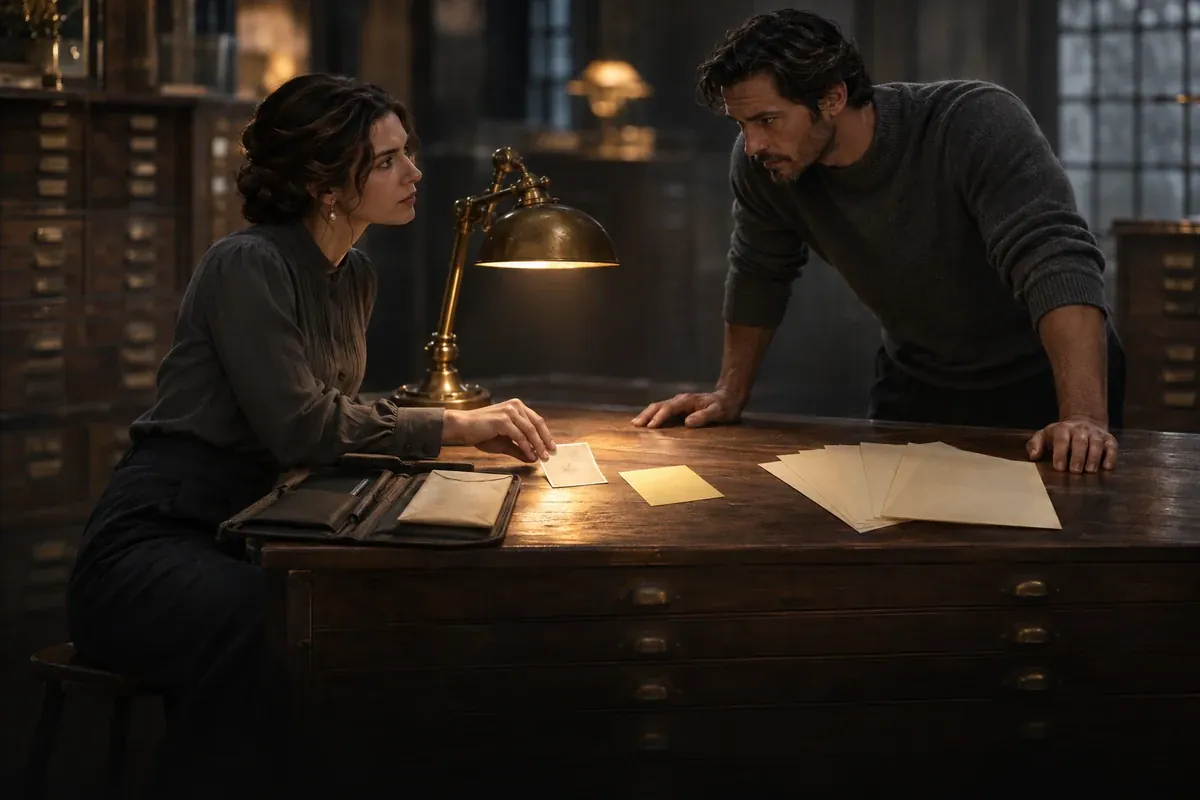
When she comes downstairs she finds him in the archive wing, at the plan chest, with the fourteen months of freight invoices fanned in front of him like a hand of solitaire. He doesn’t look up. “You’re going to tell me about the photograph.”
“You said after breakfast.”
“It’s after breakfast.”
“It’s after tea.” She sits on the stool opposite. The archive is cold and smells of old paper and cedar. “Calder, there are a hundred reasons I didn’t tell you. The best one is that I’ve never told anyone.”
“Then tell the room. I’ll pretend I’m furniture.”
So she tells it to the room.
Three years ago, at the Driscoll, in the quiet of a Sunday afternoon, she was alone in the conservation lab with a Rothko that had arrived for a spring loan, a large field of dark red over darker red, the sort of canvas that makes grown men weep in front of it for reasons they can’t name. She had been assigned to condition-check it before it was hung. A standard procedure. She had taken it off the crate lid, flipped it face-down on the padded table, and looked, as she looks at every canvas, at the back.
“The stretcher bars were wrong,” she says. “I knew they would be. I’d known since I touched the frame. But I needed it in a form I could prove, so I did the one thing a registrar is never supposed to do. I took a photograph. Close-up, raking light, the lumber stamp and the mill number and the staple pattern. And on the lower bar, a conservation label, partly peeled, in a hand I didn’t recognize. The label said FENN-VOSS FOUNDATION and under it, in pencil, a crate number. And a freight stamp.”
She watches his hands go still on the invoices.
“I took it with my own phone. I printed it in a drugstore kiosk, in a small size, and I put it in an envelope, and I never showed anyone. When the memo went upstairs, I thought: if they ask me for proof, I’ll have it. They never asked. They just ended my job with a cake.” She breathes. “I’ve carried it in the lining of my kit for three years. I’ve never taken it out. Not once, in the dark.”
“Lena.”
“May I show you?”
He nods, and she opens her kit, and peels back the lining with the thumbnail she keeps for exactly that kind of job. The envelope is soft with age. Inside is a three-by-five print gone slightly yellow, a drugstore photograph of the back of a painting: grey raw wood, rusty staples, a peeling paper label in a sloping hand.
She lays it on the plan chest, under the lamp, next to the yellow slip she took from the Greywater box truck.
Neither of them speaks.
The freight stamp on the photograph, small, blue, faded, partially smeared, reads ZURICH FREEPORT, BAY 7. The freight stamp on the yellow slip, in a sharper copy of the same ink, reads ZURICH FREEPORT, BAY 7.
“It’s the same bay,” says Lena.
“It’s the same bay.” Calder’s voice is very quiet. “Three years ago a forged Rothko came out of Bay 7, with a Fenn-Voss label, and went to the Driscoll to be hung on a wall, and my company’s freight arm moved it, and I paid the museum a building to keep it quiet. And six weeks ago, someone moved another crate out of Greywater, into the same bay, with the same ink.” His fingers are flat on the cold wood. “It’s not a series of thefts. It’s an enterprise. It has an address, and it’s been running longer than I’ve been chairman.”
“Whose label is that, in the pencil?”
He leans in, and in the lamplight she sees him read the loop of a handwritten R on the faded paper, and the loop of the F beside it, the same fast sloping hand as the note she found in her coat pocket at a funeral home, because the boy who wrote that note was taught to write by the man who wrote this one.
“My godfather’s,” says Calder Voss. “He taught me to write like that, too.”