

Clause two of the counter-proposal comes into force at four o’clock on Sunday afternoon, when Calder knocks on the door of her bedroom, a thing no one has done to her in this house, and says, “It’s time for the hour.”
“What hour?”
“The one with no conspiracy in it. I’ve been reliably informed that’s a luxury item.” He is standing in the corridor with his hands in his pockets and the weak autumn light behind him. “I’ve been practicing. I can discuss weather, sailing, or why the east lawn is that color.”
“Why is the east lawn that color?”
“Nobody knows. It’s one of the great Voss mysteries.”
They walk the grounds. It is the first time she has seen Greywater by day without a clipboard, and it undoes something in her. The long lawn runs down to the river in gold and rust. The old orchard is half bare. Calder walks beside her with the cane over his shoulder like a fishing pole, not using it, pointing out things in the voice of a man introducing a stranger to a place he loved as a boy. The ice house where he hid at nine. The crooked pear tree he fell out of, at eleven, on a dare from his sister. The boathouse, where his father kept a sailboat he never learned to sail.
“He bought it for the idea of a man who sails,” Calder says. “He was very good at buying ideas of men.”
“And you?”
“I learned to sail. It was the only way to spend time in the boathouse.” He looks out at the river. “I think I’d have been a better man if he’d just once let me be bad at something.”
“You’re bad at asking for help.”
“That’s a character flaw, not a skill.” But the corner of his mouth moves. “Ask me something that isn’t about me.”
She thinks about it honestly. “What did you want to be? Before the company. Before you were the heir.”
For a while he doesn’t answer. A heron lifts out of the reeds and flaps slowly down the river, a gray flag of its own business. “A cartographer,” says Calder. “I wanted to make maps of places nobody had been. I had a whole drawing table. I drew the orchard, and the river, and the ice house, with all the secret ways between them.” He says it with a faint embarrassed lightness. “I still have them. In the carriage house, in a flat file. You’d probably find the paper has foxing.”
“I’d love to find the paper has foxing.”
“I’ll show you. After the conspiracy.” He glances at her sideways. “Is it terrible that this is the best hour of my day?”
“It’s terrible,” says Lena. “It’s also the best hour of mine.” And then, because it is the plain truth and the light is going, “I don’t know what to do with that.”
“Neither do I. Let’s put it in the file.”
When Simone’s text arrives at five, with the single word Basement, they both look at the phone as though it had interrupted a private ceremony. Then he sets his jaw, and she picks up her kit, and the hour ends, and the conspiracy begins again, a little poorer for the loss.
The Voss Foundation keeps its books in a basement.
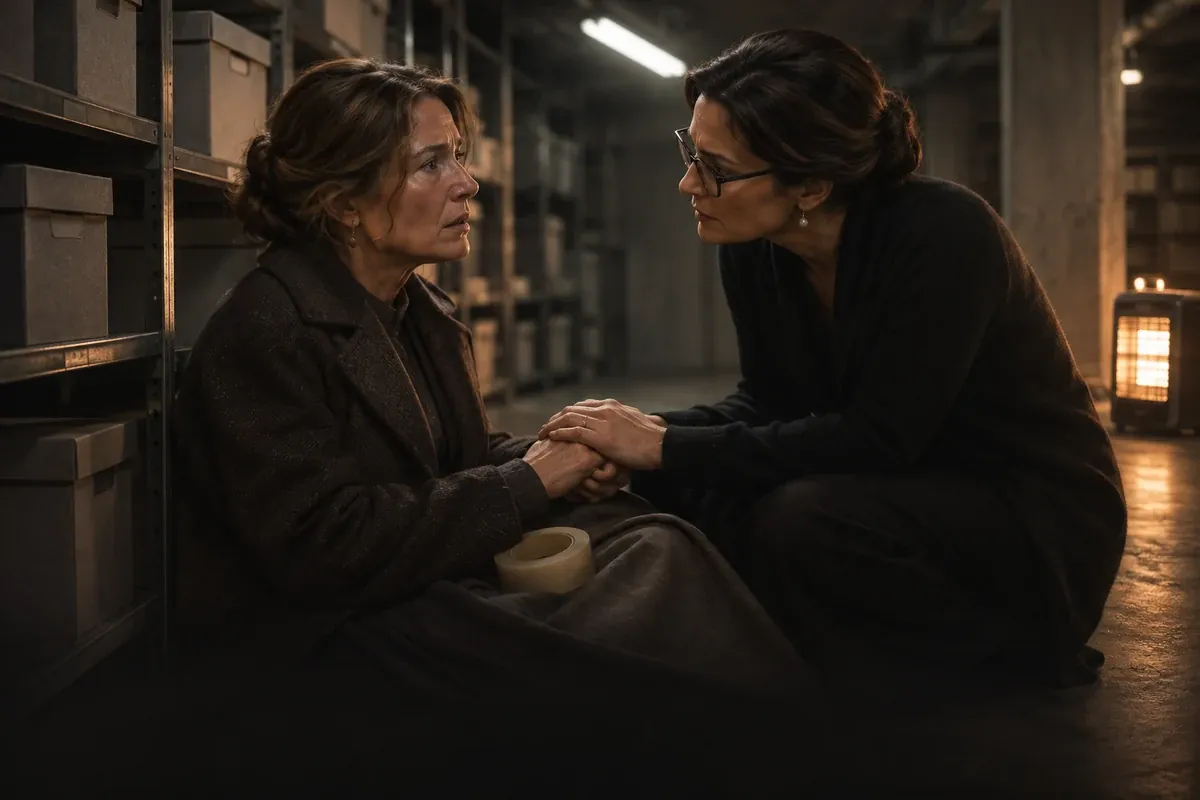
This is not a metaphor, although Lena would forgive anyone for assuming so. It is a literal room, beneath the foundation’s headquarters on Marlowe Street, down a flight of stairs behind a steel door with a keypad, where eighteen years of grant files, board minutes, and bank statements sit in gray archival boxes under fluorescent light. It smells of toner and old coffee. A dehumidifier hums in the corner like a patient animal.
At half past ten on Sunday night it also holds four people, two laptops, a space heater, and a box of cold sesame noodles that nobody has the courage to throw away.
“The exclusive is pushed a week,” Simone had announced at the door, taking charge of the heater. “Nobody sits in front of a camera until I know what we’re hiding.” Now she says, “Capital call number six,” scrolling. She has traded her armor for a black cashmere cardigan and a pair of reading glasses so severe they appear to have been issued by a government. She sits on an upturned filing crate with a laptop balanced on her knees and the unmistakable focus of a woman who has found something she hates. “Eleven million. Authorized by the foundation’s executive director on the second of March. Wire to an escrow account at a bank in Lisbon. Purpose: bridge liquidity for an infrastructure impact fund.”
“I never authorized that,” says Odette, from the doorway of the supply closet, where she has gone to look for a stapler and has been standing there for ten minutes holding a roll of packing tape. “I don’t know an infrastructure fund. I’ve never heard of an infrastructure fund.”
“The authorization has your signature.”
“It would.”
Simone turns the laptop around. On the screen is a scanned page, a clean wire authorization, two lines of boilerplate and a block of signatures. The signature in the lower right is a loose, rounded O and a long confident V. Lena looks at it from where she stands over Simone’s shoulder, with the loupe from her kit already in her hand, because there are some reflexes that survive any crisis.
“May I?”
She takes the laptop, tilts it to the light, and brings the loupe to the screen like a woman checking a pearl. It is, of course, ridiculous to read a signature through a scan. But the pen pressure shows even in the pixels. The loops are consistent. The speed is wrong.
“It’s a good one,” she says finally. “It’s too good. It’s the signature of someone who has traced it a hundred times and learned the rhythm, and not the signature of someone who has made it ten thousand times without thinking. Look at the downstroke on the V. Real signatures slow at the end of a long word. This one doesn’t. It finishes the way a trained hand finishes.”
“Whose?”
“Someone with a lot of practice and a very good sample.” She sets the laptop down. “Odette. How often do you sign wire authorizations?”
“Never. The foundation’s treasurer does it. Mr. Brandt. He retired in January.” Odette’s voice has gone thin. “I never signed a single one. I signed grant letters. Thank-you notes. The annual report.”
“The annual report,” says Simone, very quietly. She is typing. “Which has your signature on the cover letter, in the same hand, in a clean PDF that anyone could download. Eleven transfers. Fourteen months. Thirty-one million dollars.”
The dehumidifier hums. Nobody breathes. The number sits in the room like a guest who has just walked in uninvited and taken the best chair.
“Say that again,” says Odette.
“Thirty-one point four.” Simone doesn’t look up. “To an escrow account at Banco Atlântico do Sul in Lisbon. Casa Fenn Atlantic Holdings is listed as the beneficiary on the last five.”
“Casa Fenn,” says Lena.
“It’s a trust. A Portuguese holding company. It’s listed as a charitable intermediary, which is the kind of phrase that costs money to say convincingly.” Simone’s long fingers fly over the keys. “Registered four years ago. The registered agent is a law office in the Chiado district. The managing director is a man named R. Fenn.”
She turns the screen again, slowly, to face them all, and there, in a small gray corporate-registry box, is the name. Royce Edmund Fenn. Date of birth, a long time ago. Nationality, American. Address, a street in Lisbon with a tile-fronted building and a view, in the thumbnail photograph, of the river.
Odette sits down on the concrete floor, in her good coat, with the packing tape in her lap.
“I’m the executive director,” she says, in a very small voice. “Of the foundation. It’s my name on every filing. If anyone audited these, if Calder had really died, if the estate had been carved up and a forensic accountant had been brought in—“ She stops. She looks at Lena. “They’d have found a wire trail to Lisbon, signed in my hand, to a trust owned by the oldest family friend. And they’d have found my husband’s fingerprints on the cover. Or no, not Marsh’s. Mine.”
“That’s the design,” says Lena. She is surprised by the evenness of her own voice. “You were supposed to take the fall. Not just the vault, not just the fakes. All of it. Thirty-one million dollars and a dead brother’s estate, and you at the center of the picture, with a signature that matched.”
“He always said I was the most trustworthy person he knew.” Odette starts to laugh, a high helpless sound that she covers with her hand. “Royce. At my wedding. He said, ‘Odette is the only Voss who has never lied to me.’ And I was so proud.”
Simone has put her laptop aside. She gets up from the crate, crosses the floor in four steps, and kneels. It is the least corporate gesture Lena has seen from her, and she watches the publicist take Odette’s cold hands in her own and hold them there, without a word, for a very long moment.
“Listen to me,” Simone says. “I’ve written four hundred statements for men who wanted to be forgiven for less. I know what it looks like when someone is guilty. You’re not. You’re the one thing in this room that wasn’t a lie.” She tightens her grip. “I’m going to fix this. I don’t know how. But I’m going to fix it.”
“Thank you,” Odette whispers.
“Don’t thank me. I charge by the hour and I’m not finished being furious.”
At eleven Beau arrives with a pizza, and the room rearranges itself around his enormous good intentions. He sets the box on an archival crate. He hands out paper plates. He says, “I didn’t know if you’d eaten,” and nobody has, and for six minutes the Voss Foundation basement becomes the most improbable picnic in the state of anywhere. They eat with their coats on. The space heater ticks. Simone, who has not eaten a slice of anything in public in six years, folds a piece in half the way a New Yorker does and eats it with grim concentration.
Then Beau, who has been very quiet for a very long time, sets down his plate.
“I have to tell you something,” he says. “I’ve been trying to for a week and I keep losing my nerve.”
“Tell it,” says Lena.
“Fairline Motorsport.” He looks at his hands. “I know it’s on Cal’s board. The one with the sixty thousand dollars. I’ve been telling everyone that Cal lent me the money in April. And he did. He wrote a check. But when I looked at the bank record last night, because I couldn’t sleep, I saw it didn’t come from Cal’s account.” His throat works. “It came from Fairline’s parent. A company called Atlantic Mercantile. Same Lisbon address.”
The air in the room changes.
“I paid it back in August,” Beau goes on, quickly. “With my own money. I thought: good, I’m clean, I owe nobody. But it means that in April, a company owned by Royce Fenn gave me sixty thousand dollars and let me think it came from my cousin. And I called him. Royce. ‘Uncle Royce.’ He’s been the guy who sends a birthday card with a fifty in it since I was six. I called to say thanks. I thought it was a family thing.”
“When?”
“In April, to say thanks. And then—“ He stops. His face has gone the color of old paper. “And then he called me. Back in the fall. He rings every few weeks. Just to chat. And the night before we drove up to Millhaven Falls, he asked how the family was holding up. And I said fine, and I said Lena and Quill and I were doing something useful tomorrow, I wasn’t sure what, we were driving up north to find a mechanic.” The words have started to come out in a rush, like water from a broken pipe.
“I told him. I said the town. I said the name of the garage. Because he asked what I was up to and I wanted him to be proud of me, I wanted to say I was doing something.”
Nobody speaks. Lena feels the whole room look at him, and feels what the looking costs.
“The garage,” says Beau. “It was my fault. Somebody could’ve died.”
“Nobody died,” says Lena.
“Pike could have.”
“Pike didn’t. He’s in hiding. He drove away before the fire.” She says it firmly, and then she stands up, and crosses the concrete, and sits on the box next to him, close enough that their shoulders touch. “Beau. Listen to me. He’s a professional. He has been warm to you for twenty-one years because that’s the whole machine. He builds a family out of Christmas cards, so that when he needs something, it’s one phone call away. You didn’t leak. You were harvested. There’s a difference, and it’s the entire difference.”
“It doesn’t feel like it.”
“I know. It won’t, for a while.” She puts her hand over his enormous bruised knuckles. “You found the Corot. You found the mechanic. You went through a mudroom key cabinet with a flashlight at midnight because somebody had to. You are the bravest person in this family, and if anyone tells you different, I’ll appraise them.”
Beau laughs, wetly. “You don’t know how.”
“I’m adaptable.”
On the far side of the room, Simone Adler has turned her laptop around. She is staring at a spreadsheet that she has apparently been building in a separate window for the last twenty minutes, and her face, in the white screen light, has the strange rigid beauty of someone who has done the sum and doesn’t like the total.
“There’s one more thing,” she says. “I’ve been cross-referencing the wire dates against Calder’s calendar. The one I managed. Every one of these eleven transfers was authorized on a day Calder was out of the building. A conference. A sailing weekend. A sick day. Someone who knew his schedule to the hour.”
“His assistant has the schedule,” says Odette.
“His assistant has the shared calendar.” Simone lifts her eyes. “But only one person has ever had the real version, the private one, with the sailing weekends and the flights. I wrote it. I kept it. I gave read access to exactly four people.” She takes off her severe glasses and folds them, and her hands are not quite steady. “Calder. Pruitt. Me. And a man who asked me for it in March, when he said he wanted to send Calder a birthday gift and needed to be sure he’d be home.”
“Hale,” says Lena.
“Marsh Hale asked me for the calendar. He was so charming about it. He sent me flowers.” Simone makes a sound that isn’t quite a laugh. “I gave my client’s private schedule to the man who was robbing him, because he sent me peonies.”
For a moment nobody says anything. Then Odette, from the floor, in her ruined good coat, with her cold hands and her thirty-one million dollars of borrowed guilt, says the thing that has been waiting in the dehumidifier hum.
“We’re going to have to go to Lisbon.”
And Lena, who has known it since the library, since a warm voice said the word photograph, looks at the four ruined faces under the fluorescent light, and thinks: not Friday week. Sooner. Before whatever clock he has set runs out.
“I need to call Calder,” she says.
“You need to call your husband,” says Simone Adler, with a flicker of the old sharpness, and for the first time in a week, in that cold basement, someone almost laughs.