

File note: Eleven claims, all lodged by one insured, all dated between 1 a.m. and 5 a.m. Probably coincidence. Probably.
I ate the pie. It was lemon, and it was very good, and Dot Okonjo watched me eat it without saying a word about my father.
When I stood to leave, she said only, “Friday, seven o’clock, the Grange. The Mutual meets. You’ll want to be there.”
“I’m not a member.”
“No,” she said. “That’s why you’ll want to be there.”
I did not ask what that meant. I drove to the motor court, the only place in Pell Pass that rented rooms, and let myself into a cabin that smelled of pine cleaner and old radiators. I spread the eleven claim files across the bed in the order they had been filed. Then I stared at them until the dates began to bother me.
Insurance fraud has a shape. Sloppy claimants file in the winter, when the roofs leak. Ambitious ones file before the policy renews. The Cooperative Lodge claims had no shape at all. They came in January, in April, in September. They came on a Tuesday, a Sunday, a Thursday. Only one thing was uniform, and it took me an hour to see it, because it was the kind of thing nobody writes down.
Every loss was reported between one and five in the morning.
I got up and walked around the room. Then I sat down again and made a column. Eleven dates. Under each I wrote the day before and the day after, and then I stared at the neat little blocks of three until I felt slightly ill.
Three nights each. Always three.
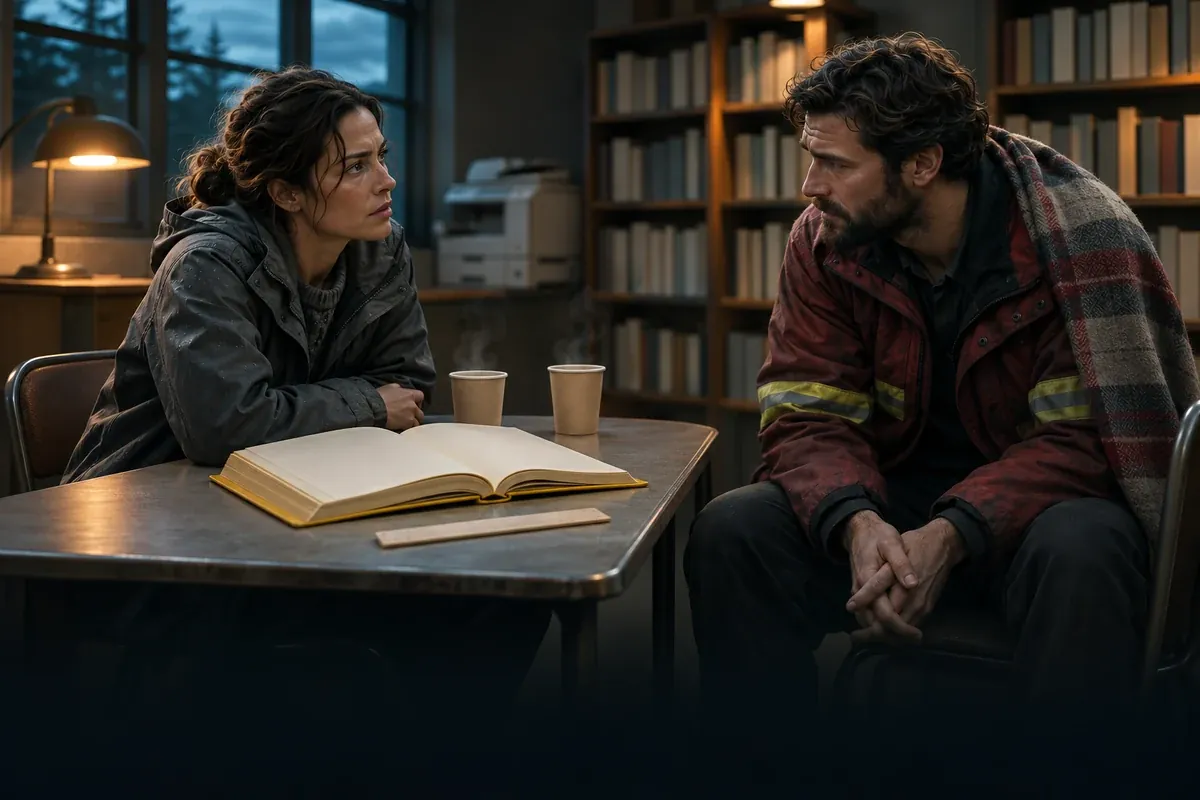
The motor court had no signal and no internet. By eight o’clock I had driven back down Main Street, past the lodge’s dead lifts and the diner’s steamed windows, to the fire hall, where a light was on in a back room labeled LIBRARY. It was a closet, really, with a card table, a copier, and four shelves of paperbacks.
The woman behind the card table was about sixty, with reading glasses on a chain and an expression of such flat professional neutrality that I felt I had been audited.
“Hollis Penney,” she said. “County clerk, Tuesdays and Thursdays. Library, whenever someone needs something unreasonable.”
“I need a moon table,” I said, “for the last eleven years.”
I expected a question. I braced for it. Instead Hollis stood, reached to a shelf behind her, and put a thick yellow almanac in front of me.
“Moon tables,” she said. “People ask for it every month. Copier’s a dime. Monday was the last one, if you were wondering.”
I looked at her. She looked at me, with all the expression of a filing cabinet.
“I file what I’m handed,” she said. “I keep what I’m asked.”
I took the almanac to the card table and opened it to the first claim date.
Full moon, 2:14 a.m. Claim lodged for the Grange hall roof, 2018: the night after.
Second claim: the night of.
Third: the night before.
I turned pages for forty minutes. I used a ruler. I checked every date twice, because the human mind loves a pattern and I have spent my whole career learning not to trust it. Then I put down the pencil, and the almanac, and my forehead, in that order.
I ran the odds in the margin, badly, and then again with the calculator on my phone. A full moon visits twelve times a year, and each of its three-night windows covers about one night in ten. The chance of eleven random losses all landing inside those windows was smaller than I could make the calculator display.
Eleven out of eleven. Every loss in eleven years fell inside the three nights around a full moon.
If I had met this in any other file, I would have called it the neatest fraud I had ever seen. Someone had gone to a great deal of trouble to hide a date pattern. Except that nobody had hidden it. The dates were right there in the policy history, in black and white. The claims had been so honest, so regular, that I had missed the lie by looking straight at it.
I am not a fanciful person. I tried the sensible explanations first. A hunting club with a night schedule. A drinking circle. A seasonal shift at the lodge, a cult, a sleepwalking ring, some kind of shared medication. I went through them one at a time, the way you check a house for gas.
None of them had a padlock on the inside of the door.
I sat there until the copier clicked off by itself. When I looked up, Hollis Penney was gone, and in the doorway stood a tall man with a damp beard and fire-department boots, holding two paper cups of coffee as if they were evidence.
“I saw the light,” said Teo.
“You’ve been waiting outside.”
“For about forty minutes.” He came in and set down one cup in front of me. “I didn’t want to interrupt. You looked like you were solving something.”
“I was.”
He looked at the almanac, open on the table to a page of small, orderly circles.
He did not say anything. That, more than any speech, told me what I wanted to know.
“Your bear,” I said, and my voice was very even, “keeps a calendar.”
Teo sat down across from me. It took him a while. He lowered himself into the plastic chair as if it were ice, and he laced his scarred hands together between his knees.
“I should say something,” he said. “I’m not sure what.”
“You could say I’m wrong.”
“I would, if I could.” He stared at his hands. “I’m not a good liar, Ms. Lindmark. I’ve been told. I did it all morning because I thought if I did it badly enough you’d stop asking.”
“That was an interesting theory.”
“It was not a good one.” A corner of his mouth moved, barely. Then it went away. “If I tell you, you can’t un-know it. You’ll carry it into your office on Monday. You’ll carry it into every report you write. And you still have to file.”
“I have a signed memo in my bag that tells me what my report says.”
I had not meant to say it. It simply came out, in the quiet, between the coffee and the circles.
Teo went still. I realized I had given him a piece of me, and that it was a real one, and that I could not take it back.
“I’m sorry,” I said. “That was unprofessional.”
“No.” He lifted his eyes. They were a light, tired brown, and for the first time that day there was nothing careful in them. “That was honest. I can work with that.”
Outside, wind pushed at the fire hall doors. The copier ticked as it cooled.
I thought about my father. I thought about a rolling pin on a counter. I thought about the cold, clean smell of a freezer and a lock fastened from the inside by someone who had known exactly how to survive the night.
“Mr. Aasland,” I said. “Tell me.”