

File note: Pell Pass Mutual, special session, Grange hall. Item 1: Whether the adjuster may see the barn. Item 2: Pie. Note: quorum reached.
He told it in nine sentences, and the fire hall copier clicked softly the whole time, like a metronome.
It was inherited, mostly. It came on three nights a month, around the full moon, and you could not refuse it. It was not a bite that did it. It was not magic, either, as far as anyone knew, any more than a bad heart was magic. It was a thing certain families in Pell Pass had, and had always had, and had kept quiet.
“What happens to the people?” I asked.
“Nothing. We get locked in.” Teo turned his cup in his hands. “That’s the whole system. A stall, a cellar, whatever holds. Afterward we lose a day. Mick calls it the Blank. You wake up with a dry mouth and a sore back and a feeling you’ve been in a very long argument.”
“And the damage?”
“When the lock holds, there isn’t any.” He looked at the wall. “When it doesn’t, there is. That’s what the claims are, Ms. Lindmark. A failed latch.”
I should have laughed, or called a doctor, or left. I wrote down, in block capitals, DOES NOT REMEMBER.
“Do you hurt people?” I said.
“Not anyone who didn’t have a key.” He said it so quietly that I understood he meant it as a confession. “It’s why I keep the Book. So we know where everyone was.”
“Show me.”
“Friday,” he said. “If they vote yes.”
“Vote.”
“Dot’s very particular about it,” said Teo, and for the first time that night he nearly smiled.
The Pell Pass Grange hall held a hundred and ten folding chairs, and on Friday night every one was filled.
I stood at the back like a child brought to a grown-up funeral. Up front, Dot Okonjo sat at a card table with the rolling pin by her right hand and a laminated copy of Robert’s Rules of Order by her left. Behind her hung a painted banner that read PELL PASS MUTUAL AID, EST. 1952, and beneath it, in smaller letters, WE DO NOT LEAVE ANYONE OUT THERE.
“The meeting will come to order,” said Dot. “Is there any old business?”
“The coffee urn,” someone called.
“It’s been tabled four meetings running, Gerald.”
“It’s still leaking.”
“Then it will be a very well-documented leak.” The rolling pin banged. “New business. Teodor.”
Teo stood. A hundred and ten heads turned toward him, and he held onto the chair in front of him like a man on a boat. “Madam Chair. I move that the Mutual allow Ms. Lindmark to see the barn.”
“Second,” said Mick Tavares, from the third row, so loudly it echoed.
“It has been moved and seconded. Discussion.”
I have sat through insurance depositions with sharks in suits. They are mild compared to a rural meeting with minutes.
An old man in a feed cap said she was the enemy. A woman said everyone in this room was somebody’s enemy at some point, and she did not see how the Mutual could afford to be picky. A man in the back said the name Lindmark had cost them the mill, and a younger man said that was her father, not her. A third said the last time they trusted an adjuster, the nonrenewal letter was in the mail before the coffee had cooled.
Through all of it Dot kept her hands folded and her face blank. When someone moved to table the motion, she said, “Point of order, we do not table things that are on fire.”
“Move the question,” said Mick.
“All in favor.”
Hands went up. A forest of them, slowly, from the front to the back. I counted forty-four. I counted a minute, and then I stopped counting, because I realized I was looking for the one that would not rise, and I did not want to know whose it was.
“Opposed.”
Thirty-nine.
“The motion carries, forty-four to thirty-nine, with seventeen abstaining on grounds of pie.” Dot slapped the rolling pin down. “Ms. Lindmark, you are our guest. Please do not take notes in front of the children.”
Afterward Teo brought me a stack of paper cups and a gray cloth-bound ledger as thick as a dictionary. “The Book,” he said. “You can read it here. It stays in the room.”
I opened it on a folding table under the buzzing Grange lights.
It was all in pencil. Page after page of tidy columns: DATE. NAME. WHERE HELD. WHAT HELD. WHAT BROKE. The handwriting changed through the decades, but the headings never did. I turned back to October and found it at once.
T. AASLAND. Lodge walk-in. Hasp failed 3:10 a.m. Door, $11,400. Arm.
Below, in a different hand: M.T. forgot to check latch. M.T. has been spoken to.
“I’ve been spoken to,” called Mick, from across the hall, happily. “It was a very good latch for 1994.”
I turned the pages. There were names I knew: the diner owner, the county clerk, the old man in the feed cap. A woman who ran the post office. A child’s name, with a note, age eight, first time, mother present, held, no damage. I read that line twice and had to look at the ceiling for a moment.
Eleven years of losses, in pencil. The Book held the losses behind the claims Harborline had received, or so I assumed until I could check, and it held everything the town had never claimed: the small stuff, the paid-out-of-pocket stuff, the quiet winters of hammering and patching. Two hundred and ninety thousand dollars, give or take, out of the Mutual’s own fund.
A dry cough came from my elbow.
“Priya Nambiar,” said a woman in a barn coat, offering her hand. She was about forty, brisk, with her hair twisted up in a pencil. “Veterinarian. I sew them up afterward. Do you have any questions about anatomy?”
“Not at the moment.”
“You will,” she said, “in the morning. Take a ride with Mick.”
The barn stood a quarter-mile above the lodge, at the end of the old lift line, a long wooden building with a roof that had been replaced by tarps and tin and hope. Mick pulled the door open on its track.
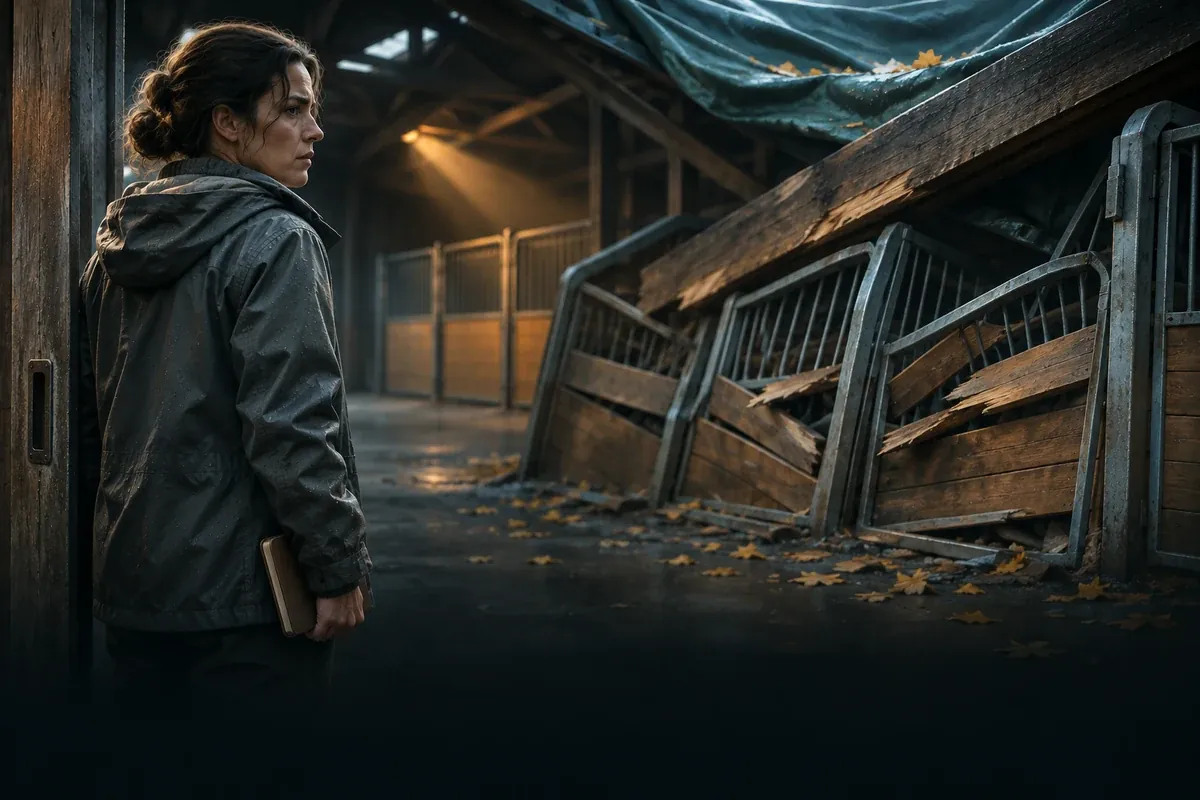
Inside were six stalls, built of steel and oak, big as horse boxes. Three had stood. Three had been crushed flat, the steel bars bent like licorice, under a roof beam. Beneath the tarp a year of leaves had drifted in.
“Avalanche,” said Mick. “Four winters back. That’s when the Kennels went. We used to be able to put everyone in here, and then the fund ran dry, and then the bank said no, and then…” He gestured at the freezer, the cellar, the diner, the world.
I stood in the doorway and thought, quite clearly, about page nine of the policy.
It was in a section nobody reads. The Protective Safeguards Warranty. The insured shall maintain, in complete working order, all protective devices required by this policy. A failed safeguard, a lapsed warranty, a loss from an unmaintained structure. A denial letter, in its simplest form, takes about six lines.
I had been looking for grounds for three days. They were in my bag, behind the memo, behind the pen.
I wrote the clause number in my notebook. I wrote it in black ink, in block capitals, the way I had written four hundred and twelve denials. Then I put the notebook away before Mick could see my hand.
My phone buzzed, once, with the single bar it had found at the top of the barn. A message, from Connie Vogt.
Brice Quillan, special investigations, arrives Monday. Sign before he does.