

File note: Insured’s interview with the chair of the mutual, Ptarmigan Diner, 12:30. Allow ninety minutes. Eat nothing offered.
By eleven o’clock I had been told four different stories by one man who was trying very hard to be consistent.
Teo Aasland drove me around Pell Pass in a fire department pickup with a cracked dashboard and a rosary of key tags swinging from the mirror. Pell Pass was one long street at the bottom of a bowl of mountains: a gas pump, a Grange hall, a diner, a lodge with a dead chairlift running up behind it like a clothesline nobody had taken in. Three hundred and forty people, the sign said. Off-season, I suspected, it was fewer.
“Claim four,” he said, and parked at the Grange hall. “Roof, 2018. Elk.”
“Elk.”
“They get in the rafters.” He said it with such dignity that I wrote it down.
The roof had been patched and patched again. Up close the damage looked like a pair of crowbars had gone through the shingles from the inside. I took pictures and made notes and said nothing. Teo stood with his hands in his jacket pockets, as if afraid of touching the building by accident.
Claim seven was a gondola cabin gutted to the frame. Bear. Claim two was a section of fence, bear. Claim nine was a sheared propane regulator, a very strong, very confused raccoon.
“Captain,” I said, back in the truck, “is there anything alive on this mountain that has not wrecked something of yours?”
“Mick,” he said, and then, as though it had come out without permission, “Sorry. That was a joke.”
“It was a good one.”
He glanced at me. It was only a flicker, but he looked startled, the way a man looks when a stranger is kind to him in a hardware store.
He was a good driver. He braked for a dog, for a child on a bicycle, and once, absurdly, for a squirrel. He had the careful posture of a man who had spent years being the largest thing in every room and had decided to apologize for it.
Every one of the stories was polished. That was the problem. Honest losses are messy. People remember the wrong day, or the wrong brand of fence. These were smooth as river stones, and Teo told them like prayers.
“Tell me about the track,” I said. “Mick sent me a photo of a footprint behind the kitchen, October. May I see where?”
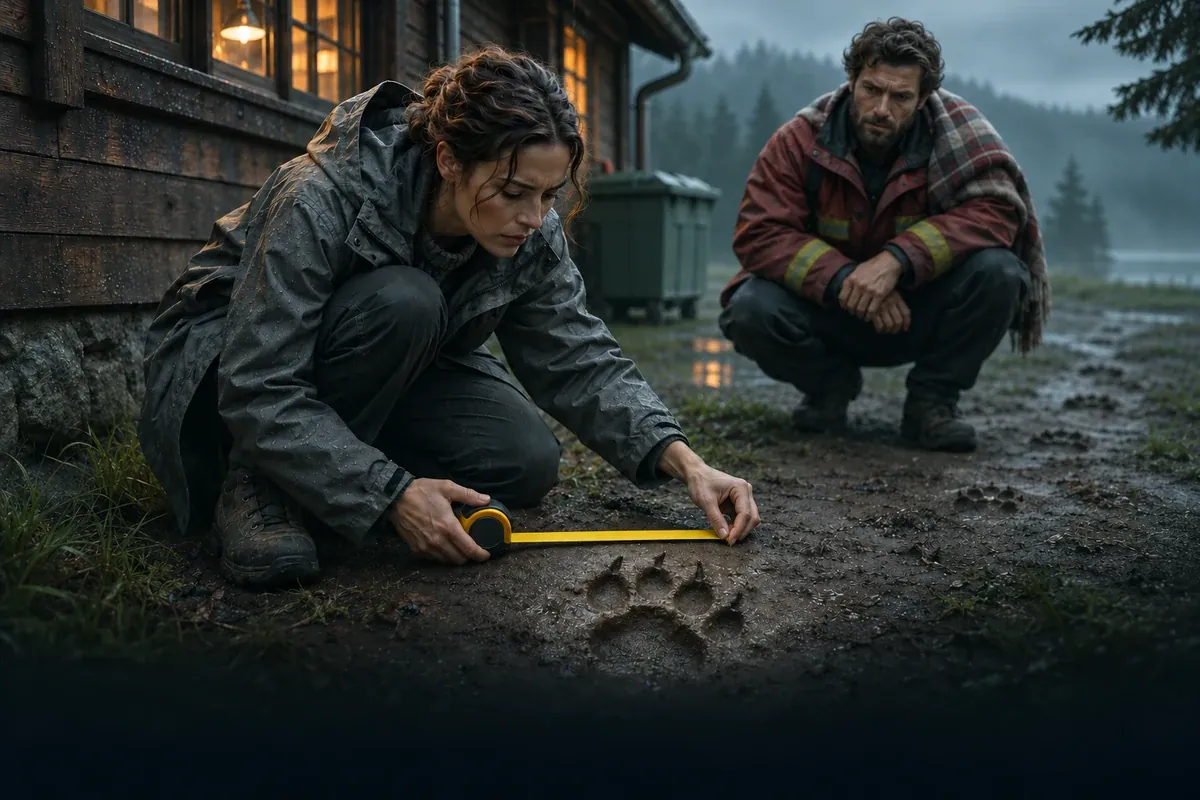
He drove me round the back of the lodge to a stretch of damp ground behind the dumpsters. Mick had marked it with an orange flag. The prints had dried into the clay, and there were seven of them in a ragged line.
I crouched. Teo crouched too, at a respectful distance.
“Four toes,” I said.
“Sorry?”
“Bears have five toes. You can see it in every print: five round pads in an arc, with the claw marks out in front of the toes, like a hand. This animal has four toes, a big pad behind them, and nails that stay out. It walks in a straight line, the hind foot landing in the front foot’s track.” I measured the stride and looked up. “That is a canine, Captain. A very large one.”
For a second he said nothing at all.
“Big dog,” he said.
“Very big dog.”
“A wolf, maybe.” He tried to say it lightly. “We’ve heard there might be a few in the high country.”
“There haven’t been wolves in this state in a century.”
“Then it’s a very lost one.”
I wrote down four toes, canine, stride length forty-one inches. I did not say what I was thinking, which was that the claims had changed under my feet. A bear is an act of God. A large dog is an act of someone’s negligence. An insured’s negligence is just one of many exclusions I was hoping to use.
I should have been pleased. It took me a long moment to notice that I wasn’t, and a longer one to notice that Teo had gone very pale.
At twelve-thirty I walked into the Ptarmigan Diner, and nobody looked up. That is how I knew they all knew who I was.
It was a long room with red stools and a pie case, and every table was occupied by someone studying a menu with total absorption. Behind the counter, a woman in her late sixties with iron-gray braids and a spatula tucked in her belt was running a meeting.
I realized it was a meeting because there was a gavel on the counter. It was a wooden rolling pin with a brass band, and she banged it twice as I came in.
“The chair recognizes the gentleman from Harborline,” she said.
“Gentleman,” I said. “Josephine Lindmark. Harborline Casualty. I’m the adjuster.”
The room went quiet in the way a stage goes quiet when the lights change.
The woman at the counter set the rolling pin down. She did it slowly and exactly, the way you put down something you might need later.
“Lindmark,” she said.
My badge was clipped to my jacket. I had known the name would carry. I had asked for this file, three weeks ago, with a cheerful email to my regional vice president, and I had not told anyone why. I am very good at not telling people things. I had assumed that, in a town of three hundred, the name would mean nothing.
I should have known better.
“Any relation to Walt?” she asked.
“It’s a common surname.”
“It really is not,” said an old man in the corner booth, without lifting his eyes from the menu.
“Hush, Alvin.” The woman came around the counter. Up close she was a little shorter than I, with forearms like a baker’s and a gaze that took an inventory of me from my shoes to my notebook. “Dorothea Okonjo. People call me Dot. I own this diner, I chair the Pell Pass Mutual, and I have been waiting about twenty-seven years to find out what a Lindmark looked like.”
“I don’t understand,” I said.
“No,” said Dot. “I don’t imagine you do. Teodor, did you feed her?”
“I offered coffee,” said Teo from the door. He had followed me in, and he stood very straight, like a boy in an office. “She turned down the pie.”
“She’ll have the pie.”
“I don’t accept gifts from insureds,” I said. “It’s a compliance rule.”
“It’s not a gift. It’s forty dollars of Harborline’s money, because I’m going to put it on the lodge’s account.” Dot pulled out a stool. “Sit down, Ms. Lindmark. Your father stood in this room in 1999 and told Frank Pell his mill was a moral hazard. I would like to see how you sit.”
I did not move.
The thing about walking into a room where everyone knows your secret is that you do not feel found out. You feel like the floor is a stage, and you have been told your lines are wrong.
My father had left the insurance business the year after I turned seven. My mother’s diner had burned the winter before. He never explained either. I had spent twenty-five years assuming the two facts had nothing in common.
“Sit,” Dot said, not unkindly. “Whatever you came here to do to us, you may as well do it with a full stomach.”
Behind me, the whole diner turned its menu pages at once.
I sat.