

The funeral of Calder Voss is held on a Saturday so clear and gold that the weather reads as hired.
Lena arrives in a black car Pruitt sent, with a veil she fought him on and lost. “The veil does half your work,” he said, handing it over like a subpoena. “People will spend the service reading it instead of you.” He was right, which she finds she resents on principle. Eleven hundred mourners at Saint Ambrose and every one of them gets the same product: a slim woman in expensive grief, face a rumor behind net, the secret wife nobody can quite see. By Monday there will be forum threads. By Tuesday, a name for her. The Widow Voss, like a yacht.
She has done the homework Pruitt assigned — fourteen months of marriage compressed into a weekend of flashcards. Met at an insurance appraisal of the Antigua sailing photographs. Married at the lake courthouse, two witnesses, both conveniently abroad. No photographs; Calder was private. She recites it in her head in the pew while the organ does its slow ascent, and what unsettles her is how little she needs it. Nobody asks the widow for footnotes. Grief is self-authenticating. People believe a lowered head the way they believe a gilded frame.
The casket is closed today. She catalogued the reason Friday night: smooth hands, mint condition, wrong body. She has spent thirty hours since then deciding what she thinks about the note in her coat pocket, and has arrived nowhere except that she re-reads it hourly. You noticed. Good. Keep mourning. — C.V. Either Calder Voss is alive and watching her perform at his funeral, or someone wants her to believe he is, and both options mean the same thing operationally: someone in this cathedral knows the casket is a prop. She can feel that knowledge out there in the pews like a draft from a window she can’t find.
The eulogies establish the official portrait. Grant Voss speaks about stewardship for nine minutes and mentions the deceased by name four times; it’s a shareholder letter with a tie.
Odette goes up with notes she doesn’t look at and tells a story about being eleven and finding her half-brother, seven, auditing his Halloween candy — counting it twice, logging it in a composition book, offering her a loan at interest — and the laugh that moves through the cathedral is startled and real and so is the crack in her voice when she says, “He counted everything. I used to think it was because he trusted nothing. It took me thirty years to understand it was how he kept what he loved safe.” Lena, who has built a life out of counting other people’s things, sits very still behind her veil and feels unexpectedly, unprofessionally attributed.
Beau doesn’t speak. He sits two rows up with his shoulders wrong, a man at the funeral of the only relative who ever lent him anything without a lecture, and twice he wipes his face with the heel of his hand like someone putting out a small fire.
Simone Adler speaks. That’s the surprise. She stands at the lectern in black that photographs like armor and delivers two hundred flawless words about brilliance and privacy and loss, and on her way back down the aisle her eyes find the veil and stay there one full second. The message is clean enough to invoice: I built this man’s image, and I don’t know who you are, and that is a professional insult I intend to correct.
Afterward, on the steps, while the cameras across the street harvest the family like wheat, Simone materializes at her elbow smelling of white flowers and litigation.
“Simone Adler. I handled Calder’s communications for six years.” A beat. “All of them.”
“Lena.” Pruitt’s rule: real first name, always; lies ride smoother on a true chassis. “He mentioned you.”
“Did he.” Simone’s smile is a bright, closed door. “Odd. He never mentioned you, and sweetheart, that was my job. Fourteen months. I’ve seen the man’s calendar at four in the morning. There was no fourteen months.”
“There was a courthouse,” Lena says, gently, “and there is a will. I understand doing both of our jobs well means we can’t be friends. I’d have liked that, I think. You’re the only person here whose condolences came with a records request.”
For a flicker, something that isn’t hostility crosses Simone’s face — the recognition of craft. Then it’s gone, and so is she, down the steps into a town car, already on the phone.
The reception between the service and the reading is held in the Saint Ambrose parish hall, and it is there, over cooling coffee in archdiocese china, that Lena gets her first unsupervised field test as Mrs. Voss.
They come at her in ones and twos, the board members and the foundation donors and the golf partners, each with the same three-part package: condolence, self-introduction, probe. She develops a rhythm by the fourth one. Accept the hand with both of hers. Thank them in under ten words. Answer the probe with a question, because grief is the only social condition in which answering a question with a question reads as depth rather than evasion.
Where did you two meet? — “He never told you about the Antigua photographs?” How are you holding up? — “Do you know, you’re the first person today to ask me that properly.” She watches each of them leave satisfied, carrying away a story they mostly supplied themselves, and files the technique under things I learned from selling furniture: the best provenance is the one the buyer invents on the spot.
Only two encounters refuse the rhythm. Marsh Hale brings her a plate she didn’t ask for — smoked salmon, two capers, precise — and stands beside her in companionable silence for a full ninety seconds before saying, “Odette will want to have you to dinner. Say yes the second time, not the first; she’ll trust it more,” and gliding off, having given her either kindness or choreography, no way to grade which. And Beau, loose-shouldered, red-eyed, plants himself in front of her and says, “He fixed my life twice and never once let me thank him. That’s the whole eulogy. Everybody else in there was doing math.” Then, horrified at himself: “Not you. Sorry. I mean—“
“Everybody else was doing math,” Lena agrees, and Beau looks at her like she’s the first person all day who speaks his language, which, God help them both, she might be.
The reading of the will is held at four, back at Greywater, in the library Lena catalogued on her second day. Pruitt presides from in front of the big window so that everyone has to squint at him; she is beginning to understand that nothing this man does is unstaged. Present: Grant, flanked by the aide Petrie and a litigator whose suit costs more than it fits. Odette and Marsh Hale, holding hands, his thumb moving over her knuckles in a slow metronome. Beau, alone in the window seat, picking at the knee of his trousers. Two foundation officers. And the widow, seated to the side, veil up now, where all of them can study her, which they do with the frank appetite of a preview before an auction.
Pruitt reads. The small bequests go by like weather — the boat to Beau, who makes a sound that isn’t quite a word; an endowment structure for the foundation that makes Odette close her eyes; a pension codicil for staff. To Grant Voss, my uncle, who taught me that the numbers are the only sentimental thing in any room: the chairmanship of the family office transition committee, which even Lena can hear is an org chart, not a gift.
Then: “The residuary estate — comprising all remaining property real and personal, all equity interests in Voss Holdings LLC and its subsidiaries, and the contents of the property known as Greywater — I give, devise, and bequeath to my wife.”
The silence has texture. Eleven words, and Lena can feel the room re-appraise her in real time, value climbing like a bid war, and it is the single most dangerous moment of her life to date because every instinct she owns is screaming that attention this total is a condition she cannot survive unexamined.
Grant’s litigator speaks first, smooth as a drawer on waxed runners. “For the record, we’ll want the certificate, the officiant, witnesses, and an explanation of why a marriage of fourteen months appears in no registry our office could access.”
“The registry access of your office,” Pruitt says pleasantly, “is a fascinating topic I’d be glad to explore with a judge. Certified copies will be provided to counsel on Monday.”
“This is obscene,” Grant says, not loudly. He has risen. He isn’t looking at Pruitt; he is looking at Lena with the pure, uncomplicated loathing of a man watching nine figures walk out of his bloodline in borrowed mourning. “My nephew was many things. Impulsive about women was never one of them. Whatever this is, I will take it apart clause by clause, and when I find the seam — and there is always a seam, young woman — I’ll see to it personally that your next inventory is conducted in a courtroom.”
“Grant.” Odette’s voice, low.
“You’re defending this?”
“I’m asking you to be ashamed somewhere else.” Odette stands too, and there’s nothing rehearsed about her now. “He chose someone. For once in his guarded life. The last thing he ever did on paper was choose her, and you’re going to honor it or fight it, but you will not perform it in front of her on the day we buried him.”
Buried him. The casket, the smooth hands. Lena keeps her eyes down, which everyone reads as grief, and thinks: one of the people in this room may know there’s a stranger in that grave, and the likeliest candidate just threatened her with discovery, and the second likeliest just defended her beautifully, and she honestly cannot price either possibility.
The family disperses into the gold evening in order of fury. Through the library window, Lena watches Grant’s sedan leave gravel on the drive, watches Odette hold Beau’s face in both hands at the foot of the steps and say something that makes him nod four times fast. Marsh Hale shakes Pruitt’s hand on the terrace — a beat too long, she notes, a signature she can’t read yet — and then the house empties and exhales, and she’s alone with eleven thousand square feet of things she has touched, every one, and a clause that just made them hers, pending seams.
She walks the long gallery because her feet want the ritual. GW-114, the swapped Corot, hangs level and shameless in its spot. Up close the copy is good; the varnish is wrong under raking light, too even, a surface with no memory. She stands in front of it and says, quietly, to the empty gallery, “I see you,” and means the painting, and the man who swapped it, and whoever else is listening, because by now she assumes someone is.
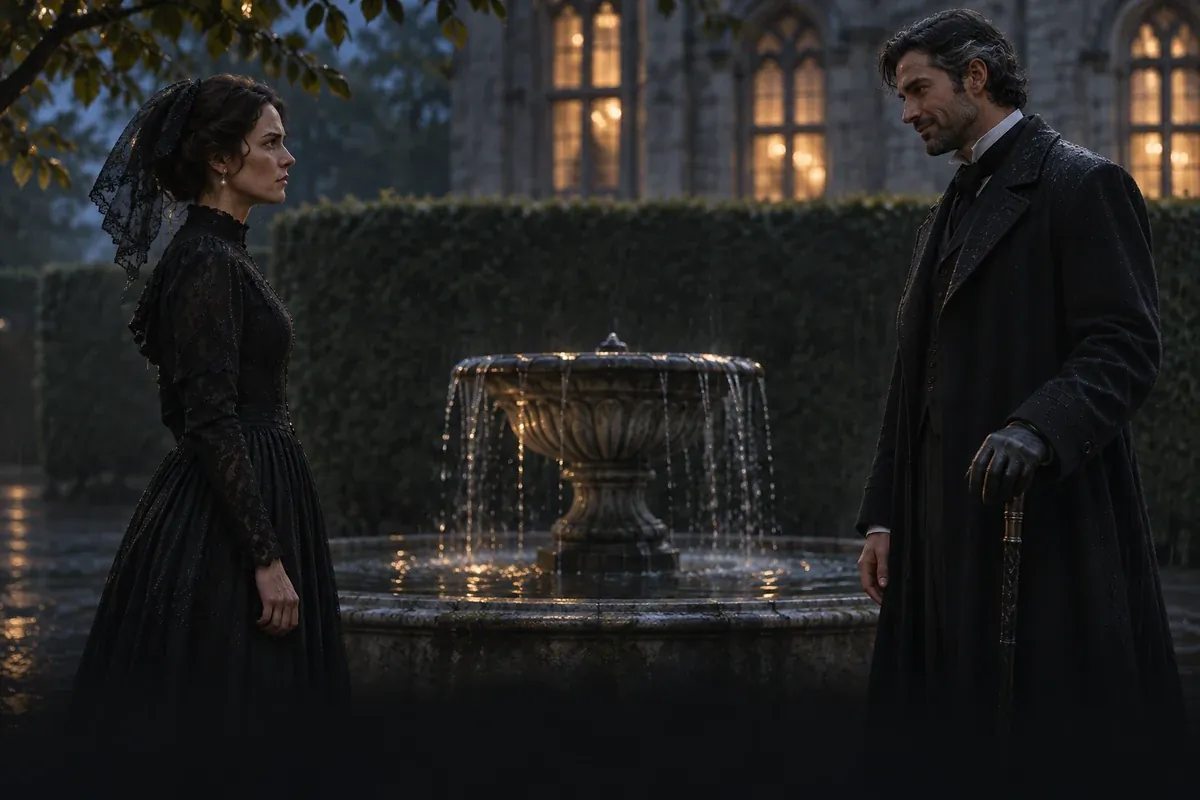
The last mourner is in the memorial garden. She sees him from the gallery’s end window: a tall figure past the yew hedge, by the fountain nobody can see from the drive, leaning on a cane. Dark coat. Gray at the temple — no. Powder. Her eye is a measuring instrument and it has three days of this man’s photographs loaded, and the set of those shoulders is not a sixty-year-old’s, it’s a thirty-eight-year-old’s doing a decent impression of one, the posture a copy with no memory.
She should call Pruitt. She should call a locksmith, a bodyguard, a priest.
She walks out through the terrace doors into the blue end of the evening, crosses the lawn, and stops six feet from him, on the far side of the fountain, close enough to see that the cane is antique blackthorn, inventory-worthy, and that his gloved left hand rests on it with the fingers slightly uneven — the ring finger with a sideways character at the second knuckle, broken, set, broken again, healed proud. Original. Authentic. Catalogued.
“Mrs. Voss,” says Calder Voss, in a voice like the note felt, fast and slanted. “I’m told the service was moving.”
“The flowers were excessive.” Her heart is a hammer in a towel again, and some ungoverned part of her is angrier than she has ever been in her life, angry the way you can only be at someone who has made you grieve on spec. “You missed the eulogies. Your sister was good. Your uncle billed us for nine minutes.”
“I heard every word. Back pew. Old men with canes are architecture; nobody checks our faces.” He studies her through the dusk with the frank appetite of the library, but slower, like a man reading a condition report on something he intends to live with. “You saw the hands on Friday. You said nothing. You took the contract knowing the merchandise was wrong. I confess I’ve been looking forward to asking why.”
“The pay was excellent and I wanted to meet the forger.”
Across the fountain, the dead man smiles for the first time, and it is the realest thing she has catalogued all week.
“Walk with me, Mrs. Voss,” he says, offering the arm that goes with the broken finger. “You should know what you married.”