

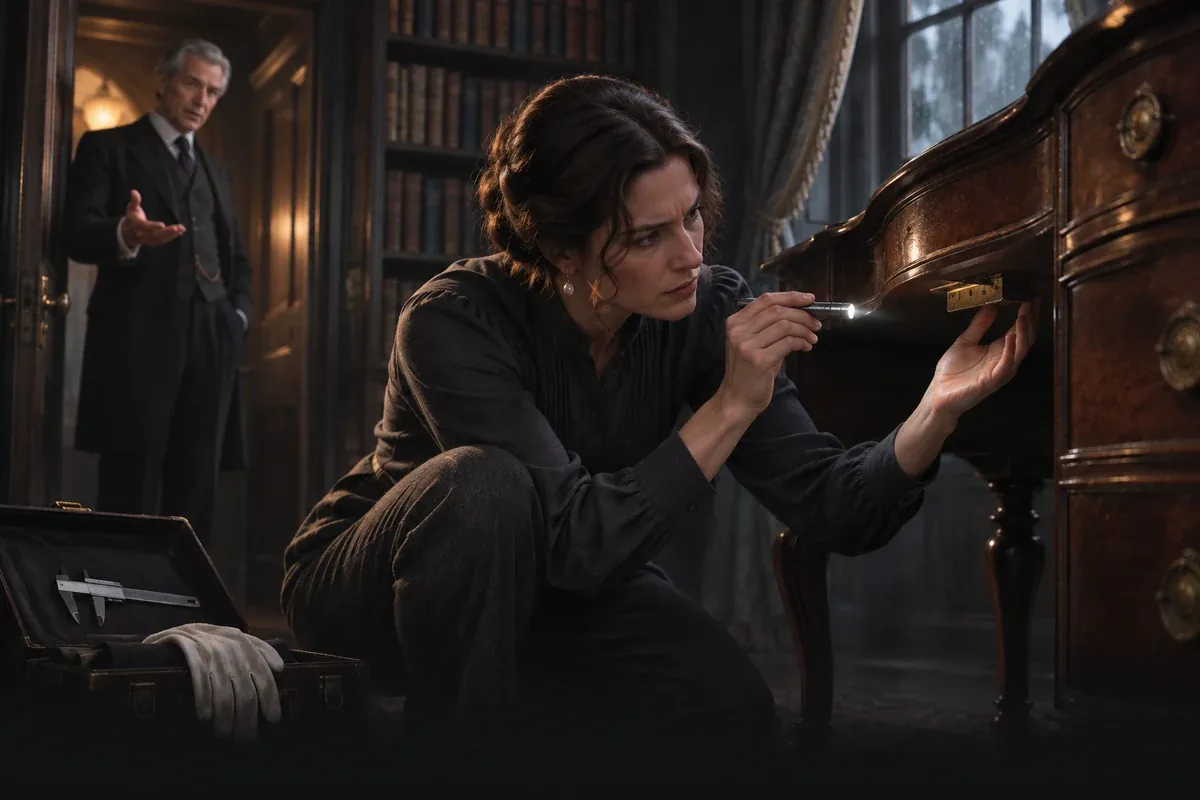
Lena Marsh is on her knees in a dead man’s study, shining a penlight up the underside of a nineteenth-century desk, when the lawyer asks if she would like to make half a million dollars.
She doesn’t answer right away. The desk deserves her attention first. Mahogany, serpentine front, brasses original except the second drawer, which someone replaced in a hurry and hoped nobody would notice. Somebody always notices. That’s the whole job: being the somebody.
“Ms. Marsh,” Ambrose Pruitt says again, from the doorway, in the voice lawyers use when they’ve decided to be patient at you. “Did you hear me?”
“I heard a number.” She clicks off the penlight and sits back on her heels. “Numbers that size usually come with a body attached.”
It’s a figure of speech. It stops being one the moment she says it, because the body in question is four days dead and this is his study, his desk, his eleven thousand square feet of river-stone house called Greywater, and she has spent three days cataloguing all of it for probate. Calder Voss, thirty-eight, founder of Voss Holdings, drowned off the dock of his own lake house. Freight and fine-art logistics. We move what matters. Even his slogan sounds like it’s hiding something in a crate.
Pruitt steps in and closes the door, which is how she knows the offer is real.
“The estate requires a widow,” he says.
Lena looks at him the way she’d look at a signature that’s too perfect. “The estate has heirs. I’ve met them. They circle the furniture.”
“Heirs, yes. A half-sister, an uncle, a cousin. What Mr. Voss’s will requires — what it names — is a wife.” Pruitt sets his briefcase on the desk she just finished appraising, which she silently prices as a misdemeanor. “The will leaves the residuary estate to ‘my wife.’ No name. The family believes there is no wife. They are prepared to treat the clause as a drafting ghost and carve the estate up along blood lines.”
“And you want to produce a ghost.”
“I want to produce Mrs. Voss.” He says it like a man ordering wine. “A quiet marriage, fourteen months ago, at the lake courthouse. A private woman. Grieving, composed, present at the service on Saturday, confirmed by documents I am in a position to supply. Five hundred thousand dollars, Ms. Marsh. And a standstill on your brother’s obligations to Harlan Credit Partners, which as of this morning stand at two hundred forty-one thousand and change, accruing at a rate I’d call predatory if I didn’t admire it professionally.”
The penlight is still in her hand. She has the strange, floating thought that if she clicked it on and shone it at him, she’d find the replaced drawer, the repaired crack, whatever it is in Ambrose Pruitt that somebody swapped out in a hurry.
Denny. Of course they know about Denny. Her little brother signed his name to a coffee-franchise dream eighteen months ago, and Harlan Credit has been selling pieces of his future ever since. She’s been paying what she can. What she can is a joke with a bad punchline. Last Tuesday a man in a golf shirt took photos of her car.
“No,” she says.
Pruitt doesn’t blink. “May I ask why?”
“Because I appraise fraud for a living, Mr. Pruitt. I don’t underwrite it.” She stands, knees aching, and starts packing her kit — calipers, cotton gloves, the UV lamp — because the catalogue is done, the report is drafted, and if she stays in this room another minute she’s going to start doing math about what five hundred thousand dollars subtracts from.
“The service is Saturday,” Pruitt says, unbothered, and leaves a cream-colored card on the desk blotter. “Should your valuation change.”
Her valuation changes forty minutes later, in the long gallery, for a reason that has nothing to do with money.
She’s doing her exit walk — final pass, every room, checking her tags against her list, a ritual as fixed as a pilot’s — when she hears the east door, the one to the service courtyard, open and close with the particular care of a person being quiet in an empty house. From the gallery balcony she watches a narrow man in a gray suit cross the parquet below with a painting in his arms. Mid-size canvas, ornate frame bagged in moving blankets, but she tagged that frame on Tuesday: the little Corot, river light through poplars, inventory number GW-114. Grant Voss’s aide. Petrie, he’s called — she’s watched him trail the uncle all week with a leather folio and the expression of a man who alphabetizes his regrets.
He isn’t stealing it. That’s what’s interesting. He’s replacing it. A second man outside hands a wrapped canvas in through the door, same size, same bagged frame, and Petrie hangs it where GW-114 lived and spends a careful minute making it level.
Lena stands very still with her list against her chest, and her brain, unhelpful organ, does the one thing it is world-class at. It appraises. A swap executed in daylight, four days after the owner’s death, before probate seals anything, by the staff of the man who controls the estate’s books. Which means the catalogue she just spent three days building is going to be used as the official record of a collection that is already leaking out the service door. Her name is on the condition report. Her signature, under the words true and accurate to the best of my professional knowledge.
They didn’t just hire an appraiser. They hired a cover.
She could call the sheriff’s office and be known forever as the hysterical subcontractor who accused a grieving family of looting itself. She could walk away clean-ish, invoice paid, brother drowning. Or.
Or someone could inherit the whole thing out from under them.
She doesn’t call right away. She makes herself drive home first, because big decisions made standing in rich men’s houses have a way of pricing themselves in rich men’s numbers, and she wants to hear what the offer sounds like in her own kitchen, with its cabinet that won’t close and its view of the airshaft.
Denny is on her couch when she gets there, which is how she knows it’s bad. Her brother has a sense for her worst possible moment the way some people have perfect pitch.
“Before you say anything,” he says, which is how he begins every sentence that ends her week, “I want you to know I handled it.”
“Handled what.”
“The guy. The golf shirt guy.” Denny is twenty-six and still sits like a teenager, folded into furniture as if he’s apologizing for having bones. “He came by the shop. Took pictures of the register. Mr. Harlan’s office says if I miss the November payment they’re going to move to garnish, and the franchise group still hasn’t released the deposit, and — Lena, I handled it, I just need you to not look at me like that.”
“Like what?”
“Like you’re adding me up.”
The worst thing is that she is. She can’t help it. Twenty-six years old; two hundred forty-one thousand in principal and poison; one talent, which is making strangers love him in under a minute; one conviction, bone-deep and wrong, that the next signature will be the one that fixes the last one. Condition: good heart, structural damage. If he were a desk, she’d buy him anyway. That’s the problem with the whole category of brother.
“The payment’s covered,” she hears herself say. “I picked up a big job. Estate work.”
“Yeah?” The hope that comes up in his face is instant and total, a lamp with no dimmer, and it does to her what it has done since he was five. “Whose?”
“Nobody you know. Dead guy. Very organized.” She fills the kettle so she doesn’t have to look at him. “Denny. If anyone asks you about me in the next few weeks — anyone, a reporter, a lawyer, a golf shirt — you call me first and you say nothing. Can you do that?”
“Is the estate work shady?”
“The estate work is lucrative.”
“That’s not a no.”
It isn’t, and he’s not stupid, he’s just nineteen percent interest, and after he leaves — two slices of her freezer pizza and one borrowed phone charger later — Lena stands at the window a long time, looking at the airshaft, doing the other math. Not the money. The museum.
Because she has been here before, is the thing. Three years ago she had a title on a door at the Driscoll Museum — assistant registrar, collections — and she wrote a memo. Four pages, measured, lethal, about a Rothko on loan from a donor’s foundation whose stretcher bars were twenty years younger than the paint. She’d been sure. She’d been right. And six weeks later the loan was quietly returned, the donor’s name went up on a new wing anyway, and Lena’s position was eliminated in a restructuring so polite it came with a cake. The lesson everyone wanted her to learn was: don’t notice things above your pay grade. The lesson she actually learned was: next time, get it in writing and get paid.
The cream-colored card is where she left it, in the zip pocket of her kit. The phone rings once.
“Pruitt.”
“Three conditions,” Lena says. Her voice comes out level, which she will be proud of later, in private, briefly. “The standstill on my brother’s debt is signed before Saturday, not after. I keep cataloguing — if I’m the widow, I control the inventory, every room, no exceptions. And when this is over, whatever this is, I get to be the one who tells the family.”
A pause the length of a smile. “Mrs. Voss,” Pruitt says, “welcome to your bereavement.”
The viewing is Friday evening, private, family only, at Lindqvist & Sons Funeral Home, a building with the carpeted hush of a bank that failed gently. Lena wears black that cost more than her rent — delivered to her apartment in a garment bag, no note, size exactly right, which she chooses not to think about — and a ring, plain platinum, that Pruitt handed her in a velvet box as if it were evidence. It fits. She chooses not to think about that either.
The family is arranged around the casket like a committee that can’t agree on the font for the letterhead.
Odette Voss-Hale, the half-sister, comes to her first, takes both her hands and says, “You’re her. You’re the wife,” with a warmth so smooth and practiced that Lena catalogues it as showroom condition, provenance uncertain, and then Odette’s eyes fill, abrupt and ugly and real, and Lena has to revise the entry on the spot. Behind Odette, a tidy silver-haired husband — Marsh Hale, which draws the evening’s only genuine laugh when they’re introduced, no relation, two strangers wearing the same name like an ill-fitting coat.
Grant Voss does not take her hands. The uncle stands at the casket’s head the way a CFO stands at a lectern, and he looks at Lena the way she looks at a signature. “Fourteen months,” he says. “Remarkable discretion.”
“Calder was private.” The dead man’s first name is wet cement in her mouth. She walks across it anyway. “We both are.”
“Evidently. You’ll understand there are questions.”
“I’d think less of you if there weren’t.”
Something flickers in Grant’s face — approval, or the recognition of a worthy expense. Beside him a younger man in an unstructured blazer gives her a lazy, friendly nod. Beau, the cousin. He smells faintly of gasoline under the cologne and is the only person in the room whose grief reads as simple: the condition report would say honest wear, consistent with age.
And there’s a woman by the window in architectural black, auburn hair, watching Lena with open, professional interest. Nobody introduces her, which is its own introduction. Simone Adler. The ex. Her gaze does a slow walk from Lena’s shoes to the platinum ring, itemizing, and Lena feels briefly, collegially seen. Takes one to know one.
Then there’s nothing left to do but the thing she has been not-doing since she walked in.
She approaches the casket.
Here is what Lena knows about grief, from working estates: it lives in objects. The dead are an absence; their reading glasses are unbearable. So she has armored herself against the glasses, the wedding photos she’ll be expected to have copies of, the hundred little blades of a staged life. What she has not armored herself against is the plain fact of him — Calder Voss, in charcoal wool, hands folded at his waist, looking like his photographs the way a copy looks like a painting.
That thought arrives in her professional voice, so at first she doesn’t hear what it’s actually saying.
Looking like his photographs the way a copy looks like a painting.
She has spent three days in the man’s house. She has catalogued his racing trophies and the sailing photographs on the stair — Calder at the helm in half of them, line wrapped around his left hand, and in the close one from Antigua you can see the ring finger, broken and set and broken again, healed with a slight sideways character at the second knuckle, a flaw she noticed the way she notices everything, because flaws are how you tell originals from copies.
The hands folded on the charcoal wool are smooth. Straight. Manicured. A dealer would call them mint. Mint is what you call a forgery that didn’t do its homework.
The room goes very far away and very loud at the same time. She is aware of Grant Voss’s reflection in the casket’s polished lid, of Odette crying softly somewhere behind her, of her own heart going like a hammer wrapped in a towel. Say something. Don’t say something. If the body is wrong, then either the family knows, or the family must never know, and she has no way of telling which family she’s standing in, and she signed papers this morning that make her the person with the single largest motive to have put a wrong body in a right casket.
She does what any professional does with a dangerous attribution. She closes the catalogue.
Lena bows her head over the folded smooth hands of a stranger, and lets the room watch the widow grieve, and grieves a little for real — for Denny, for her museum job three years gone, for the version of her that would have said something — and when she straightens, her face is exactly as composed as a woman being paid half a million dollars to be composed.
It’s in the cloakroom, after, that she finds it. Her coat, alone on the rail, heavier on one side than she left it. In the pocket: a note, heavy cream stock, no envelope, six words and two initials in a fast, slanted hand.
You noticed. Good. Keep mourning. — C.V.
Lena stands in the little lamplit room, in a dead man’s house of a building, holding a dead man’s handwriting, still warm from someone’s inner pocket, and her unhelpful, world-class brain delivers its verdict with the serene authority of a final sale.
Attribution: Calder Voss. Condition: alive.
Provenance: unknown.