

Harold Pell kept his television on for company, and he was eighty-one years old before he ran out of anyone else to keep it on for.
That is what I know about him on Thursday morning at ten o’clock, standing at the head of an open grave in the north section of Hillcrest Cemetery with a clipboard in one hand and the wind trying to take it out of the other. The north section is the part of the county’s cemetery that the county owns outright.
It lies at the bottom of the hill, past the water spigot and the dumpster for dead flowers, in rows of flat gray stones set into the grass so the mower can pass over them. Each stone has a number. When we have a name, it has a name, too.
Harold Pell has a name. I made sure of that. The stone isn’t ordered yet, but the name is on the paperwork, in capital letters, in my handwriting.
There are four of us. June stands in her black cardigan, holding the folded flag she keeps for veterans, which Harold was not, but which she brings anyway because the box it comes in smells like a church.
Aubrey Lund, the gravedigger, is seventy years old, in a canvas barn coat and a cap with earflaps, leaning on a shovel with the patience of a man who has been paid by the hour for fifty years and has never once been late. Then me. And the casket, which is plain pine and which the county buys by the dozen.
I am not counting the one who is not here.
“Your fella’s not coming,” Aubrey says, to the shovel. “The one with the hood.”
I turn. “You noticed him?”
“Eleven of your graves. Course I noticed him.” He takes off the cap with the earflaps and rubs his scalp with the heel of his hand. “Never once saw him leave, either. I’d turn to spit, and he’d be gone, like a man stepping off a bus.”
“I didn’t know you’d seen him.”
“Nobody asks the gravedigger.” He puts the cap back on. “There’s a coffee on the stump by the spigot, Thursdays. Paper cup, two sugars, still hot. Been there every service for six years. First one, I thought it was somebody’s mistake. Then I figured it was mine to drink.” His voice does not change. “No coffee on the stump this morning.”
I look at the stump by the spigot. It is bare, a wet gray circle in the grass.
“Mr. Lund,” I say. “His name was Walter Brandt. He died on Tuesday.”
Aubrey does not say anything for a long time. Then he takes the cap off again and holds it against his chest, the whole cap, earflaps and all, and stands that way in the wind, and I realize that nobody has ever told him anyone’s name before the service. I have always told him afterward, if I told him at all.
“Walter,” he says. “All right.”
I look toward the back before I say the first word. I cannot help it. I look at the place beyond the last folding chair and the small table with the black ledger on it, where for six years a man in a tan hood has stood in whatever weather the county could produce. There is nothing there but a stretch of gray grass and the long blue wall of the sky.
Nobody is standing there. The absence is so loud that I take a breath through my nose, hold it and begin.
“Harold Pell,” I say. “Eighty-one years old. Thursday, ten-oh-four in the morning.”
That is Rule One. It always goes first.
“Mr. Pell was found a week ago Friday in Room 6 of the Orchard Motel, where he had lived for eleven years, in the chair by the window. He had a reputation among the staff for tipping at Christmas and arguing about the parking. The television was on. The television is always on, the housekeeper told me, from the minute he wakes up until the minute he falls asleep. She says he never watched it. She says he talked to it.”
June’s eyes are on the grass. Aubrey shifts his weight.
“There’s a remote control in the effects,” I say. “It’s an old one. Somebody put a rubber band around it, tight, over the button that turns the volume down. Mr. Pell did it himself. It meant he couldn’t turn the sound lower than a person talking in the next room.”
I have the remote in my coat pocket. I take it out, because I have never read a eulogy that was only words. “He didn’t want it quiet. I thought somebody should know that. So I’m saying it now, out loud, in front of a witness, and it goes in the book.”
I put the remote on the lid of the casket. I do not know why. It has never been in the manual. It seems right to leave him the thing that kept the room from going quiet.
It is as I step back that I see the man.
He is at the back. He is where the hood used to be, a hundred feet away, beyond the table with the book on it, with his hands in the pockets of a tan canvas jacket and his shoulders against the wind. He has not come up the slope. He has not taken a chair. He is standing in the exact square of grass that I would know from any distance, and I realize that he has no idea that is what he is doing.
Cal.
Our eyes meet over the pine lid. It takes one second. It is not long enough to call anything.
I look away first. I am a professional.
Aubrey lowers the casket on the straps. June says the Lord’s Prayer in her low church voice, and I say nothing, because nobody asked me to, and because the one time I tried at a service, six years ago, I got to the part about trespasses and stopped.
When it is over, Aubrey picks up the shovel. That is the committal. In Plover County the clerk stays until the first shovelful. Rule Seven, in the margin, in the green pencil: You are the only one who is going to see this. See it.
I stay. I hear the dirt begin to fall.
And at the back, Cal does not leave.
I know because I look. In six years I have never once looked, I have only listened for the scrape of boots on gravel that meant the man at the back was gone, a sound I stopped hearing the way you stop hearing a clock.
Today there is no scrape. Cal stands there with his shoulders square to the wind until the first shovelful, the second, the third, with his chin up like a man waiting for a verdict. When Aubrey stops to wipe his face, Cal is still there.
He lifts one hand, not quite a wave, the gesture a man makes to say, I saw that.
I nod. That is all. We are both very good at not saying things.
When the grass has been smoothed and Aubrey has gone for the truck and June has folded the flag back into its box, I walk up the slope to the small table at the back and open the black ledger.
Harold Pell’s page is blank. Of course it is. Nobody signs a page they have no reason to sign. I put my pen on it, and then I look up at Cal, who has come two steps closer, and has his hands out of his pockets, and I say, “Do you want to?”
“Sign it?”
“It’s for anybody who was here.”
He takes the pen. The pen on its string is a ballpoint, blue, the cheap kind. He looks at the page for a moment and then, slowly, in block capitals, pressing so hard I can see the paper dent, he prints:
CAL.
I stare at it. It is three letters and I have been looking at it for six years without knowing. It is his father’s hand. The square, the slant, the weight on the downstroke. I have seen it on grocery lists and on the back of an envelope with a mileage log, on the note on my kitchen table, and I never thought of it as anyone’s but his.
“You print like him,” I say.
“I print like a guy who failed penmanship.” He caps the pen. “It’s what they do at the truck school. Everything block, nothing cursive. Less to read when you’re tired.”
“It’s the same hand.”
“It’s a hand.” His eyes are on the grass. “I wanted to see what he stood at the back of,” he says abruptly. “That’s all. I was passing.”
“You’re nine miles from the plaza and the road to the plaza doesn’t pass here.”
“I took the long way.”
I put the cap back on my own pen. I do not say that I know what the long way costs.
Prairie Rest is a one-story brick building on the east side of Plover with a covered drive-up, a rose garden in a state of dormant surrender and a hall that smells like instant mashed potatoes. It is the only place within sixty miles that has a locked wing for people who forget. I go on Thursdays after the service. I have gone every Thursday for three years.
“Hey, Dess,” says Marguerite at the desk, which is the entire protocol. She has a small plastic name tag and a large kind face and has been with the home for twenty-two years. “She’s had a good morning. She ate the whole toast.”
“Is that a record?”
“It’s a Thursday.”
The memory care wing is a long hall with a keypad door, a bird in a cage by the nurses’ station, and a mural of a prairie in July that someone has painted in a sort of defiant optimism. At the end, on the left, there is a door with a laminated card on it: LOTTIE.
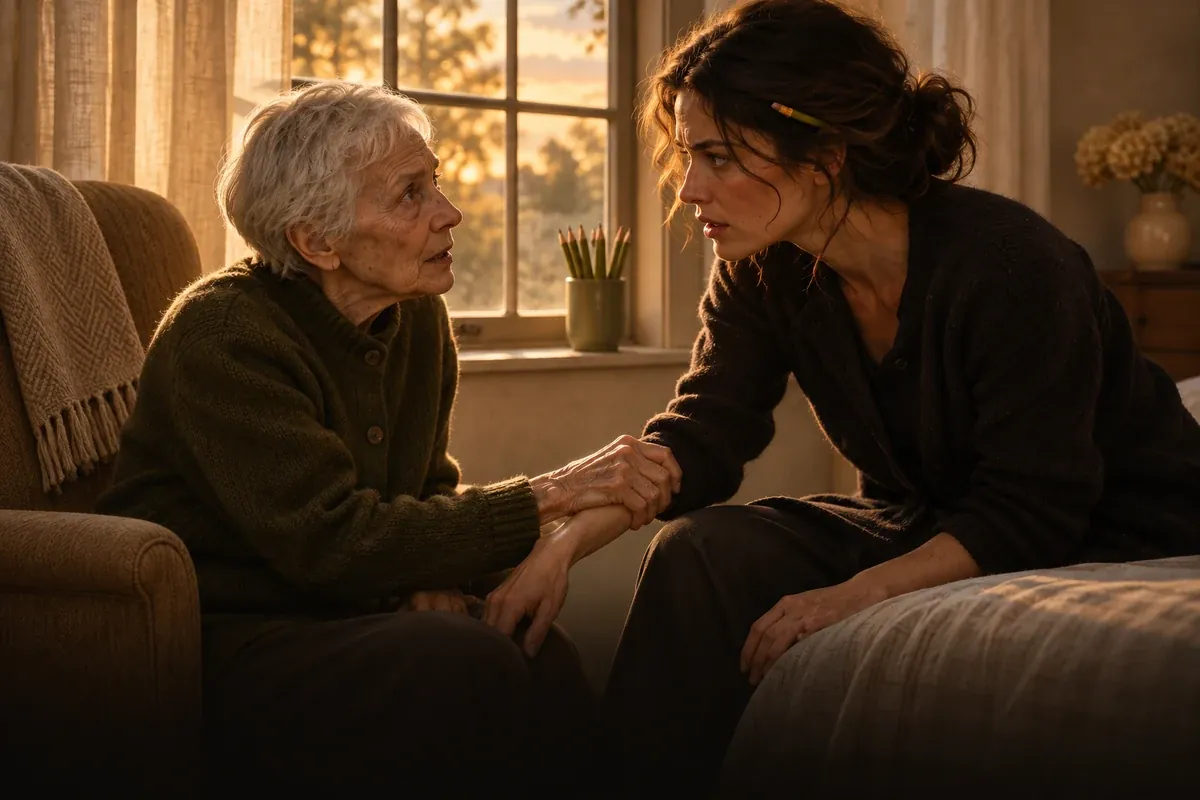
Loretta Szabo is seventy-seven years old and weighs about as much as a good coat. She has white hair cropped short and a green cardigan buttoned to the neck, and she sits in the armchair by the window with a cup of pencil stubs on the sill beside her, green ones, every last one of them sharpened to a point. Nobody knows who keeps sharpening them. I suspect that she does.
She ran the county clerk’s office for almost forty years. She taught me how to read a deed in a single glance and how to tell a bride from a bridesmaid at the counter by the tilt of the pen, and in the last six years she has forgotten all of it by degrees, a little at a time, like a lamp being turned down.
“Hi, Lottie.”
“Mm,” she says. She is looking at the window.
“Lottie, it’s Dess. It’s Thursday.”
“Rule eleven,” says Lottie.
I sit on the edge of the bed. I have learned not to correct her. “What’s rule eleven?”
“Always bring the thermos.” She says it with great firmness. “Rule four. Never wear white to a hearing. Rule thirty. Do not trust a man who laughs at the courthouse clock.” She nods, satisfied. “That’s all of them.”
“There are thirty-one.”
“There are.” Her hands are in her lap, restless, plucking at the cardigan. “Are you going to the Pell service, honey?”
“I just came from it, Lottie.”
“That’s good. That’s good, honey. He kept the television on.”
My hands go still. “How did you know that?”
“Rule nine,” says Lottie.
It comes out quite differently from the others. It is as if someone has opened a door in the room behind her face. The cloud in her eyes thins, and thins, and clears, and Loretta Szabo, county clerk, looks at me across eleven inches and six years of working side by side. She takes my wrist, hard. Her grip has not changed.
“Odessa,” she says. “Did he finally tell you?”
I stop breathing. “Did who tell me what?”
Her mouth opens. Her eyes go bright and focused and absolutely terrified. I have the quick mad conviction that she is going to say the one thing I have spent six years making sure nobody ever says, the thing in the bottom drawer, the form, the date, and that I will have to find out how she knew.
“Lottie. Tell me what?”
“Did he finally,” she says, “tell you.”
And she is gone. It is like watching a tide go out. The eyes dim and the hand loosens and a sort of polite vagueness settles over her face. Eleven seconds, I think, though I did not count and I always count. She pats my wrist.
“Rule twenty-two,” she says kindly. “You have to eat something.”
I sit there until Marguerite comes with the cart and says it is time for the afternoon pills. I kiss the top of Lottie’s head. It smells like talcum and pencil lead.
In the hall I stand by the caged bird and press my forehead against the cool wall. It is not Cal she meant. I would know it if she meant Cal. She meant something else, something she has had in her mouth for years, and she has been waiting to ask it since before the memory went.
Did he finally tell you.
I do not know who he is.
The courthouse after dark has its own temperature. The heating cuts off at six, and the limestone gives up its warmth slowly, a degree a minute, until the building feels like the inside of a cupped hand someone has stopped holding. I stay anyway. I have the lamp on the desk, a thermos of coffee, and the gray binder, which I have been carrying around my life like a pet.
It is nine o’clock. Cal’s truck is at the plaza, nine miles away, and I am here, with the manual open on my blotter to a page I have not read in years.
Rule Nine.
I have always found it the cruelest rule in the book. It is on page forty, in a column of green marginalia down the right side, in Lottie’s small upright hand. It says: Do not look for the cause. Bury first.
I have never understood it, because I spent my whole adolescence looking for a cause. My mother was Marisol Varga, forty-one years old, a night nurse at the county hospital, and on the eleventh of February, twenty years ago, she drove home from a shift in a whiteout and was hit at Bishop Road on Highway 30 by a tractor-trailer that did not stop.
I, fourteen years old, woke on the couch to a deputy’s hat on the kitchen table. The file says unknown tractor-trailer. It has said that for twenty years.
My mother was left-handed and hummed when she charted, always the same four bars of something I never learned the name of. She smudged every page with the side of her hand. I used to find her notes in the pockets of her scrubs, little blue-smeared reminders in a slanting hand: pick up D’s shoes, call about the furnace, you are a good kid, eat something. I still have them in a tin.
I read the last one every February, and it says only: milk. For twenty years I have waited for the cause to walk up to me and say its own name, and in all that time it never has, and the only thing I ever learned was how to bury other people’s dead, in the right order, with the right words, so that nobody had to go looking.
Bury first. Do not look for the cause. I have followed it every day of my working life, with my teeth.
I turn the page. The manual is old, the paper brittle at the edges and soft in the middle where a hundred thumbs have turned it. Rule Nine is printed at the top of the column in Lottie’s green. And below it, where there has always been white space, I see a second line of green pencil.
It is newer. It is a different weight of lead. I have turned past this page a dozen times and never seen that line. It has been here all along, and I have never looked down, like a woman on a staircase in the dark who finds out where the last step was.
There is a date in the corner in Lottie’s tiny numerals. It is six years old to the week. It is the week I was hired.
I read it.
I read it again.
I put my pencil down, because it is shaking, and I put both hands flat on the desk on either side of the page, like a woman holding a table steady in an earthquake, and I read it a third time, slowly, because I am a clerk, and a clerk reads the thing that is written.
In green pencil, in a margin, in the county’s own handwriting: Dess, when you learn it was Walt Brandt on Highway 30, February 11, remember Rule One.