

There is no form that says no.
I tell Cal this at 5:44 on Tuesday evening, with his hand still lying on my counter like something he has set down and cannot remember how to lift. I have a form for claiming a body. I have a form for withdrawing a claim. I have, God help me, a form for a dog license that has lapsed. I do not have one that lets a man stand in my office and say he wants nothing to do with the dead.
“The county doesn’t take refusals,” I say. “The county takes the calendar. If nobody signs in fourteen days, I order the interment. That’s the whole procedure.”
“Then I’ll let it run.”
“You can’t just let it run. Somebody has to be the person it runs on.”
“You.” He says it gently, and that is the worst part. “It’s your office. It’s your clock.”
“Ordinance 14-C requires me to make a reasonable effort to find anyone with a claim. You’re the claim. You’re standing in front of me.” I pick up the pen and put it down.
“I am required to tell you what it costs. Forty-eight hundred, Cal. That’s the county schedule, and I wrote the schedule, and I know it’s low. If you sign, you’re liable. If you don’t, nobody is, and he goes in the north section on Monday night’s clock with a number on his stone.”
“Okay.”
“Okay what?”
“Okay, I understand.” He finally lifts the hand. There is a faint oblong of warmth on the form where it was, and I notice it, and I am furious that I notice it. “I’m not here to make you do anything. I drove back so I could say it to your face. So you wouldn’t sit in here for two weeks wondering if I was coming.”
“I wasn’t wondering.”
“Dess.”
“I was running a clock.”
He nearly smiles again. It is the third time today, and it is wearing him thin. “Where’s he at?”
“Oyelaran and Sons. June’s keeping him cold.”
“I don’t need to see him.”
“Nobody asked you to.”
“I’m on I-80 by Friday,” says Cal. “I’ve got a load out of Omaha. I only stopped to tell you.”
“You said that.”
“I know.” He turns the cup of coffee a quarter turn on my counter. “I’ll stay at the plaza till then. I’ve got the bunk.”
That is how I find out my ex-husband is going to sleep for three nights in a truck parked beside his dead father’s truck, in a lot nine miles from my house, and that he thinks this is a reasonable thing to say out loud in a courthouse.
“I have to ask you something,” I say, because Rule One is not a suggestion, and because I have been waiting my whole shift to find out whether I can do it. “His name. What was it?”
Cal’s face closes, one door at a time.
“You know what it was.”
“I know what it said on his license. I want you to say it.”
“Dess.”
“It’s the first rule. Before you say anything else about the dead, you say their name aloud. It doesn’t matter if you liked them. It matters that somebody does it.” I keep my voice flat, like a form. “Say it for me. Then we can talk about the rest.”
The courthouse clock that is four minutes wrong chooses that moment to strike six, a cracked brass note. I wait for the last stroke.
“The old man,” Cal says.
“That’s not his name.”
“My mother walked out when I was five,” he says, to the middle of my counter. “He never said her name again. Not once. Thirty years, and I would ask him, and he would look at the road. So I don’t say his.” His jaw works. “It’s a rule, too.”
“That’s not a rule. That’s a grudge.”
“Yours has a binder.”
It lands exactly where he meant it to. I put the Claim of Remains back in the drawer, and the drawer sticks, and I push it shut with my hip, and when I turn around he is already at the door.
“Eleven oh nine tomorrow,” I say. “Basement archive, if you want to help. I’m looking for anything the county has on him.”
“Why would I want to help?”
“Because you’re going to sit in a truck for two days with nothing to do.”
He stops with his hand on the door. The little bell begins to ring and he catches it with two fingers. Calvin Brandt is a man who catches bells.
“Two hundred eleven,” he says, quietly, to nobody. And he goes down the steps.
It takes me a full minute to understand that he was counting exits.
On Wednesday I am in the courthouse basement by ten. It is down a flight of stairs that creaks in a different key on each tread, past a boiler the size of a cow and a room that smells like old paper, wet coat and the ghost of a 1970s coffee machine. The county archive is eleven rows of steel shelving, floor to ceiling, lit by bulbs that all burn at slightly different temperatures.
I have been down here every Wednesday for six years. It is the only place in the building where nobody calls my name.
Cal comes in at 11:09 on the dot. I have my back to the stairs when I hear him, and I know it is him by the way the boards do not complain. A man who has spent twenty years learning to enter a sleeper berth without waking someone learns a particular step.
“You’re early,” I say.
“It’s eleven oh nine.”
“I said eleven oh nine.” I do not turn around. “Row seven. I need the folder on any county contact with Walter Brandt, any year. Marriage, a plate, a property. His parents’ probate. Anything with a signature.”
“You said it,” says Cal behind me, softly. “Just now. His whole name.”
I turn around. I do not remember doing it.
“I said it to you,” I say. “You can say it to me.”
He looks at the shelf. His mouth is a flat line. Under it, I can see his throat work.
“Wally,” he says, finally. “That’s what the drivers called him on the radio. Wally. Then somebody had a Dutch uncle and somebody said he was as stubborn as a Dutch uncle and it stuck. Dutch.” He shrugs. “Everybody on I-80 knew him as Dutch. I never did. He was just the old man.”
I have a stack of manila folders in my arms. I am holding them so tightly that one of the corners has bent.
“Dutch,” I say.
“Yeah.”
“D-U-T-C-H. All capitals.”
“I guess. He printed everything.” Cal’s brow furrows, and I watch him look at me, really look, for the first time since he came up the courthouse steps. “Why?”
I do not answer. I walk past him, down row nine, to the shelf at the far end where the sign-in books live.
Here is a thing I do that is not in the manual. Whenever the county buries someone nobody claimed, I put a book on a small table at the back of the service, a plain black ledger with a pen on a string, and a sign that says IF YOU KNEW THEM, OR IF YOU DIDN’T, SIGN.
I thought of it in my first year, in a cold chapel with three people in it, one of them the gravedigger. I thought somebody should be on the record as having been there. I call the books the Thursday Book, singular, the way you say the Bible, because services happen when someone is ready and it is usually a Thursday.
Six volumes, one a year, bound in black cloth with a strip of masking tape on each spine and the year written in my own hand.
I do not need to open them. I know what is in them. For six years I have seen the same signature on every page, in blue ballpoint, in square block capitals, pressed so hard that it has embossed the paper. I always assumed it was a nickname. Some old farmer, some retired gravedigger, a man who liked a good funeral and signed himself the way old men do.
I take down the first volume. I put it on the steel table under the brightest bulb. I open it to the first page.
DUTCH.
I turn the pages. Cal has come up behind me, quietly, so close that I can feel the warmth of his sleeve against my arm, and for a second neither of us moves. It has been six years since I stood this near to anyone I have not given a form to. I can smell the road on him. Diesel, laundry soap, the cold-metal smell of a man who works with his hands. I turn another page. Another name. DUTCH.
Cal takes one full step back.
He does it deliberately. I hear it in the floor. It is the way you step back from a stove you did not mean to lean on. I do not turn around. I note that he stood too close, and I note that he caught himself, and I note both of them down in the place where I keep the things I am never going to say aloud.
“Page by page,” I say. “Every service. Every Thursday.”
“Dess.”
“Seventy-one pages. Let’s count.”
We do it together, the way you count anything you do not want to be true, one page at a time with a pen, in a basement, with the boiler knocking in the next room. Volume one. Volume two. At volume four Cal sits down on the step stool because his knees have decided for him.
At volume five I stop turning pages and just read the names beside the signature, the people we buried: Edna something, Ruth something, a man who was found in a ditch, a woman who had a cat. And at the bottom of every page, never at the top, never in the middle, always the last line, always in the same square capitals pressed so hard they have dented the pages behind:
DUTCH.
There is a rhythm to it, I realize. Every Thursday. Every funeral. Rain or shine. A man in a canvas coat with the hood up, standing at the back of the chapel or the back of the graveside, behind the last row of folding chairs, who left before the committal and was gone by the time the dirt began to fall. I never saw his face. He was always just a back. A shape. A Thursday.
I have a service on the calendar for Thursday morning. For the first time in six years, nobody will be standing at the back of it.
“He came to every one,” Cal says. His voice is quiet. “All of these.”
“Seventy-one.”
“He was away. He was always away. I called him once on a Thursday and he said he couldn’t talk, he was due somewhere.” Cal laughs, short and painful. “I thought he had a girlfriend.”
“He had a rule,” I say.
“What?”
“I don’t know. Lottie would say that’s what it is when you do it every time.”
Cal looks at his hands. He opens and closes the right one slowly, the one with the scar, as if he is checking that it still belongs to him.
“I need to get out of this room,” he says. “Where’s June’s place?”
“Oyelaran and Sons. Four blocks.”
“I’ll walk.”
“I’ll come.”
He stops on the stairs. “You don’t have to.”
“I’m the officer,” I say. “It’s the county’s clock.” That is only part of the answer. I leave the rest of it in the basement with the books.
Oyelaran and Sons is a Victorian with a deep porch, a green awning and a smell of lemon polish that has been in the walls for three generations. It was a house before it was a funeral home, and it has never entirely stopped being a house.
There is a bowl of butterscotch on the hall table. There is a long runner on the stairs. There is a small brass plaque on the door that says PLEASE COME IN, and a doorbell that plays four notes of a hymn.
Cal stops on the first step. His lips move.
“Three,” he says. “Two. One.”
I watch him count the porch steps like a man counting down to something, and I open the door for him, and he goes in ahead of me.
June is waiting in the front parlor with a plain cardboard box on the coffee table and her hands folded at her waist. She looks tired. She is wearing her good black cardigan, the one she keeps for services, and her hair is pulled back with the hard, careful tension I recognize from the winter her father died.
“Cal,” she says, in the bell-clear voice. “I am so sorry for your loss.”
“Thanks, June.”
“Dess tells me you don’t want to see him. That’s completely your choice, and no one will think less of you.”
“I don’t need to see him.”
“Of course.” June’s eyes find mine over his shoulder. She is lying, and I know it, and I know exactly what she is lying about. She wants to give him something, and she is afraid to say it. “Mr. Brandt is very peaceful. He’s in our quiet room. Whenever you want.”
“I’ll sit outside,” says Cal. “If that’s okay.”
“Take as long as you like.”
He goes out to the porch. The screen door sighs behind him. I watch him through the lace curtain as he lowers himself onto the top step, with his back to the house and his elbows on his knees, a big tired man looking at a street with nothing on it.
“Mm,” June says quietly. “Noted.”
“Don’t.”
“I’m going to say it anyway. You didn’t tell me he looked like that.”
“Like what?”
“Like a man who hasn’t slept since he left.” She shakes her head, back to her normal voice, and for a second her face is just the face of a girl who bit me in a church nursery. “Never mind. I brought you his effects. They’re in the box. The inventory’s on top, but I wanted you to see this before you read it.”
“See what?”
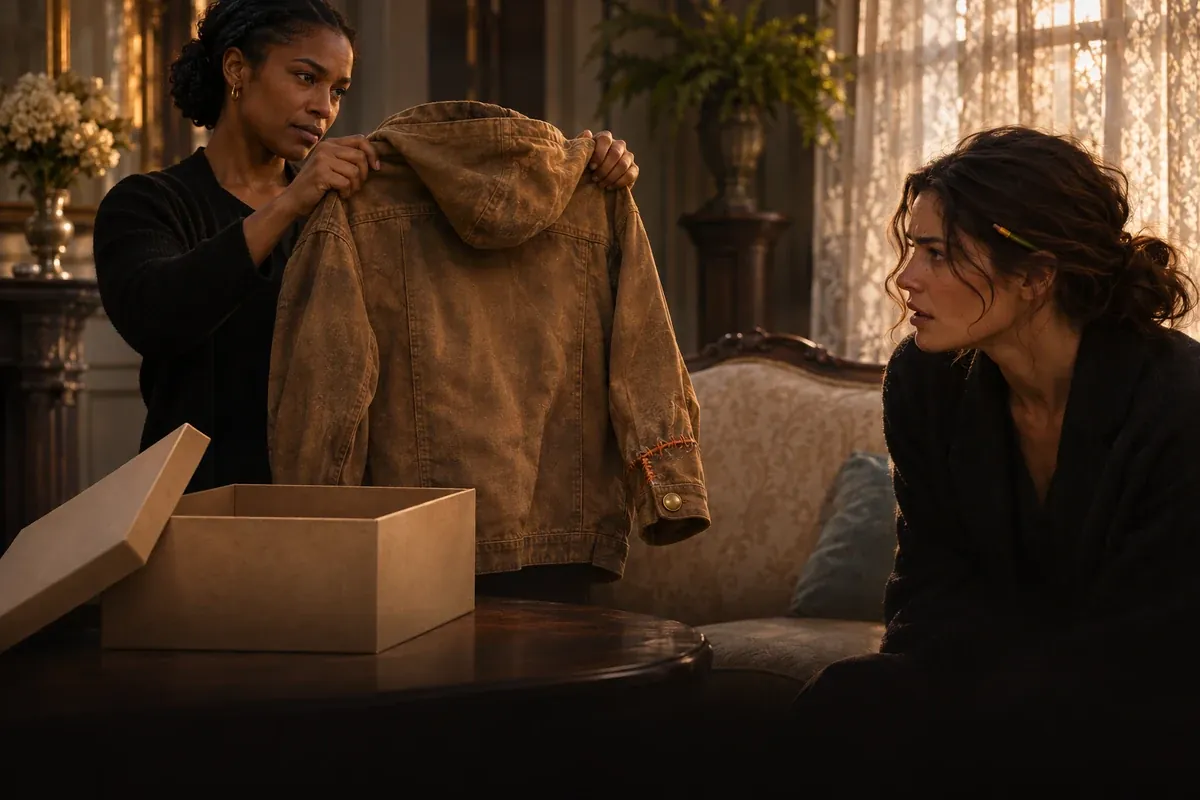
She does not answer. She opens the lid of the cardboard box and takes out a folded canvas jacket.
It is the one I touched in the cab on Tuesday morning. Tan canvas, soft with age, worn pale at the elbows. It has a hood, and a cuff mended with orange thread, and a brass snap where a button used to be. June shakes it out and holds it up by the shoulders, and the light from the parlor window falls across the back of it, and I stop breathing.
I know the back of this coat.
I have looked at the back of this coat for six years. Every Thursday, at the back of a chapel or a graveside, in the rain, in the cold, in a wind that took my notes out of my hand: a man in a tan canvas coat with the hood up, standing behind the last row, who never turned his face to me.
He was always gone before the dirt began to fall. Seventy-one times I thought I should turn around and say thank you. I never did. I told myself you do not turn around during a service, that the witness does not need a witness.
There is a flash of orange at the cuff, and I remember: I saw that thread on a Thursday in the rain, a bright mean little thread on a cuff that was holding a hood closed, and I thought, someone should fix that.
“Dess?” June says.
I do not answer. I am looking at a tear in the lining where the left pocket is. I am looking at the stitches. I am doing a very careful sum.
Seventy-one funerals. Seventy-one Thursdays. Seventy-one strangers I buried with my own hands, in a county that gave me a binder and a stamp, while a man stood in the rain behind me, keeping a vigil I never once thanked him for. A man who carried my name in his wallet next to forty-one dollars. A man who wore this coat to every one of them, and never let me see his face.
He was my father-in-law. I never turned around.