

In the bunkroom at 2310, Luz Ballesteros deals the sleeping arrangements out like cards she does not like.
“Odd, you’re under Sam. Teo, you’re across from Greenhorn.” She taps the steel post of the nearest bunk twice with two fingers. “I’m below her. Nobody sleeps in a room by themselves. Nobody sleeps with the door shut. Captain’s in his cabin with the seventh hand in the chair, and if he complains about the company, he can complain to the Articles.”
She does not say it unkindly. She says it like a weather bulletin.
The tag off the cut bridle ring said what it said. Walt read it at supper, out loud, in the flat voice. Clause nineteen. No hand shall sleep alone. Nobody at the table looked at me while he read, which is how I know exactly whose clause it was. I have spent a good many years learning to feel a room blame me without a single face turning.
The sea answered my little test with a rule about bedtime. It is the most frightening thing I have seen all day.
“Why the pairing?” I ask. “If it says alone, anyone awake counts, right? A watch.”
“Anyone awake, anywhere in the room,” Luz says. “That’s what Ansel Brannigan decided in 1974, and he wrote it on the back of an envelope, and the envelope is in the safe.” She yanks a blanket straight on the lower bunk. “You can ask the Articles when you read them. I haven’t. Nobody has.”
“Nobody’s read them?”
“Nobody’s read all of them.”
I make a note.
The bunkroom is a steel box eight feet by fourteen, below the waterline, and it hums with the engine like a swallowed bee. Six bunks, in two tiers, each with a curtain and a reading light and a little shelf for a Bible or a photograph. On Luz’s shelf is a school picture of a girl with two missing teeth. On Odd’s, a hymnal with the cover held on by electrician’s tape. On Sam’s, nothing yet but a bag of wintergreen gum and a phone with no signal.
Sam is sitting on the edge of the lower bunk with his left foot in a bandage and his mouth working on his gum.
“Respectfully,” he says, as I climb into the bunk above Luz’s. “I owe you.”
“You don’t.”
“I do. You cut me out of that thing with a knife the size of a butter knife. I’d be down there.” He looks at the deck. He has said this four times, and each time it comes out smaller. “Also, you were counting. I’m not going to ask about it. I think I hit my head. I think I saw a guy.”
“Which guy?”
“I’m not going to ask.” He chews. “Is it okay if I don’t ask?”
“It’s okay.”
“Good.”
I lie back and look at the underside of the deck, three feet from my nose. There is a long streak of rust in it shaped like a river. I follow it from the headwaters to the delta and I do not count the bends.
The lights go out at 2330.
I lie in the dark with my phone in my hand, though there is no signal for two hundred miles, and my thumb moves on the screen by habit. There is a voicemail icon. It has the number 1 beside it. It has had the number 1 beside it for eleven months, and I have never once touched it, because the second I play it I will know the last thing my brother said, and until then he has not said it.
Three calls. February twenty-first, twenty-second, twenty-third. I was in a client’s kitchen in Eagle River with a salt line around the stove and a pencil behind my ear, and I let it ring because he owed me twenty-three hundred dollars, and I was proving a point.
I put the phone back in my pocket. I make my breathing slow.
Across the room, in the dark, Teofila Aguon is not asleep either.
I cannot hear her. I can feel her. It is the sensation of a person lying very still on purpose, a held-in quality in the air. I let a long time go by. I let Sam start to snore, a bubbly little snore, and Odd begin, below him, to hum in his sleep, four bars and a stop. I lie there and I listen to a boat full of people breathing.
At ten past one, Teo gets up.
She does it very carefully. She does it like a mother getting out of a bed with a baby in it. The bunk creaks once. A blanket whispers. Bare feet touch the steel, and then boots, and then the curtain moves, and in the faint red glow from the exit sign I see her shape stoop at the door and turn the handle without a sound.
Nobody sleeps with the door shut. She leaves it a hand’s width open, and goes.
I count to a hundred, in my head, with my lips closed. Then I swing down.
Below me, Luz’s breathing does not change. It is slow, deep, even. If she is awake she is very good at it. I put my sock feet on the deck, and I walk out of the room the way I once walked out of a house in Palmer where the owner’s late husband was asleep in the bed, and I tell myself that I am not alone, because Luz is in the room.
I am a hand, after all. I am not sleeping.
The passage is lit by one bulb in a cage. I can hear the engine, and the long slow roll of the sea along the hull, and the ice hitting the steel like gravel on a roof. I go along it with one hand on the wall. At the end of it, at the foot of the galley stairs, a thread of yellow light lies under the door.
I stop. I listen.
“...not yet,” Teo says, very softly. “She’s a smart one. Let her come to it herself.”
There is a silence. There is no answer. There is only the clink of a spoon against a bowl, and then a voice, hers again, tired and warm.
“I know. I know, honey. Eat.”
The door is open an inch. I put my eye to it.
The galley is dark except for the light over the stove. The table has been wiped, and the plates put away, and one plate has been taken out again and set at the end of the table, the seventh place, nearest the stairs. It has soup in it. Teo is sitting in the sixth chair, beside it, with her elbows on the table and a bowl of her own.
The seventh chair is empty.
She has put a spoon in the seventh bowl. As I watch, she lifts it, and eats, and sets it down, and takes a spoonful from her own bowl, and eats that. She does this as if she were tasting for the two of them. Her eyes are shut. Her lips are moving.
She is praying, or she is talking to someone who is not in the chair.
I stand there with my sock feet going numb. In my trade, anyone who feeds the thing she is afraid of is either a fool or a creditor, and Teo is neither.
Teo finishes. She wipes both bowls and stacks them, slowly, the seventh on top. She takes down a tin from the shelf above the stove, a plain red coffee can with a plastic lid, taped shut, and a brown cookbook with a cracked spine and a rubber band round it. She sets them on the table. She takes the cap off a pen.
She opens the book. She writes for a minute, and I cannot see what. Then she shuts it, and rubs her face, and in the light over the stove she looks about a hundred years old.
“Forgive me,” she says, to nobody.
She puts the tin and the book back on the shelf, behind a row of spice jars, and turns off the light, and comes toward the door.
I am four steps down the passage and into the shadow of the engine hatch before she opens it. She goes by me close enough that I smell the clove and the cold on her coat, and she does not see me, or she chooses not to. She goes along the passage to the bunkroom door.
I wait until it clicks.
Then I go up the galley stairs.
The galley at 0130 is a cave of dark steel and the long glimmer of the portholes. I do not turn on the light. I use the little penlight I keep in the ledger, the one I use to read the writing on cellar walls, and I cup my hand over it until the beam is the color of a rose.
The shelf is behind the spice jars. Cumin, paprika, a jar of something black. I move them one at a time. The coffee can is red and dented and the plastic lid has been taped on with white medical tape, twice around, and signed across the seam in ballpoint, in two different hands. I know one of them at once. The big rolling capitals are Walt’s.
The other is a scrawl I do not recognise. It says, ODD.
I leave the can alone for the moment. I take down the cookbook.
It is not a cookbook, or it is also a cookbook. The spine says The Pacific Table. The pages are stained and soft, and in the margins, in blue ballpoint, in a square careful hand, are notes. Lard, two cups. Walt likes it salty. Luz won’t eat the skin. Do not serve the red one to Odd, he gets sad. Three years of a cook’s small secret history. I turn the pages with the edge of my thumb.
At the back, after the index, there are lined sheets stuck in with tape. Dates, names, a column of numbers. A ruled sheet, with the heading, in capital letters: THE COUNT.
My mouth has gone dry. I hold the penlight steady.
Fifty-two lines. I know in the first second it is a ledger, because it is ruled like one. A column of years. A column of names. A column of numbers, two to a line, with a dash between. For decades the handwriting is a different one, an older woman’s, the cook before Teo, copied out of some earlier book, and then in the last three lines it is Teo’s, blue and small.
I read down.
There are men’s names. A few women. Some have a note: lost overboard, lost with the boat, lost in the ice. Every line has a score at the right, and the score is always the same shape. Six to nothing. Five to one. Four to two, with a note saying the bad year.
The last line is this season’s last.
Mac R., last haul, Feb 24. 5 to 1. Pruitt no. Mac voted himself.
I read it. I read it again, with my lips closed. I do not count.
Five to one. Six voters. Walt, Luz, Odd, Teo, Ronnie Pruitt, and my brother.
My brother, who was lost overboard in heavy seas with no witnesses, because the whole crew was below, sorting.
I know now what the sea did to Mac. It did nothing. It did what it was asked.
I do not know how long I stand there. A long time. The penlight has begun to shake. The galley rolls with the boat and the ice taps at the portholes, and I can hear my own pulse in my ears, slow and enormous, like something coming up a staircase.
I thought I was going to find out what the sea did to him.
I came out here with a ledger and a strategy and a very clear idea of the villain. A thing in the water, a bargain, a debt, and I would audit it and the books would balance and it would have to give him back. It never occurred to me that the thing I wanted was in the room. That it had been at the table. That it had said grace.
I do not weep. I have not wept since the church basement. What I do is fold, very precisely, one corner of the page, and I hold it between thumb and forefinger so that the crease will keep, and I say, in my head, that is a debt.
“It’s not what you think,” says a voice behind me.
I do not jump. I have stood in a lot of dark kitchens, and the first thing you learn in them is not to. I turn, slowly, with the penlight in my hand.
Luz is standing in the door.
She is in her socks and a grey thermal shirt, with her braid over one shoulder and her arms folded. The light goes up her face, from the chin, and makes her look like someone telling a ghost story. She has not been crying either. She has the look of someone who has stood in a corridor for twenty minutes making up her mind.
“I thought you were asleep,” I say.
“I was in the room. I wasn’t asleep.” She does not come in. “I was awake last year, too. I’m awake every night. I don’t sleep much on this boat.”
“You followed me.”
“I followed her. Then I followed you.” She looks at the book in my hand. “You were quiet. I’ll give you that.”
“Who moved it?” I say.
She does not answer.
“The vote. Somebody has to put it to the table. Somebody has to say, we do this now.” I am whispering, but my voice is steady, and I hear a note in it I do not like, the one I use in other people’s kitchens. “Who stood up and said Mac?”
Luz taps the doorframe, twice, with two fingers.
That is all. She does not say a word. She taps, and her mouth goes thin, and I understand that I will not get an answer tonight, and that I do not need one. She has just given me the answer, and it was all the way down in her hands.
“What do you want?” she says. “Dee. What do you want from this boat?”
“I want it to balance.”
“It doesn’t balance. That’s the point.”
“Everything balances. That’s the only thing I know.” I put the cookbook down on the table. It makes a small, flat sound. “A man died. Somebody paid for it. Somebody got something out of it. It’s in a column. I want to see the column.”
“Then look at the can,” says Luz.
I stare at her.
“You’ve been looking at it since you came in.” She jerks her chin at the shelf. “It’s this year’s. It was sealed at the dock. Walt taped it. Odd taped it. There are five in it.” Her voice does not change. “Open it.”
“Why would you want me to?”
“Because you’re going to find out anyway. And because it would be better,” says Luz, with an odd, tired grace, “if you found out from someone who was going to be sorry.”
I go and get the can.
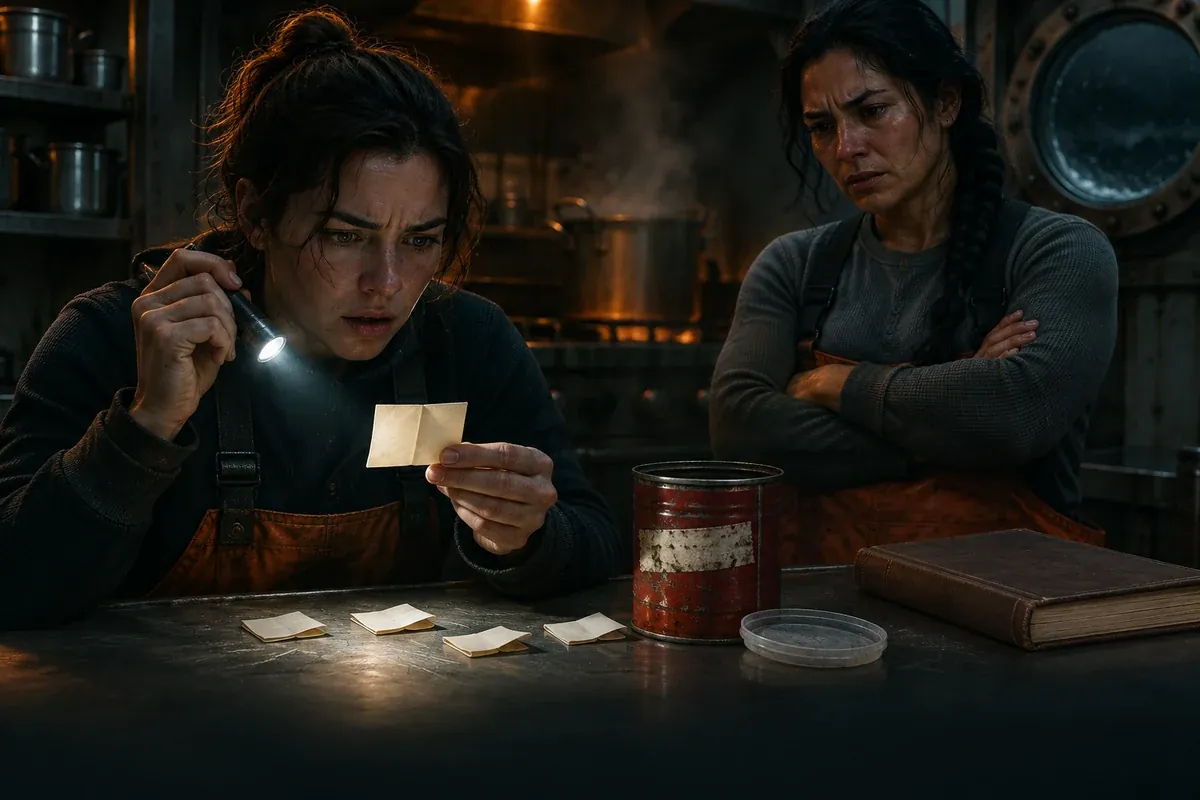
The tape comes off with a long ripping sound that seems to fill the galley. The lid comes off. Inside, there is a smell of old paper and coffee dust, and five folded slips of paper lie on the bottom, like a hand of very small cards.
I take them out one at a time.
The first is on lined paper, torn from a notebook. It is in Walt’s capitals. It says SAM.
The second is on a napkin. It is in a small, tight, careful hand, and it says Sam W. It is Luz’s.
The third is on the back of a receipt. It is a cramped, spidery scrawl. Sam.
The fourth is on a square of paper towel, in blue ballpoint, in a neat square cook’s hand, and I look at Teo’s writing for several seconds and think about a spoon going into a bowl.
Sam.
Four slips. Four hands. Four people at the table who have decided, before the boat has cleared the harbor, before the nineteen-year-old from Zanesville has had time to learn one of their names, that if the count falls, it falls on him.
He is the spare. I can see it, suddenly, with perfect clarity. A kid hired in December, for eighteen thousand dollars, because his mother has a bill. Not a deckhand. A ballot.
“I didn’t want it to be him,” says Luz.
“But you wrote it.”
“I wrote it.”
The fifth slip is lying in my palm, and I have not looked at it.
It is on older paper. That is the first thing I notice. It is thicker than the others, cream, a little yellowed at the edges, folded in three, as if it had been carried a long time in a wallet. I unfold it with two fingers.
The writing is in black felt-tip, in small square capitals. I know the writing. I would know it in the dark. It is the writing that signed my birthday cards, in the dull years when we had no money, and that put the dates on every receipt my brother ever kept, in a cardboard box that I still have under my bed in Anchorage.
It says, KOWALCZYK, D.
Under it, in the corner, small, there is a date.
I read it. I read it again. I put the penlight on it, and hold my hand steady, and I read it a third time, because my eyes have decided there has to be a mistake.
There is no mistake.
“Where did this come from?” I say.
“It was in the can,” says Luz. “It was in it when Teo opened it at the dock. It wasn’t there the night before. Nobody wrote it.” She has come into the room. She stands at the other side of the table, and the light from the stove catches the wet in her eyes. “I swear to God, Greenhorn. Nobody on this boat wrote that.”
“It’s Mac’s hand.”
“I know whose hand it is.”
“He’s dead.”
“I know.”
At the top of the slip, in the same black felt-tip, the date is written as my brother wrote every date, month first and the year in two digits, with a little slash.
It is February twenty-fourth, of last year. It is the day he died.
The ink is still wet.