

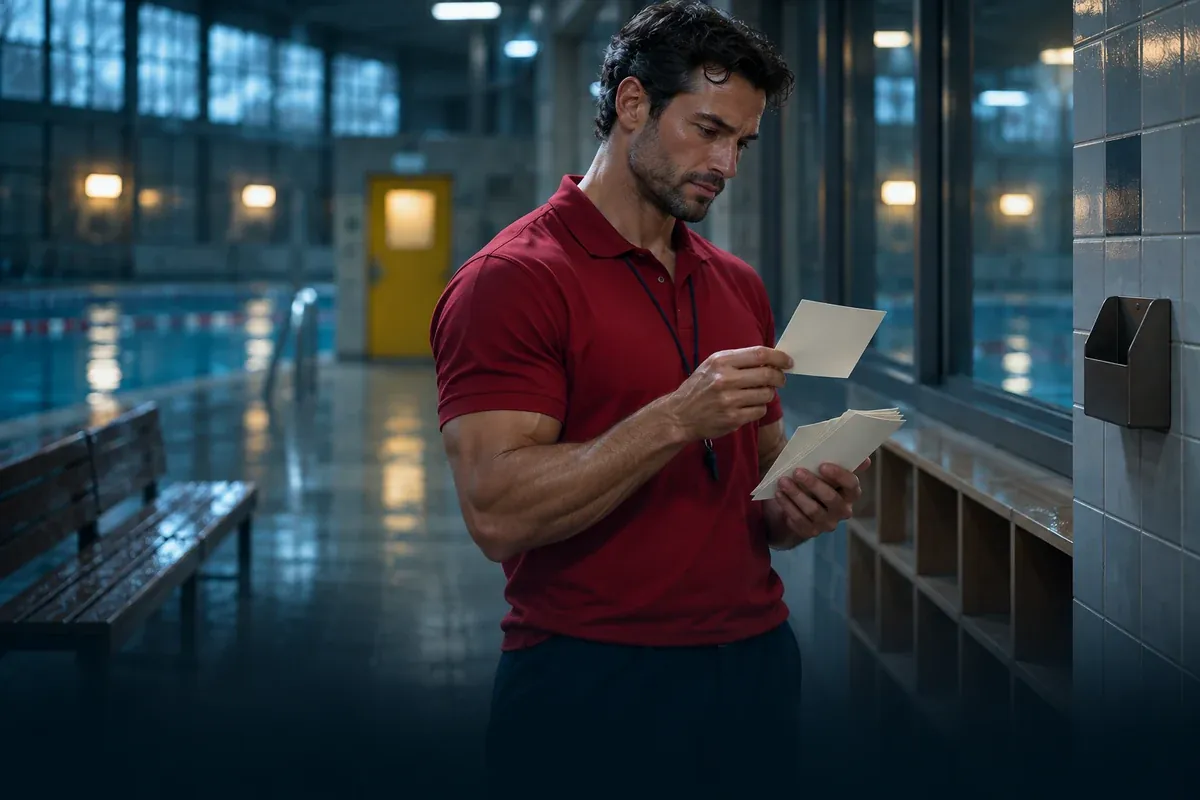
Miles had forgotten Tess’s handwriting, which felt like a betrayal more intimate than forgetting the date of their anniversary. He remembered the date. For years it had made buying milk on an otherwise ordinary Thursday unnecessarily complicated. But the small square letters on the note beside the clock surprised him.
OPEN PUBLIC DOOR AT 7:50. LEN TO CONFIRM.
Under it, Len had written YES in enormous capitals.
Miles carried the lesson equipment past the desk. Nia Boone, the other instructor, was eating crackers from a paper cup. “Your former wife looks like she might repair the entire city with tape.”
“She’s very good with tape.”
“You’re doing that face.”
“What face?”
“The one where a person wants credit for not saying more.”
Nia went to check her teaching area. Miles stayed in the staff room long enough to consider how badly he wanted to be the kind of man who had nothing difficult left to say.
At eight, the public door was open. Twenty-seven people came through it. Della arrived carrying her shoes in a cloth grocery bag because she did not trust the shelf. Nobody argued. Miles found a dry place near her lesson spot where she could see them.
“I know that sounds silly,” she said.
“They’re your shoes.”
“You don’t want the long version?”
“Only if you want to tell it.”
She looked at him, then lowered herself onto the top step. “I like that arrangement.”
His old coaching work had favored visible results. A hundredth of a second. A student making the next team. Adult beginners sometimes arrived with goals they had not said aloud to anyone. Progress might be a man taking his hand off a rail long enough to adjust his goggles. Miles had learned to pay attention without making an announcement every time someone was brave.
Tonight Della wanted to try putting her ears in. He described what they would practice and where he would stand. She chose the wall. When she shook her head after the first attempt, they stopped. The pool did not vanish because she had said no. The lesson continued with something else.
Through the observation window he saw Tess talking with a man in a delivery uniform. She was pointing at the printed schedule, listening. She had tucked her hair behind one ear, where it would stay for perhaps ten seconds. Miles turned back to his class before that became something he was waiting to see.
At nine, Len’s radio crackled. One of tomorrow’s desk staff had a child with a fever. The replacement list was short. Miles heard Tess say, “I can stay on the desk,” and felt the old reflex: accept the solution, admire her competence, go on with his own work.
He finished helping a student rinse her goggles before approaching the window. Tess and Len were still talking. “Do you want me in this conversation?” he asked.
Tess looked irritated. He could not tell whether it was at the question or at herself. “Give us a minute.”
He did. On the other side of the glass, her mouth moved. Len nodded, checked something on his phone, and went into the office. Tess came out a little later.
“Desk coverage isn’t in my contract,” she said.
“I know.”
“I almost said yes.”
“I heard.”
“It’s going to take Len a while to find somebody.”
“Probably.”
She leaned against the cool tile. “You’re being conspicuously unhelpful.”
“I have suggestions. But you didn’t ask for one.”
Her eyes narrowed. He had earned that suspicion. There were ways to make asking permission into a performance, and he knew he was capable of them. “That sounded smug,” he admitted. “Sorry. Are you all right?”
“I need to call my mother before she goes to bed. I need to send three invoices. And I need to stop volunteering for jobs because I’m afraid people will find out I’m not worth the fee.”
“The invoices first?”
She looked at him.
“That was a suggestion,” he said. “I lasted eight seconds.”
This time her laugh had an edge of relief. “You could take down the comment cards at closing. Len said I can leave at nine thirty. Actually leave.”
“I can do the cards.”
She walked away to make the call. He did not tell her she should have left earlier. She had made an actual request, and he had a job small enough to complete.
When she returned, she wore the careful face he remembered from hospital hallways. Her mother was well now, he knew from their brief meeting with June. Well did not necessarily mean easy. He waited until Tess spoke.
“Mom wants me Thursday. I usually have dinner with her.”
“You’re here Thursday.”
“Yes.”
He almost said he could handle the end-of-night forms. The sentence reached his tongue before he understood how neatly it would allow her to keep both obligations and get home at midnight. He swallowed it.
Tess said, “I’ll talk to her tomorrow.”
“You don’t have to explain it to me.”
“I know. I’m deciding whether I want to.”
He held still. Six years before, he would have filled that pause with reassurance until neither of them could hear what she was choosing.
“The night you left for the regional meet,” she said, “I told you I had Mom’s appointment handled. You believed me.”
“I chose to believe the useful part.”
Her mouth tightened. “That was the beginning of a terrible month.”
“It wasn’t the beginning.”
She looked up at him. He had never said that out loud. They had spent their mediation sessions discussing accounts, furniture, the lease. Their friends had understood a story about one disastrous trip. He had let them, because a single mistake was easier to regret than a daily habit.
“I liked being the person with the big opportunity,” he said. “I liked that you made it possible. When you were tired, I asked whether we were okay. I didn’t ask what I was asking you to do.”
“You did ask whether I wanted you to stay.”
“With my suitcase by the door.”
Water slapped the far end of the pool. Nia called a student’s name, laughing about something Miles could not hear. Tess put both hands in the pockets of her cardigan.
“I said yes anyway,” she said.
“Yes.” He could not make that word kind by making it vague. “You did.”
She nodded once, as if they had signed for a parcel neither of them wanted. Then she looked at the clock. “I have eleven minutes. I’m going to use them for invoices.”
At closing, Miles collected seven comment cards. One praised the temperature. One asked whether a person could attend without taking a lesson. Four described the late bus. The seventh was a mostly blank sheet with a single sentence in firm blue ink: I want to come, but I get off work at nine and the next bus gets here at ten twelve.
He put that card on top. The room’s benches were still damp. Della’s cloth bag was gone from its spot, her shoes safely inside. Twenty-seven admissions. Better than yesterday, still below thirty.
Miles took a photograph of the public schedule and sent it to Tess with the cards’ tally, keeping student details out. Then he typed, You left on time.
He deleted it. She did not need her former husband to award her a sticker for going home.
Instead he sent, Cards ready for you. Good night.