

At eight o’clock, Tess Calder stood outside a locked public swimming pool with twenty-three people, a box of questionnaires, and the man she had divorced six years ago.
Someone had taped a sign inside the glass. WELCOME TO LATE SWIM. Under it, in smaller letters, PLEASE USE MAIN ENTRANCE. They were at the main entrance.
Her ex-husband held up a pair of yellow foam floats. “I don’t think these will pick the lock.”
She remembered that voice in bed, in airports, at the kitchen table where they had worked out which of them would keep the car. She had prepared for every version except this one: Miles Ibarra, standing beside a hospital laundry worker who had exactly eighty-four minutes before her bus home.
Tess knocked again. Beyond the lobby, the pool lights burned a cheerful blue. This was the first paid contract she had landed in eleven weeks. In her bag, the printed schedule promised that the building would open at eight. The schedule had her name on it.
“I’m going around to the staff entrance,” she told the group. “Please stay here. If you decide to leave, I’d appreciate knowing why, but you don’t owe us an interview.”
“Locked,” said a woman in purple work pants. “That’s my interview.”
“Fair.” Tess wrote it on the cardboard box.
Miles stepped away from the wall. “Want company?”
She wanted him not to know how frightened she was about the invoice, or how familiar it felt to stand next to him while something that looked fine on paper went wrong. “Would you stay with them? Don’t promise how long.”
“Okay.”
He did not follow. It was a small thing. She noticed anyway.
The manager, Len Ward, answered the service door with a radio pressed to one ear. His evening desk attendant had called in sick. The replacement was waiting at the employee entrance on the opposite side. They had missed each other by a building’s width. Nobody had told Tess because nobody had imagined the public door would remain locked.
“First night,” Len said, sounding a hundred years old. “We’ll get better.”
“Can we get open first?”
He flinched, and she regretted the sharpness. Not the request.
By eight eleven, the door was open. Four people had left. The woman in purple work pants introduced herself as Della Ruiz and asked where to put her shoes. Tess found the shoe shelf, showed her the changing rooms, and kept herself from apologizing for the bus system, the chlorine smell, or the city of Bellweather in general.
At the desk, she recorded twenty-three arrivals and nineteen admissions. June Saye, the city analyst responsible for evaluating the trial, had specified both. The distinction had seemed fussy on Friday. Now it contained four entire evenings.
Miles crossed the lobby with his towel over one shoulder. His dark hair was shorter than it used to be. He had a little gray at the temples, an observation Tess resented herself for finding attractive. “Len needs to know whether your opening talk can be five minutes. People want the water.”
“It can be zero.”
His smile arrived before he could stop it. She knew that, too.
Three weeks earlier, when Len had mentioned the name of the cooperative supplying instructors, she had asked for its staff list. Then she had called him back and said, very clearly, “One of your instructors is my former husband.”
She had expected to lose the assignment. Instead, June had joined a call. Tess could coordinate schedules and collect feedback. She could not supervise Miles, assess his teaching, select his employer, or make decisions about its payment. June would conduct the evaluation. Len controlled operations. Everyone had agreed in writing before Tess signed.
That was the tidy version. It had not accounted for the way Miles still folded a towel in thirds.
Tess stayed on the dry side of the observation window. She could swim in the technical sense that she had once passed a childhood lesson. She did not like putting her face underwater. She especially did not like people who told her water was nothing to fear, as if the water had agreed.
Miles sat on the deck beside six adults, his feet in the pool. No whistle. No commanding demonstration. He asked what they wanted from the class. Della said she wanted to go to a lake with her grandchildren and stop inventing reasons to stay on the shore.
Another woman wanted to wash her hair without feeling foolish about the shower spray. A man said he had signed up because his wife had asked, and he wasn’t sure that counted.
“It counts for getting here,” Miles said. “You get to decide what happens next.”
Tess looked down at her questionnaire. She had written, What would make you attend again? It was a good question. It seemed indecently large.
At nine sixteen, Della came out with wet cuffs and dry hair. She had spent most of her lesson holding the side. She looked pleased until she saw the clock.
“Next bus is nine twenty-four,” she said. “How far to the stop?”
“Seven minutes if the crossing’s with you,” Tess said.
“Then I’m leaving.”
She went without filling out the form. Tess put a blank one in her bag instead of chasing her. Beyond the glass, Miles helped a student find his glasses. He did not put them on the student’s face. He held them where the man could take them.
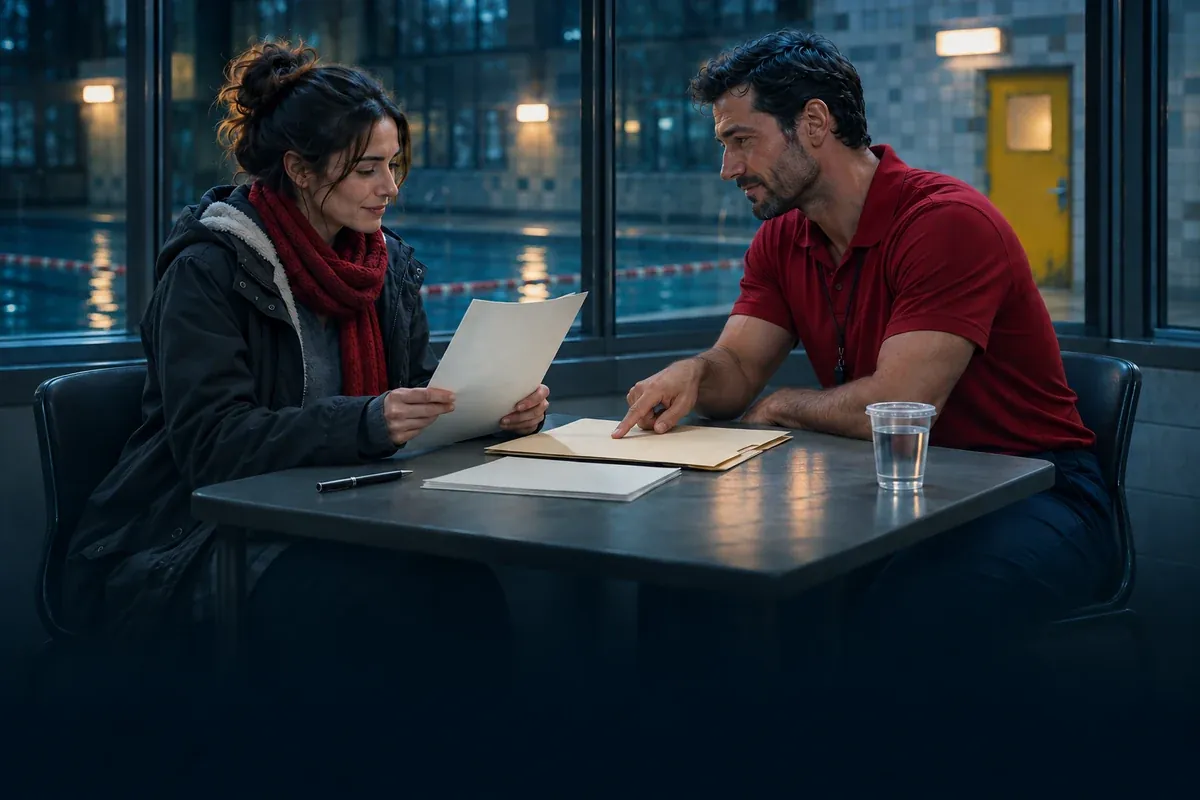
At ten fifteen, with the lifeguards finishing their checks and the public rooms empty, Tess sat at a lobby table. She drew two columns: things she could change tomorrow and things she could not. Opening the door belonged in the first. The night bus belonged in the second. She stared at that division until it began to feel like an excuse.
Miles set a sealed cup of water at the far corner of the table. “Would you like this?”
“Thanks.”
“You used to hate people hovering while you worked. I couldn’t remember if that included refreshments.”
“It included asking me twelve questions about whether I wanted refreshments.”
“Good. I’m at one.”
She laughed before remembering to be careful. The sound changed the room. Miles pulled out a chair but kept his hand on its back.
“May I?”
“Yes.”
He sat. For a moment they watched a moth batter itself against the lobby’s high window. They had once shared seven years of mornings. Now a quiet minute needed permission.
“I’m glad you got the contract,” he said.
“I haven’t managed to unlock a door yet.”
“You got it open.”
“Len did.”
“Then I’m glad Len got the door open.”
She turned the paper toward him. “Will you look at this as someone who works here? Not as someone who knows me.”
“I can try. I can’t promise I won’t know you.”
He studied the columns without touching her pen. Then he pointed to the bus. “We can’t change when it comes. Could we ask whether beginners want an earlier lesson?”
The trial counted visits between eight and ten. An earlier start would cost staff time they did not have. She explained that. He listened without converting the problem into a promise.
Tomorrow she would have to call June. Tonight she drew a line under the columns and wrote a third heading: ASK SOMEONE ELSE.
Miles read it, and his expression shifted. Neither of them mentioned the marriage.
“Twenty-three people came,” he said.
“Thirty was the benchmark.”
“I know.”
Tess closed the folder. Four people had walked away from a pool with its lights on. Tomorrow she would call them first.