

THE COURT: We’ll recess until one-fifteen. Members of the jury, you are not to discuss this case with anyone, including each other.
THE COURT: Mr. Fenner, you remain under oath.
MR. FENNER: Of course, Judge.
I make it as far as the second-floor restroom before my knees give out.
The tile is cold through my slacks. I sit on the floor of a stall with my machine strapped across my chest like a child I’m not allowed to put down, and I count. Counting is what I do instead of screaming. Four hundred and twelve words in that testimony about the slip. Sixty-one in the answer about the niece. Eleven of them were my name.
Not Nell’s. Mine.
Someone knocks lightly on the outer door. “Ms. Aldous? It’s Otis Hale, from the courtroom. Judge Lyle says you’ve got until a quarter after, and I’m to say there’s no hurry in it.”
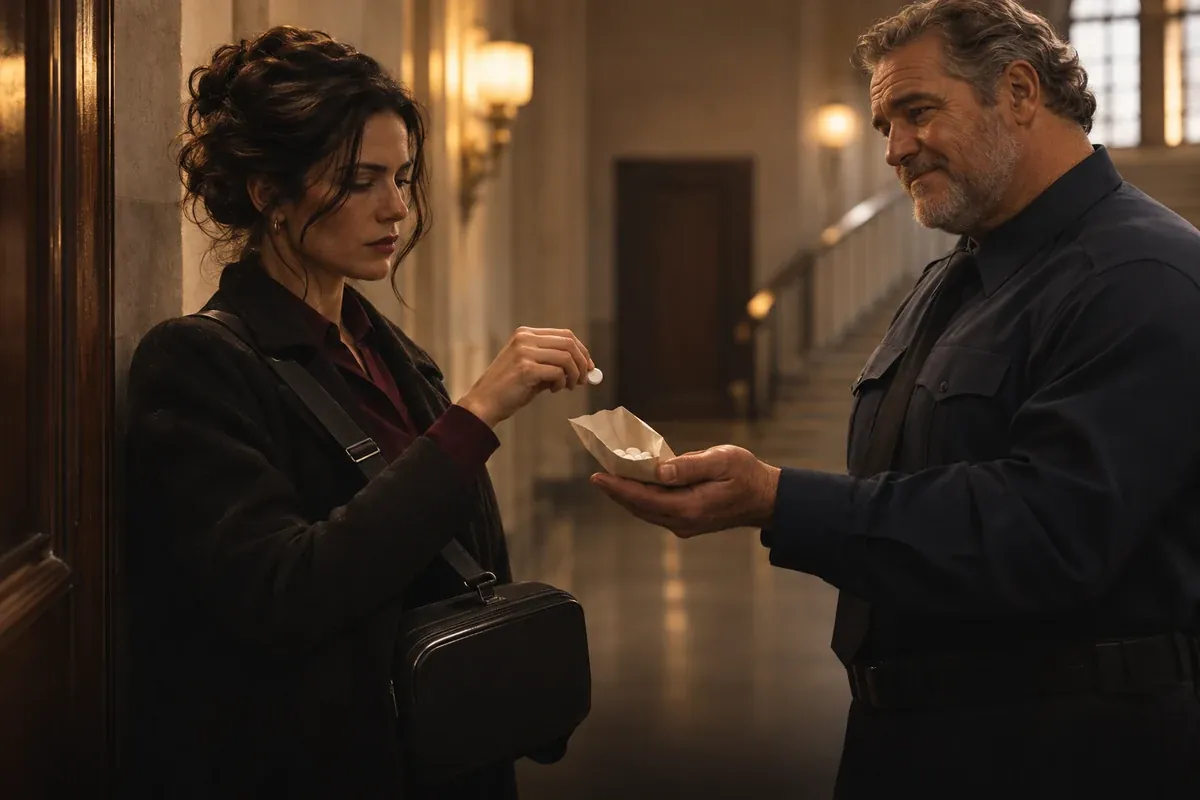
I wash my face and open the door. Deputy Hale is sixty, wide as a doorway, with the carefully soft voice of a man who has spent thirty years telling people their time is up. He holds out a paper sleeve of peppermints.
“First-day nerves,” he says. “Everybody gets them. Wanda cried in the stairwell her first week and now she’s got a plaque.”
“I’m fine.”
“Sure you are.” He doesn’t believe me, and he lets me see he doesn’t, and somehow it helps. “Take the stairs at the end of the hall. The elevator’s got a view of the lobby, and the lobby’s got a view of everybody.”
I look at him a second too long. He gives me a gentle nod, as if he’d said nothing at all.
I take the stairs.
At the landing I stop, because below me, through the wired glass of the door, I can see my uncle. He is standing with Cosmo Teague, his driver of eleven years, a tall tired man in a gray raincoat who used to carry my school bag up the dock steps. Ray is talking and Cosmo is not. Cosmo is looking at the courtroom doors.
Then he turns, and for half a second his face points up the stairwell.
I do not breathe. I stand with my back to the cinder block until he looks away.
My whole body wants to run. It is a very physical wanting, like thirst. But a reporter who leaves in the middle of a murder trial gets a letter from the agency, and then a call, and then someone pulls my certification file and finds out that Nell Aldous was buried in Tupelo, Mississippi, six months before I borrowed her name.
So I eat a peppermint on the landing, and at 1:10 I go back to work.
The afternoon belongs to Marguerite Doss.
She doesn’t hurry. That is the first thing I learn about her voice. She asks a question, waits for the answer to finish, waits a moment longer, and lets the silence do the part that most lawyers do with volume.
“Mr. Fenner, you told Mr. Roark you saw all this by the slip floodlight.”
“That’s right.”
“Plain as day.”
“As plain as you.”
“Was that light working that night?”
“It was.”
“Do you recall when it had last been serviced?”
“Couldn’t tell you.”
“Who handled maintenance requests at Fenner Stevedoring?”
My uncle’s pause is brief, but I have been trained to hear pauses the way a doctor hears a murmur. “My bookkeeper. My niece.”
“The one who ran.”
“Yes.”
“The one who was, you said, very thorough.”
“She was.”
“Thorough enough to file a work order on a broken light?”
“Objection,” Roark says, rising. “Speculation.”
“Sustained,” says Judge Lyle. “Ms. Doss, he’s told you he doesn’t know.”
“He has, Judge,” says Ms. Doss pleasantly. “That’s all I wanted.”
I write every word. Q, A, Q, A. My hands are steady. In my head, a very small, very cold voice has begun to ask a different question.
How does she know about the light?
I never told anyone. I put one work order in one tray, and it burned, or it was shredded, or Ray fed it to the harbor. Nobody outside the Number Nine office should know that light had been out since August.
Unless somebody found my paperwork. Unless somebody has been looking for the person who wrote it.
Doss turns, with a graceful little half-pivot, back toward her table. And Jude Marchand, who has been watching the jurors, the clock, and the witness in careful rotation all afternoon, turns his head and finds me.
This time he does not look away.
I hold his eyes for as long as it takes me to type, “Q. Thank you. Nothing further at this time.” Then I look at my screen.
At 4:40 the judge adjourns for the day. Ray is told he’ll return in the morning. Everyone stands, and the courtroom fills with the noise of fifty people trying to leave at once.
I am closing my machine when a man’s shadow falls across the rail.
“Ms. Aldous.”
Up close he is bigger than he looked from across the room. He has a salt-and-pepper shadow of beard coming in, and the kind of stillness I associate with deep water. The deputy is three paces behind him, bored, because the defendant is out on bond and has done everything right for five weeks.
“I’m sorry,” Jude says, evenly, as if we’re discussing the weather. “I lost my place. Which exhibit number is the harbor chart?”
“Counsel can tell you, Mr. Marchand.”
“Counsel is busy being clever.”
I almost smile. The reflex disgusts me. “State’s Exhibit Six,” I say. “It’s on the clerk’s list.”
“Thank you. Also for the read-back this morning. You do it very well.”
“It’s my job.”
“I know.” His eyes are gray-green and entirely without apology. “That’s what makes you so good at it.”
He walks away. The deputy follows him out.
I stand at the rail for a long time, my hand flat on my machine.
In the corridor, Ray is already gone. The lobby is a tide pool of people. I carry the machine to the street and sit on the bottom courthouse step, and that is when my phone, which is on silent and has been on silent since six forty, buzzes against my hip.
Unknown number. A text.
Nell Aldous died in Tupelo, Mississippi, six months before Ada Fenner left Port Sable. Brain aneurysm. Lovely cemetery, I’m told. The 6:10 ferry has a covered deck. You’ll want it. J.
I read it four times.
My business card is on every counsel table in Division C. I put it there myself at the nine o’clock break, the way every reporter does, so that lawyers can order a transcript. A defendant sitting beside his lawyer would have only to pick it up.
The rules for a situation like this are very clear. I know them by heart. I carry them like prayers. Any outside contact from a party goes to the judge, immediately, in writing. The judge will bring in counsel. There will be a hearing, and a note in my file, and within two days someone will ask a clerk to pull Nell’s paperwork, and a clerk will do it.
I could walk back up the steps right now. Deputy Hale is still inside. It would take me four minutes.
Instead I do arithmetic. It is 4:52. The ferry leaves at 6:10. Between now and then there are seventy-eight minutes in which I can still decide to be an honest woman.
I sit on the courthouse step and do not decide anything at all.
At 6:05 I am at the terminal, with a machine on my shoulder and a ticket in my hand. The covered deck is warm and empty and dry.
I walk past it, and I stand at the rail on the open deck, in the wind, where anyone who is looking for me will be able to see.