

Q. Please state your name for the record.
A. Raymond Fenner.
Q. And how do you spell Fenner?
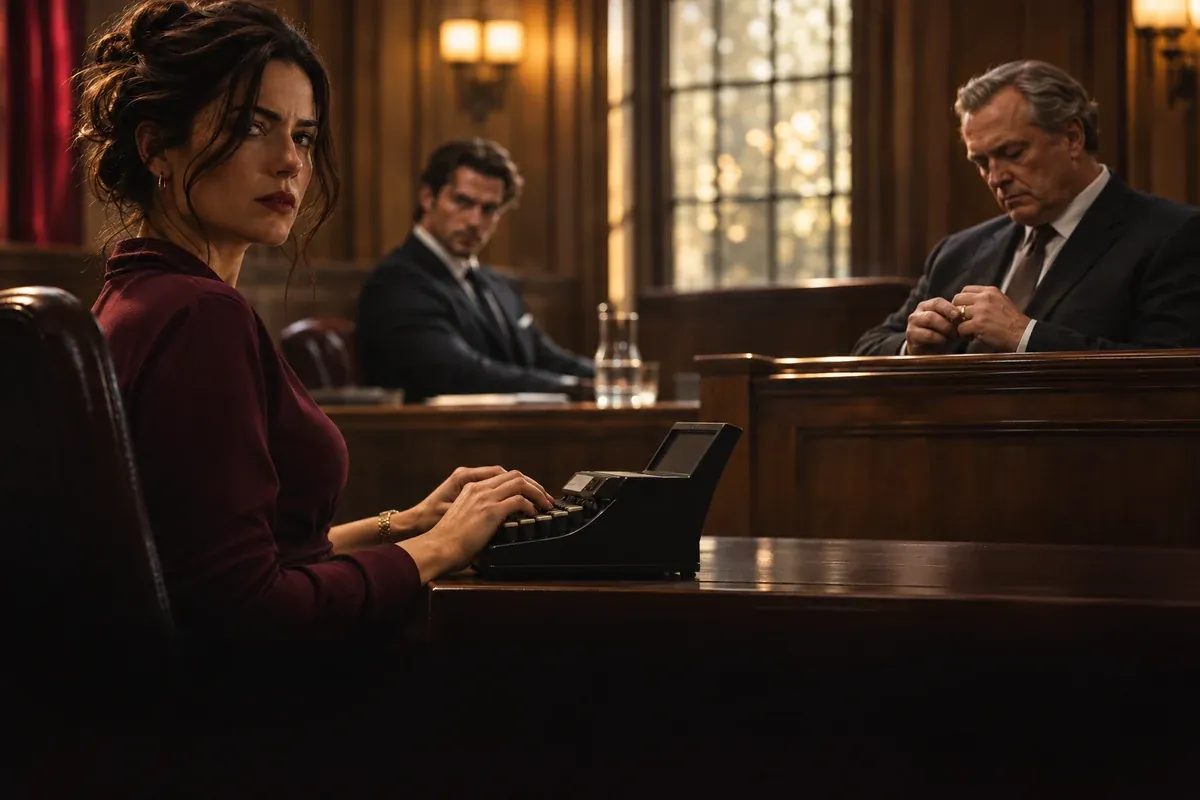
I take down my uncle’s name at 9:14 on a Monday morning, in the third week of State v. Marchand, and my hands do not stop. That is the only thing I am good at. Whatever happens in a courtroom, my fingers keep moving, and the machine keeps counting, and nobody ever has to know what it cost.
Three hours ago I did not know his name would be in this room.
The call came at 6:40, while I was standing in a rented kitchen in Birch Landing eating cereal out of the box. Dee Ocampo ran Penmark Reporting out of a strip mall and a very loud voice. “Sugar, Wanda Pell broke her wrist on her own porch step. Division C, Judge Lyle, murder trial, daily copy. You’re the only one I’ve got who can write realtime and doesn’t complain.”
“What murder?”
“Boats. A dead commissioner. Don’t worry about it, it’s all in the binder.” She hung up before I could ask which commissioner.
I should have asked. But for five years I have not read the news from Port Sable, and I did not read the binder either. I carried my machine across the bay on the 7:30 ferry, climbed the courthouse steps with my laminated certification around my neck, and sat in the court reporter’s chair with my back to the wall and my face to everyone.
NELL ALDOUS, CSR, says the card. That is not my name. It fits me better than my own ever did.
Judge Hortense Lyle looked down from the bench over reading glasses. She had a face like a closed ledger. “Ms. Aldous, welcome. Wanda is a hard act to follow. Please keep your fingers faster than our witnesses.”
“Yes, Your Honor.”
That was the only complete sentence I had planned to say all day.
I read the room the way I always do, in a sweep, to learn where the voices will come from. Twelve jurors and two alternates. A prosecutor with a good haircut and a legal pad he didn’t need. A woman at the defense table in a gray suit, with reading glasses pushed up into silver-black hair.
And beside her, the defendant.
Defendants do not look at the reporter. We are furniture to them, a clacking noise at the edge of their fear. But the man in the navy suit looked straight at me when I sat, held it for one beat, and looked away as if he had checked a clock.
He was tall, with a boat-yard tan that had not faded under three weeks of fluorescent light. A scar through his left eyebrow. He kept his hands flat on the table the way people do when they have decided not to be the one who moves first.
Then the bailiff said, “The State calls Raymond Fenner,” and the door in the back of the room opened.
I did not look up. I did not have to. I know that walk. Heavy, unhurried, a little pigeon-toed from a dock injury he used to tell strangers was a war wound. I know the click of the heel he reinforced himself with a bit of rubber.
My uncle took the oath with his left hand flat on a Bible he has never owned.
“State your name for the record.”
“Raymond Fenner.”
Four strokes. I wrote them clean. My pulse was a hammer in the soft part of my throat, and I let it hammer.
Anselm Roark, the prosecutor, walked him through the easy part. Owner of Fenner Stevedoring, thirty-one years on the Port Sable waterfront. Known the harbor commissioner, Walter Prejean, for twenty. Knew the defendant, Jude Marchand, to nod to at the hall.
“Mr. Fenner, where were you on the night of October fourteenth, five years ago?”
“At the Number Nine slip. My offices overlook it.”
“And what did you see?”
“I saw Mr. Marchand and Walter Prejean at the water’s edge, at about twenty minutes to ten.” My uncle’s voice is warm. People trust it before they know why. “They were arguing. Jude Marchand shoved Walter against the open door of a sedan. Then he shut Walter in. I saw it by the slip floodlight, plain as I see you.”
The slip floodlight had been dead since August.
I know because I filed the work order, in my own hand, on Fenner Stevedoring letterhead, and watched it sit in a tray for two months.
My fingers did not stop. Q. A. Q. A. The stenotype does not care what is true. It cares what is said.
“Mr. Fenner, you’ve told us the commissioner’s records were in your offices. Who kept them?”
“My niece,” said Ray. “She kept the books for me. Ada. Ada Fenner.”
There it was, in the air of a public room, in front of strangers. I wrote it without looking down.
“And where is she now?”
“I wish I knew.” He sighed like a man shaking a head over a pet that wandered off. “She stole from me, Mr. Roark, and she ran. A week after poor Walter went missing. My brother’s girl. I raised her myself, and I can’t tell you what that did to this family.”
I had gone cold from the hands inward.
Across the room the defendant had stopped looking at the witness. He was looking at my mouth.
“Your Honor,” said the woman in the gray suit, rising without hurry. “Marguerite Doss for the defense. I’m sorry to interrupt a very moving answer. I’d like the reporter to read it back, please. The whole thing, from the question. I want the jury to hear precisely what the witness said.”
Judge Lyle took off her glasses. “Is that an objection, Ms. Doss?”
“A request, Judge. I’m told the new reporter has a lovely voice.”
A few of the jurors smiled. I did not.
Nobody has ever asked me for a lovely voice. I do not use it. In ten thousand hours of testimony I have never said a word that was not already someone else’s, and that is the point. A reporter has no opinions. A reporter has no past.
“Ms. Aldous,” said the judge. “If you would.”
I scrolled back. There they were, the steno strokes I had written five seconds earlier, translated for me neatly on the screen. My name. My real name, in my own record, in my own hand.
I opened my mouth.
“Question,” I said. My voice came out level, and I was so proud of it I could have wept. “Mr. Fenner, you’ve told us the commissioner’s records were in your offices. Who kept them?”
The jurors leaned in a quarter inch. They always do.
“Answer. My niece. She kept the books for me. Ada. Ada Fenner.”
A page turned somewhere behind me.
“Question. And where is she now?”
“Answer.” I did not look at the witness stand. I looked at the screen. “I wish I knew. She stole from me, Mr. Roark, and she ran. A week after poor Walter went missing. My brother’s girl. I raised her myself, and I can’t tell you what that did to this family.”
I stopped. The room had gone quiet in the way a room does when it has heard something and hasn’t decided what.
“Thank you, Ms. Aldous,” said Ms. Doss. She sounded satisfied, like someone who had finally heard a note she’d been waiting for.
Then I made the mistake I have spent five years training myself not to make. I looked up.
My uncle was looking at the reporter’s chair.
Not at me, exactly. At the chair, at the rim of the machine, at the laminated card on my chest. His face did not change. He was smiling at the prosecutor, and then he was not smiling at anything. For four full seconds, Raymond Fenner studied the place where his niece’s voice had just been.
Then he looked down at his own hands, and began, very slowly, to turn his wedding ring.
In thirty-two years, I have never seen my uncle look at his hands.