

By eleven that night I have taken in the waist of a bridesmaid’s dress, replaced a zipper in a christening gown, and hemmed three pairs of church trousers, and I have thought about a slice of lemon roughly once a minute for seventeen hours.
Mags would not tell me anything. I asked her four ways across the booth table, and each time she said the same thing in a slightly different voice. Eat your eggs, hon.
The eggs came, two over easy, rye dry, and next to the plate sat a lemon wedge on a saucer, a plain yellow wedge with a seed in it. I did not touch it. She took it away without a word and I watched her carry it to the kitchen as if it were a cup of something hot. When I asked a fifth time, she said handwriting could be copied by anyone with a pencil and a grudge, and then she turned the sign in the window to CLOSED, in the middle of the breakfast rush, for the first time in twenty years.
I kept the ticket. It is folded in the pocket of my apron, against my hip, like a hand.
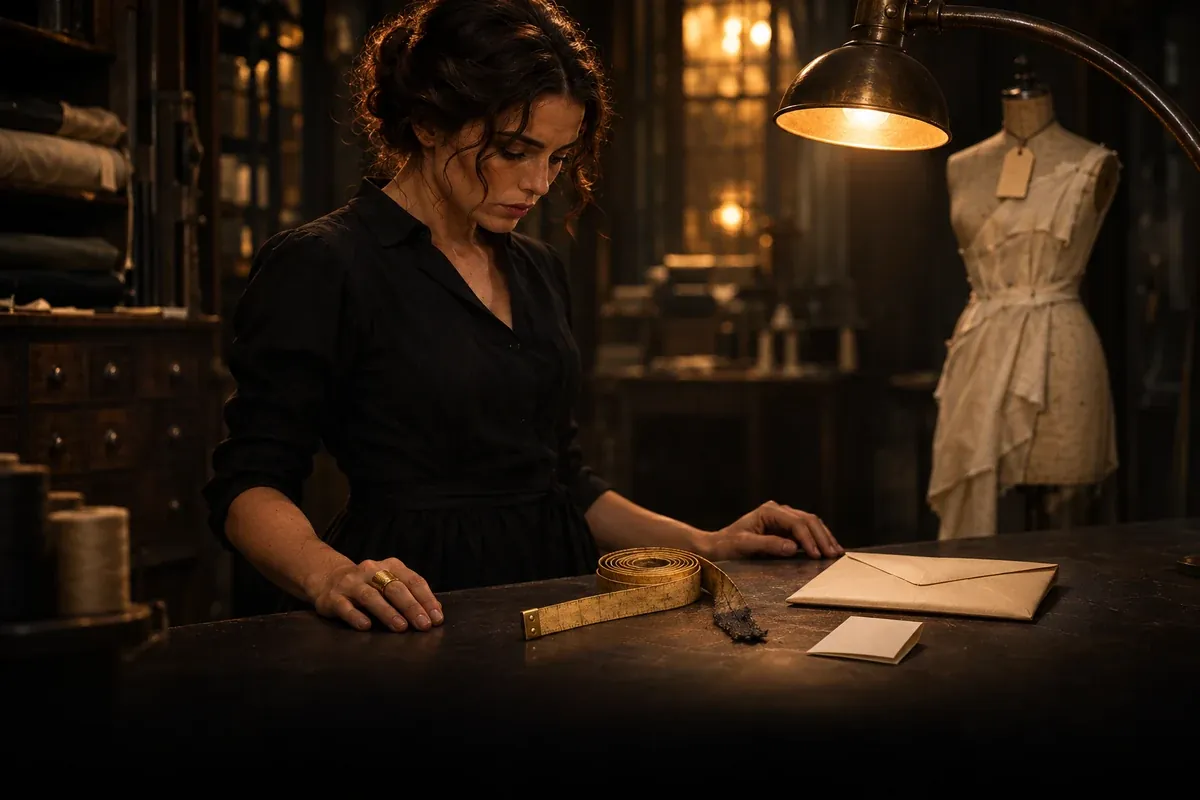
The back room of the shop is where I do what I cannot do in front of anyone. There is the cutting table with its secret shelf, the steam press that coughs, two Singers from the year my mother was born, a rack of garment bags, a stove that smells of scorched wool.
And there is Mabel. She stands in the corner under a cone of lamplight, a dress form on a cast-iron stand, taller than I am and narrower than I am and sloped a little to the left in the shoulder, as if she is listening for something. My mother built her out of plaster and horsehair and a lot of private opinion. A cardboard tag hangs from a string around her neck, written in a clerk’s square hand: bust, waist, hip, nape to waist, arm.
Every March a new tag comes in an envelope from the Registry along with my licence, and every March I swap it for the old one, and that is how every treaty gown in Port Halvard gets cut: to Mabel’s tag. She is the Line’s standard bride. I have been tucking muslin around that woman for twelve years and I know the back of her neck better than my own.
I am pinning a dart into her tonight, not for a customer, just to be doing it, when somebody knocks on the back door.
Not the street door. The back, the one that opens on the air shaft. Two knocks, a pause, a third.
I do not own a gun. I own a pair of dressmaker’s shears eleven inches long, and I am holding them when I open the door.
“Miss Quarrie.” The man on the step is holding his left arm against his ribs with his right hand. “May I come in?”
It is Rafe Dunmore. I have known his shoulders for three years. In the light of the air shaft they are the wrong shape. The left one has dropped a half inch and the dark wool of his jacket is darker there, shiny, heavy-looking, soaked through to the sleeve. There is a hole in the cloth across the top of the sleeve, with a burn ring around it, and the cuff beneath hangs from one thread.
“You’re bleeding on my step,” I say.
“I’ll stop as soon as I’m invited in.”
“Come in.” I step back. “Don’t touch anything. Sit on the stool.”
He is a tall man and the shop is not built for one. He ducks under the pipe by the door out of habit and sits on the fitting stool in the lamplight with his legs folded like a heron’s. He is thirty-four. He has the kind of dark hair that falls in his eyes when he forgets about it, a long straight nose, and a mouth that always looks like it is about to say something and has decided to charge for it.
He is not handsome in the way a magazine means. He is handsome in the way a good coat is: you notice the work.
His face is gray. He is wearing, I see, the gray wool jacket. It is the oldest suit in his closet and the only one I have never been allowed to alter.
“Take it off,” I say.
“I’d prefer to keep it on.”
“It’s stuck to the wound. I need to soak it loose.”
“Then soak it.”
So I do. I fetch the kettle off the stove and a bowl and a roll of clean muslin, and a bottle of rubbing alcohol from under the sink, and a curved needle from the case that was my mother’s. I put a folded towel over the arm of the stool. I do not look at his face. In a fitting room you never look at the face. You look at the shoulder, and the shoulder tells you the truth.
“Hospital?” I ask, to the shoulder.
“No.”
“It went through. The bullet.” I peel the sodden wool back. The sleeve has taken most of it, which is probably why he is still talking. The wound is a long furrow across the meat of the shoulder, deep at one end, shallow at the other, ugly and not fatal. “You’re lucky.”
“I’m told it’s a family trait.” His voice is quite steady, which is itself a sign. “A Dunmore man is shot at a little, in the way a sailor is rained on.”
“Hold this.”
I put the folded towel in his right hand and press it against the wound with mine. He sucks in air through his teeth, once. I count pins under my breath, three, four, five, six, and then because my hands are busy and my mouth is not, I say, “Someone shot you tonight, in my city, in a coat I’ve pressed forty times, and you came to a dressmaker.”
“I came to a dressmaker because the doctor’s at the Salt Market delivering a baby.” He breathes. “And because the coat’s yours.”
“It isn’t mine. It’s the only one I’m not allowed to touch.”
He does not answer that. His eyes are on the window, where there is nothing but the black air shaft and a drainpipe and the lit yellow window of the laundry across the way. The way people look when they are saying something to a window.
The water in the bowl goes pink. I rinse the wound with alcohol while he says nothing, and I pad it with muslin and bind it with a strip torn off the roll and fasten it with a safety pin, because that is the sort of surgery a seamstress can do.
I tell him he needs a real stitch and that I know a woman on Brine Street who will do it for cash and no questions, and he says the doctor will come when he can. Then I sit back on my heels, and there are no more pins to count, and the room is very quiet.
He has taken a thick envelope from the inside of his waistcoat and laid it on my cutting table. It has a cashier’s stamp. It is as fat as a sandwich.
“What’s that?”
“The shop’s note.” He says it to the window. “The Line’s loan, from the winter your mother died. The Counting House called it in last month with interest. It is paid. In full.”
I stare at the envelope. I know that note. I have paid on it in installments for twelve years, every first of the month, one hundred and sixty-two dollars in an oilcloth pouch to Pruitt, and I have never once come to the bottom of it. The note has been a fact of my life like the tide table. It has an expiry date of never.
“I didn’t ask you to do that.”
“No.”
“I don’t take money from a man who bleeds on my stool and expects me not to ask why.”
“Noted,” says Rafe Dunmore.
It is the way he says it that makes me look up. All of his contractions have gone out of his voice. It is flat, and neat, and cold, like a measuring tape pulled to its full length. For the first time since he came through the door he looks straight at me, and his eyes are the gray of the wool he is wearing, and I find that I have been wrong about his face. It is not a face that charges. It is a face that is tired of paying.
“Take the money, Miss Quarrie,” he says. “You will need the room.”
“For what?”
He glances at the jacket lying in a heap beside his feet. “Turn it over, please.”
It takes me a moment to understand that this is a request about the coat. I pick it up. It is heavy, and the lining is wet and stiff with blood along the left side, and I turn it inside out on my knees the way I would turn out a pocket, and I see the lining.
It is black silk. Good, old, slightly rusted from sweat. And over the left breast, an inch above where the heart would be, there is a short row of chain stitch in a thread the color of ink, four inches long, with a tiny bar tack at the end that anyone else would take for a mend.
It is not a mend. I know that stitch. I would know it in the dark by touch. It is a chain with a dropped link every ninth loop, a flaw you would never notice unless you were taught to look for it, because the flaw is the signature. I have the same flaw at the head of every row in my fitting book. I have always thought it was my own bad habit.
I turn the lining toward the lamp. The thread has gone soft and dull with age. It has been sitting there a long time.
“My mother made this,” I say.
“She fitted me for it twelve winters ago. I was twenty-two.” He is looking at the jacket and not at me, and I realize he is saying it carefully, the way you put weight on an ankle. “My father had been dead a month. I had been made Conductor in a room full of men who were waiting for me to fail. She took my measure in this shop. She did not say very much. When she was done she gave me this and said to keep it until it was needed.”
“And what’s it for?”
“I do not know.” His mouth moves. “It is the only thing in the Line that has never lied to me.”
I run my thumb along the chain. It goes down under my thumb like a row of small, patient teeth. The end of the chain is bar-tacked flat, the way my mother tied off the ones she wanted to be pulled someday. A chain stitch unravels in a single draw if you know the end. Ruth used it for anything she meant to undo.
“Don’t pull it,” says Rafe.
“I wasn’t going to.”
“You were considering it. You have the same hands.” He does not smile. “Not yet. When she says so.”
I look up. It is a pronoun I do not like. “When who says so?”
“Whoever my tailor decides it is time.” He does not look away. “I wore it tonight because I thought I might need it. I was wrong about what for.”
I put the jacket in my lap and sit very still, and then I take the ticket out of my apron pocket and flatten it on the cutting table in the lamplight, between the cashier’s envelope and the bowl of pink water. Two over easy. A slice of lemon, for Ruth.
He reads it from where he sits. He does not touch it. I watch a muscle jump in his jaw.
“Pruitt sent it to my desk this morning,” he says. “It came to the Registry in the night, in a sealed envelope, with the Line’s breakfast seal on it. No one saw who left it. I could not decide whether it was a letter or a threat.” A short breath. “So I sent it to you, with a courtesy, so you could decide.”
“That was kind of you.”
“It was not. It was a coward’s kindness.” He says it plainly. “I did not want to be the man who handed you that and watched your face.”
I think about that. “Did you write it?”
“No.”
“Do you know who did?”
“No.”
He says it so fast and so level that it is almost, and only almost, the truth. I have spent twelve years reading where a bride’s fabric pulls. A man who is lying holds his shoulders as if the lie were a coat that did not fit, and Rafe is holding his as if it fit him perfectly, which tells me that he knows more than he is going to say and has been practicing the rest.
“I am going to ask you something,” I say, “and you’re going to hold still, because I’m going to be pinning your arm in a minute and I’d like to keep the sleeve.”
“I will hold still.”
“What is Ruth Quarrie to you?”
The lamp ticks. Across the air shaft the laundry light goes out.
“She was the best fitter the Line ever had,” he says. “She was the only person who ever told me the truth about how I looked in a room.” He folds his good hand over the bad one, as if to keep it from shaking. “And she did not die of pneumonia, Miss Quarrie. That is not a thing I know. That is a thing I have never been able to stop thinking.”
I have been waiting twelve years for somebody to say it to me, and now somebody has, and I find I do not know what to do with my face.
So I get up, and I take a fresh strip of muslin to the sink, and I wash my hands twice. When I come back he has put his jacket over his knee and is sitting with his head down, the dark hair fallen across his eyes, looking, for a moment, exactly his age.
“Why did you come here tonight?” I ask. “There are a dozen tailors in the Line who would have stitched that sleeve for free.”
“Because in nine days there will be a wedding at Lantern Street,” he says, “and you are going to make the gown.”
I do not say anything.
“Lenz to Brakhage,” he says. “Cora Lenz and Anton, on the Equinox tide. The Timetable has been trying to make that treaty for two years. If it is signed, the Bell Platform and the Salt Market go under one hand, the pumps go with it, and the Line will have one master for the first time in twenty years.” His voice is level again, but the contractions are still gone. “If it is not signed, there is a war. A quiet one, at first. Tonight’s was the first shot of it.”
“I do alterations, Mr. Dunmore. Hems. Take-ins. I don’t make a gown from a bolt of silk in nine days for the biggest wedding of the decade.”
“The gown has been commissioned.”
“By whom?”
“By the groom.” He lets that sit. “Anton Brakhage has asked for you by name. Not Quarrie and Daughter. Not the Sumner Street seamstress. He asked for Ruth Quarrie.”
The room does something strange. The lamp goes too bright and the edges of everything go too sharp. I put my hand flat on the cutting table, and the thimble taps the wood.
“My mother’s dead,” I say.
“I know.”
“So he’s a liar, or a fool, or he knows something I don’t.”
“Or all three,” says Rafe. “Anton Brakhage has been all three on different days.” He stands, slowly, and the movement costs him; I see the wound open under the bandage and a bloom of red come up through the muslin, and I am already moving toward him with the safety pins before I remember I was angry.
“You will say yes. You have no choice. If you refuse, you refuse a Timetable commission, and then you are a woman who has made an enemy of five families and has a shop on Sumner Street that burns easily. I would rather you said yes and let me keep an eye on it.”
“That’s not a choice.”
“No.” He looks, for the first time, sorry. “It is an arrangement.”
I pin the cuff back to the sleeve while he stands, the way a person pins a hem on a customer who will not hold still. I am so close that I can smell the salt in his collar and the iron of his blood and, under it, wool and clean laundry and cedar, and I do not look up. When I am finished, I step away. He puts the ruined jacket over his good shoulder and takes the envelope off my cutting table, and then, instead of leaving it, he sets it back down on the wood and squares it to the edge.
“I will send a car at nine tomorrow,” he says. “Cora Lenz will come for her first fitting in two days. Her family will want the shop swept.”
“Mr. Dunmore.”
“Yes?”
“Is it true? That you wore my mother’s stitch for twelve years and nothing happened?”
His hand is on the door. He turns, and I see him choose his words the way I choose a needle. “Something happened every day,” he says. “I simply did not know it was her.”
He reaches into the pocket of his trousers and takes out something that gleams dull yellow in the lamp: a tailor’s measuring tape, rolled tight. Not mine. Mine is white and modern and marked in inches and centimeters. This one is old, the old stiff yellow kind, cracked at the folds, with a brass tip at one end and the other end burned black as if it had been held in a flame.
I know it before he sets it down. It hung around my mother’s neck every day I was alive. It was not on her when they told me she was gone. Nobody gave me her coat, or her glasses, or her shoes. Nobody gave me her tape.
He lays it across the cutting table, beside the envelope and the ticket.
“Mabel will tell you the rest,” says Rafe Dunmore. “Measure her yourself this time.”
Then he ducks under the pipe and goes out into the air shaft, and the door closes behind him on its own, and I stand there in the lamplight with my mother’s tape on the table and the whole back room listening, and a dress form in the corner with a cardboard tag around her neck that has said the same thing to me for twelve years, and that I have never once checked.