

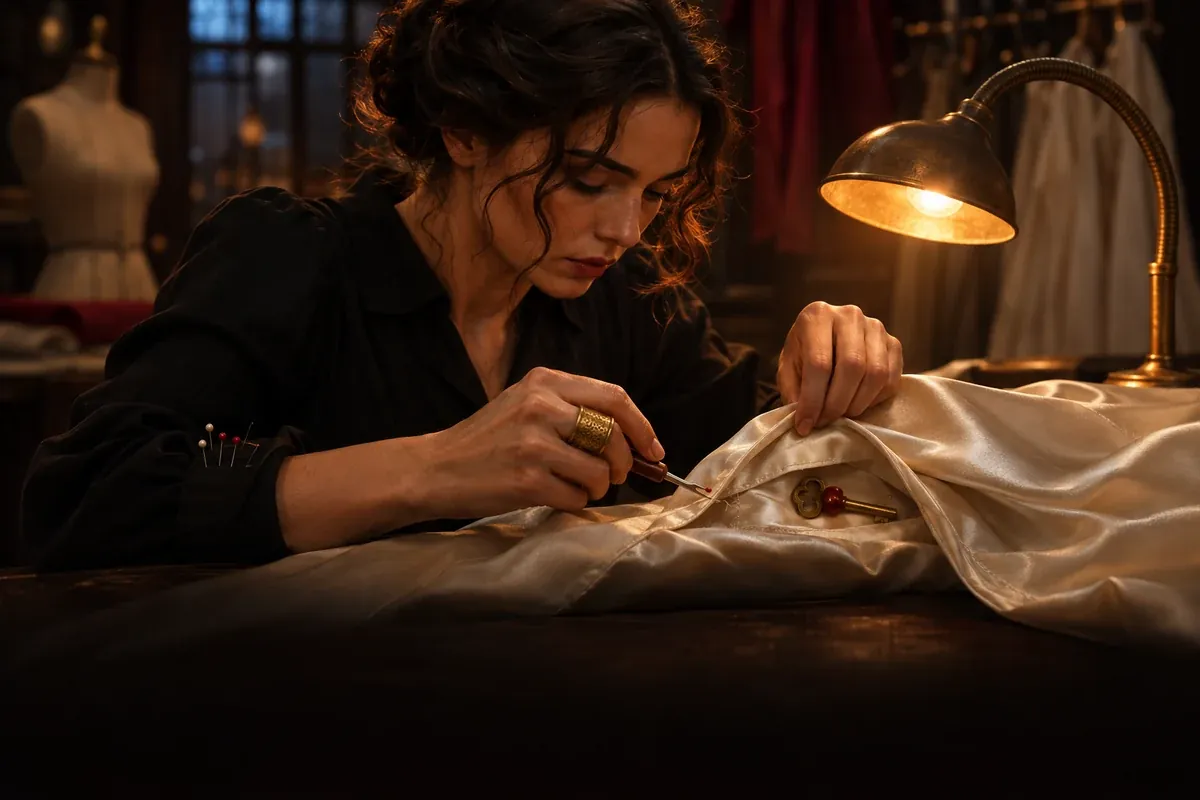
The hem of Delia Sable’s wedding gown is lying to me. There is something stiff inside it, flat as a playing card and about the length of my thumb, and the work order pinned to the bodice says the lining is empty.
I stop the needle and lay two fingers on the silk. It is 4:50 in the morning on Sumner Street, the shop is cold, and the only light is the gooseneck lamp clamped to my cutting table. Under my fingertips the wax-sealed edge of the thing is unmistakable. Somebody sewed a secret into this skirt, and somebody else wrote “none” on the order and counted on me to be the kind of seamstress who believes what she reads.
I have felt a hundred and forty-one of these in twelve years. I have written down every one of them in a book nobody knows exists, and that book is the only object in Port Halvard that could get me drowned.
Count it out, Nell. Three pins, four, five.
I take the pins from my cuff and put them between my teeth, which is how I stop myself from saying anything out loud. Then I turn the hem toward the lamp and work the blade of my seam ripper under the tape, one stitch at a time. The work is quiet. I am good at quiet. My mother used to say you can tell a fitter’s age by how loud her scissors are, and by that measure I am about ninety.
The pocket opens like a mouth. Inside it is a key, brass, flat, no longer than my thumb, with a ward cut like a row of tiny teeth and a bead of red wax over the bow. Not a house key. Nobody in this city locks a house with something that small. It is the kind of key that belongs to a box, and the box is the kind that sits on a shelf in a place where I will never be invited to look.
“A hundred and forty-two,” I whisper, around the pins.
I do not take it. That is the first rule and the only one I have never broken: a seamstress who touches the payload is a thief, and a thief is the first one in the water. I only look. I look the way I look at a bride’s shoulders, long enough to know where the fabric pulls, and then I press the tape back over the pocket and close it with a ladder stitch that would pass a customs inspector.
The wax gives a faint, waxy click against my thimble. The thimble is brass and dented, my mother’s, and it sits on my right middle finger where it has sat since I was seventeen.
Then I go to the cutting table and kneel.
The fitting book lives in the underside of the table’s bottom shelf, wrapped in a bolt of unbleached muslin that looks, to anyone who bothers to look, like stock I have been too lazy to sell. It is a record in stitch-code, my mother’s code, which I learned before I learned to read. A row of tiny knots is a date. A twist is a bride. A French knot is a thing that rattles, a straight line is a thing that folds.
I find the next bare inch of cloth and sew one entry: today, Delia, a key, brass, flat, red wax. I start the way Ruth taught me to start every entry, with a single dropped stitch, a hole in the row you could miss if you did not know to look. It is a habit so old I have never asked where it comes from.
I do not know what the key opens. I know exactly what it is. In this line of work those are different crimes.
My mother taught me that a seamstress who does not know what she carries is a courier, and a courier is the first one the water takes. She said it while threading a needle, the way other mothers say to wear a coat. The book is how I stay a seamstress. If I ever need to bargain for my life, it will be with a list of everything that has moved through the Line since I was seventeen, and that list is a thing a person kills for.
So I count the pins back into my cuff, wrap the muslin, and shove the shelf closed with my knee.
The care label is the last thing I check. Every week, one garment carries the week’s order, stitched in chain stitch in blue thread on the inside of the label, and it is whatever garment comes through my door first on Monday morning. This week it was Delia’s gown.
The words run along the label in a hand that is mine, because I stitch them myself from a slip Mags Pell slides under the shop door every Sunday night. The slip burns in the sink by midnight. The label stays with the gown. The rule is the same for the order as for the payload: I do not forget it, and I do not say it anywhere but at the right door.
Two over easy, rye dry, coffee from the old pot, and a glass of tap water, no ice.
I know it so well I could recite it in my sleep, which is the whole trouble. A person who is tired can say the right thing in the wrong order. At Pell’s Diner, the wrong order is just a very strange breakfast. At the freezer, it is the end of the evening.
“Boss.”
I jump hard enough to drive a pin into my lip. Tam Idowu is in the back doorway with a garment bag over one arm and a paper bag of sugar rolls in the other hand. He is nineteen, six feet of elbows and good intentions, and he has a tide diver’s habit of arriving without any sound, like the water does.
“You’re early,” I say.
“You’re always early, so I’m early on top of early.” He holds up the sugar rolls. “Ife’s dialysis moved to five a.m., so I’m up anyway. Is that Sable’s? Want me to run it down?”
“No.”
It comes out too quick. He tilts his head. I have a policy about apprentices and the Line, which is that I do not have apprentices in the Line. Tam is paid to carry dresses to the shop door and not one step farther. He is also the best swimmer in Port Halvard, and I have more than once been tempted to use him, and each time I have remembered my mother, and each time I have said no.
“Door doesn’t like company,” I say, gentler. “You know that.”
“The door doesn’t like anybody.” He puts the bag on the rack, and the white shoulder of the gown slides out of the plastic. His eyes drop to the care label, quick as a bird. “Blue thread this week. Nice.”
I take the garment out of his hands and fold the label under. “Go home. Eat something that isn’t sugar. Tell Ife she can have my afternoon appointment if she needs a quiet chair.”
“I already ate,” he says, and whistles two low notes, the way he does, and I think nothing of it. I would like that on the record, later. I think nothing of it at all.
He goes. I zip the gown into the bag, shrug into my black work coat, and climb the five steps to Sumner Street with Delia Sable’s wedding on my arm.
Pell’s Diner is three shopfronts east of mine, and at ten past six it is the only lit window on the block. The sign has said OPEN for twenty years. I have never once seen the door unlocked at night. I have never once seen it locked in the morning.
Inside it smells of bacon fat, bleach and old coffee, and the three regulars at the counter do not look up. A truck driver who has been eating the same short stack since I was in high school. A woman in a nurse’s coat reading a paperback so old its cover has gone soft. A man who is asleep with his chin on his chest and is paid to be. Behind the pass-through, Mags Pell, sixty-one, in an apron with a stain in the shape of Ohio, is flipping something that hisses.
“Morning, hon,” she says without turning. She calls everyone hon. I have known her nineteen years and I do not think she knows my name. I think that is what she wants.
“Morning, Mags.”
“You’re going to want a table in the back. We’re out of the good stools.”
“I’ll stand.”
She flips the egg. Her eyes go to the front window and stay there a moment longer than eggs require. Somewhere in the kitchen a radio is playing the tide report in a low voice, high at 7:12, low at 1:30. The nurse turns a page. I walk the length of the counter past the three stools and through the swinging door by the pie case, and the kitchen heat hits me like a hand.
The walk-in freezer is at the end of the line, a steel door with a long handle and a rim of frost around the seal. A door like any door. I set the garment bag against my hip and say the words to it, to the whole steel face of it, in the flat voice you use to read a ticket back to a customer.
“Two over easy, rye dry, coffee from the old pot, and a glass of tap water, no ice.”
Nothing happens.
The compressor hums. Fat ticks in a pan. Behind me Mags is not saying Open.
This is the part I hate. The order is the order, and the order is only half of it: the door opens when the one who keeps it says so, and Mags has a way of letting you stand there with your own heart going while she decides whether the street looks right. Fifteen seconds is the longest I have ever waited. I count them in pins. Three, four, five, six. By eleven I have started to wonder if I said “rye” with the wrong shade on it, and by thirteen I am running the whole sentence through my head to look for the word I have fumbled.
“Open,” says Mags, at fifteen, in the voice of a woman reading a grocery list.
The frost splits along the seal. The latch gives.
Cold comes out. It is not a freezer’s cold. It is stone cold, brine cold, the cold of the inside of a very large and very old cellar, and it smells of salt and iron and something sweet underneath that I have never been able to name and have never wanted to. I step through. Mags pulls the door shut behind me with a sound like a lid on a pot.
Sixty-three steps. I have counted them for twelve years and they are never different. Past the freezer shelves, which are a painted-on shelf, a plywood prop; past the second door, which is a real door, painted the green of a hospital; past the tile stairwell that someone in nineteen-twenty-something built to carry a hundred thousand commuters and that now carries one seamstress with a wedding gown over her arm. At the bottom the tile gives out and the water begins, and beside the last dry step hangs a pair of rubber waders on a peg, a size too big for me, with a name inked inside the cuff.
R. QUARRIE.
I get into them the way you get into your mother’s coat.
Lantern Street station is waist-deep and lit with work lamps. They hang from the old iron brackets along the platform edge, amber, buzzing, a hundred little suns in a line, and under them the whole station lies flat and black and full of reflected light. The arched ceiling is tiled the color of old teeth.
Down the middle of the platform runs a plank walkway on iron stilts that is, for everyone but me, a respectable way to travel. I wade. The plank belongs to people who can afford to be seen. A seamstress carrying a gown over her head with both arms is not the kind of thing the Line likes to be reminded exists, so I stay low and I stay in the shadows of the pillars, in the water, and I keep the white bag above the waterline the way I would hold a baby over a puddle.
Halfway down I pass the long wall of waxed boxes: the Registry. Hundreds of them, stacked on shelves cut from railroad ties, each box sealed in oilcloth and tied with red cord. There is a guard in a yellow slicker who watches me pass and does not look at me. Nobody looks at the Registry, either, which is the point of keeping it in the one place in the Line where everyone can see it.
The Judge’s clerk is at his desk at the far end, on a dais of pallets and sandbags, dry as a church. Ansel Pruitt is fifty and bald as an egg, in a collar so white it hurts, and he has a rubber stamp in each hand like a man holding two small pets. He takes the garment bag from me over the rail without a word and unzips it a foot. He does not touch the hem. He is too good for that. He puts two fingers to the label, reads the blue thread, and nods.
“Sable, D.,” he says. “Alteration to bust and hem. Delivered 6:34.”
“Six thirty-two,” I say.
“Six thirty-four, Miss Quarrie. The Registry keeps its own clock.”
He stamps something, twice. Every March, this man stands me on a brass scale and wraps a cloth tape around my arm and my wrist and my shoulder for what he calls the licence fitting, a ritual of the Line that I have never questioned, because some questions cost more than the licence. He hands me an oilcloth envelope with my fee in it, folded thin. I count it. It is correct. It is always correct.
“Thank you, Mr. Pruitt.”
“One moment.” He leans a little over the rail. “The Conductor has asked that you wait.”
My stomach does what it does. “For what?”
“I have not been told.” He folds his hands over his stamps, and for a second, in the amber light, I think he looks sorry. “Courtesy of the Line. Breakfast is on the account.”
Nobody refuses a courtesy of the Line. It is a hand on your shoulder, and the shoulder does not get a vote.
So I wait. I wait for twenty minutes, in a pair of my dead mother’s waders, in the lamplight, in a station where every pillar has an ear.
I use the time to do the thing I do when I am afraid, which is to take the measure of the room. A man with a clipboard, left. Two women with a hand cart of oilcloth, right. A boy of eleven, in a diver’s wetsuit with the sleeves cut off, sitting on the edge of the platform with his feet in the water and a plastic bag of crackers, who looks at me the way a kid looks at a stranger on a bus.
Seven men in dark coats at the far pillar, standing with their hands loose, which is the way men stand when the hands are going to be asked for.
Rafe Dunmore is not among them. I have mended four of his suits a season for three years and I could pick his shoulders out of a crowd of a thousand. I have never once been in a room with him that was not a fitting room. A man can be very close to you in a fitting room. You measure his inseam and he looks out of the window. I know his shoulders better than I know his face, and that is not a thing I plan to say aloud.
At twenty past seven, one of the seven men detaches himself from the pillar and wades over. He is thick through the neck and has a gray mustache and the careful, polite face of a man who has been told not to frighten the help. He is a Dunmore man, from the cut of the coat, a quarter inch too short in the sleeve. A man who has never had a good tailor.
“Miss Quarrie. Mr. Dunmore’s compliments.” He holds out a slip of green paper, folded once. “He is delayed. He asks that you take your breakfast at Pell’s, on his account, before you go home. He says it is a courtesy.”
“That’s very kind,” I say.
“It is a ticket.” He pushes it into my hand. “For the kitchen.”
I put the ticket in my coat pocket without reading it. I have a theory about tickets, which is that you read them when you are sitting down.
I climb the sixty-three steps with my waders over my arm and my legs full of cold, and Mags lets me into the kitchen with a nod. The regulars have not moved. The truck driver has not finished his short stack, although he has been eating it for twenty minutes. The sleeping man has not stopped sleeping. In the corner booth, now, there is a plate with nothing on it, and a coffee cup, and a paper placemat with the specials printed on it in red.
“Sit,” says Mags. “I’ll do your eggs.”
“You don’t have to do the whole thing.”
“Hon. He put it on the account.” She shrugs, and the shrug is as heavy as a coat. “It’s the Line’s breakfast. I make what’s on the ticket.”
“Right.”
I sit. The vinyl is cold through my skirt. My hands are still wet to the wrist and I dry them on my apron, and the thimble clicks against the table when I lay my fingers flat. Then I take the ticket out of my pocket, because I am sitting down, and I unfold it.
It is a guest check, the kind with the carbon underneath. The order is written in pencil, in the cramped, upright, left-leaning hand of a woman who learned to write on the back of pattern paper and never lost the habit of making every letter lean into the next as if it were being held by a pin.
Two over easy. Rye dry. Coffee from the old pot. Tap water, no ice.
And under that, underlined once:
A slice of lemon, for Ruth.
I know that hand. I have not seen it in twelve years. I have seen it on every pattern in the shop and on the label inside the waders, and I have not seen it written down since the week they put my mother in the ground and told me it was pneumonia.
The room does not go quiet. It is a diner. It is full of sound, the grill, the fan, the fork on a plate, the radio. But the sound pulls away from me like a tide going out, and I find I am holding the edge of the table with both hands.
Behind me, a pot clinks on its burner.
“Mags,” I say. My voice comes out thin. “Who wrote this?”
She has come up beside the booth with the old pot in her hand, the coffee pot with the cracked handle taped in blue, the one she says is for regulars, and I look up and see her face. It has drained to the color of the placemat. She is looking at the ticket, not at me. In nineteen years I have never seen Marguerite Pell look at anything for longer than it takes to flip it.
She sets the pot down, very carefully, as though it were something that might go off.
“Hon,” she says, “nobody has ordered the lemon since the day your mother died.”