

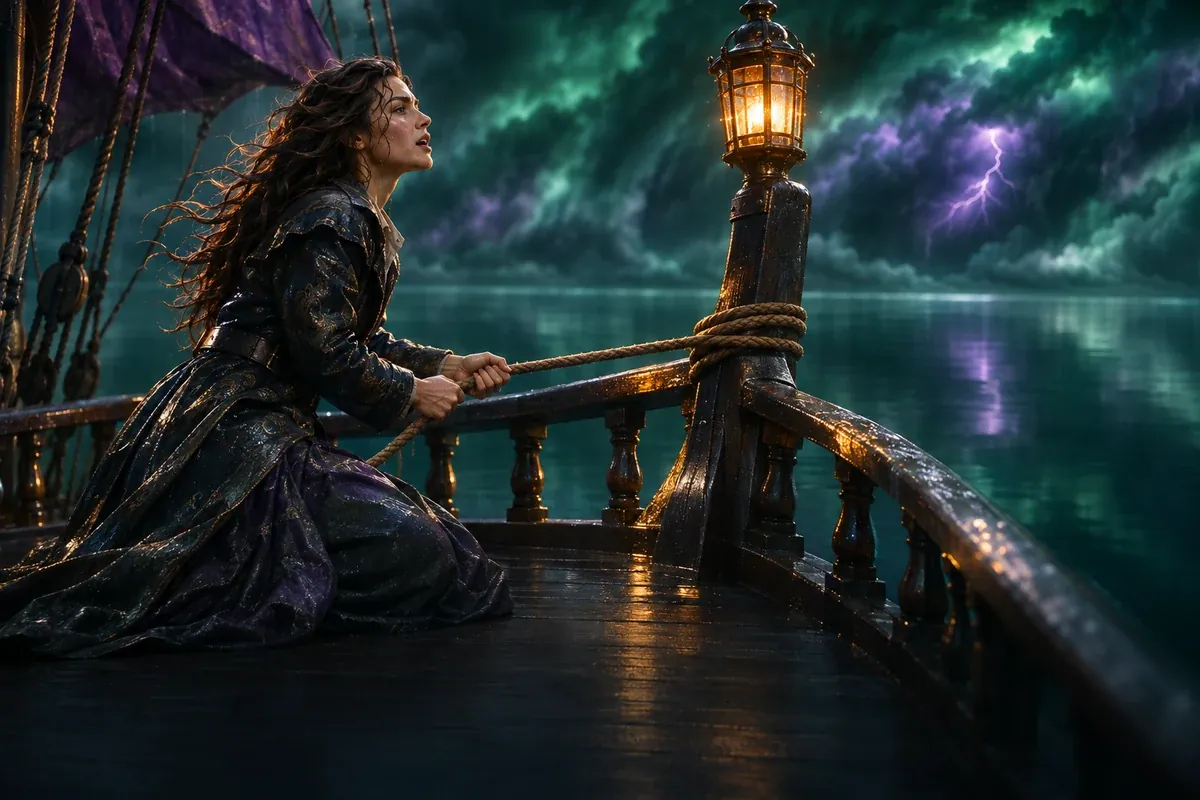
Stormships don’t run from a storm. They go and stand in front of it.
By the time the gale-horns had finished their first round, the whole Sworn Fleet was under way. The horns were long curled things of wrackwood, one note to a ship, and the sound they made together was like a very large animal clearing its throat. Mercy Pending’s was the lowest. I felt it in my back teeth.
Dagny buckled a lifeline around my ribs without asking. “Don’t unclip it for anything,” she said. “Not for the captain, not for a cat.”
“What if it’s a very good cat?”
“Gratuity can fend for herself.”
The harbor was draining as we cleared the Black Pier. Mud flats showed in the mouth of the Long Quay, shining like the inside of a shell, and people lined the sea wall to watch us go. On the balcony of the Tallyhouse stood one small gray figure with a wooden hand. She didn’t wave. She was counting us out.
Then we reached the breakwater, and I saw what we were going to stand in front of.
It was a wall. Green-black and ragged along the top, taller than the Tallyhouse, with lightning crawling around inside it like something looking for the door. It smelled of iron and cold. The stormships swung broadside to it in a long line across the harbor mouth, hull beside hull, and the horns hit their notes and held them.
Not one thing about it was survivable. I’d like to be clear on that.
“Miss Keel,” Idris Vane called from the helm, quiet and level, as though he were asking me to pass the salt. “Whenever you’re ready.”
I went forward. The bow was already running with water. I wrapped my lifeline around the stem post, knelt, and held the brown cord in both hands.
You don’t command the sea. People think that. What you do is stand at the counter and haggle, and the sea is the worst shopkeeper alive, because it has all the time in the world and nothing to lose.
“I’d like to buy a calm,” I said, into the howl. “For the fleet and the harbor, through the end of this storm. Name your price.”
The wave lifted its head. Somewhere inside the noise something answered, not in words, just a pressure behind my eyes. A number. A weight.
“Seven coppers,” I offered, and flung them over the side. They came back, all seven, and hit the deck like thrown pebbles.
“A lock of hair?” I cut one with my knife. The wind tore it away, and the sea considered it, and sent it back as a clump of weed.
“A tooth of luck?” That was my lucky charm, a shark tooth Grizel had given me at twelve. I held it up. The water sneered. I know that sounds ridiculous. I know what I saw.
Then the voice found its shape. It didn’t come from the wave. It came from under the keel, from everywhere, and it said, quite clearly: “Something that follows you.”
My lantern swung on its hook above the bow. In its light, my shadow lay along the deck, long and thin and wet, braced against the stem post just as I was.
“That’s a cheap shot,” I said.
“It is small,” said the sea. “You will not miss it.”
“That’s what everybody says before the bill.” But a wave the size of a granary was leaning over the Second Thoughts, and Tuck was somewhere behind me, and I had never been good at saying no to a price when the roof was coming in.
“Done,” I said.
Salt filled my mouth like a slap. My shadow peeled off the planks the way a sheet comes off a bed, slowly at the corners. It stood a moment, upright and gray and entirely too much like me. Then it turned its back, walked along the rail, and went over the side without a splash.
The sea went flat.
It went flat the way a tablecloth goes flat under a hand. A ring of calm opened around the fleet, glassy and dark, and beyond the ring the storm stood up on all sides like the walls of a bowl, roaring and white and held at arm’s length. The wind still screamed in the rigging. The surface under my knees didn’t so much as shiver.
I began to hum.
It wasn’t a choice. It’s the song I always hum when I’m afraid, a little winding tide-song with no words, one I could not have told you the origin of. My voice went out across the flat water and the water listened, and every time I reached the turn in the tune the ring pushed outward a little, and the walls leaned back.
At the helm, Idris Vane had gone absolutely rigid. His knuckles were white on the wheel. He was staring at me the way you’d stare at a door you’d been told did not exist.
“What did it take?” he called over the wind.
“Term one,” I shouted. “My shadow!”
He looked at the deck where mine should have been. “Mercy,” he said, very softly, and nothing else.
Then the forestay parted with a crack like a snapped whip, and the world came apart.
The line whipped across the foredeck. A spar swung. I saw Tuck, who had run forward to help with the sail like the fool he was, take the end of it in the chest and go over the rail into the flat dark water without even a shout.
“Tuck!”
Idris did not shout. He went over the quarterdeck rail in one long motion, coat and boots and all, and the sea took him in without so much as a ripple.
I kept singing. I don’t know how. My mouth was full of salt and my hands had started to shake, and each time my voice wavered the ring stuttered inward, the walls creeping closer with a sound like an inhaled breath. I counted. I counted the way Grizel taught me, one copper at a time, because the sea had taken my shadow and I’d be damned if I’d let it take the next ten seconds as well.
Forty. Fifty. The calm went from glass to slate. Something under the surface stirred, huge and patient.
At sixty-one the water broke beside the hull.
Idris came up with Tuck locked under one arm, and Dagny hauled the boy aboard by his belt and slapped him between the shoulders until he vomited a pint of harbor over her boots. The captain took the ladder one rung at a time. He wasn’t gasping. He wasn’t even breathing hard. When he reached the rail he stopped, one hand on the wood, water streaming off him, and simply stood there, as if waiting for something.
Lightning forked down inside the wall, and for one white instant the whole deck lit up from behind him.
Dagny’s boots threw a shadow. So did Tuck’s, and the cat’s. Mine threw none, and I knew why. Then I looked at the captain.
His coat hung from him like a flag. The boards beneath him were bare and wet and clean, and nothing, nothing at all, lay behind him in that light.
I wondered how long it had been missing. I wondered how many hours I had spent looking at him and not seeing.
And then the ring of calm drew in a breath, all of it at once, and every horn in the fleet stopped. The wind stopped. The only sound left in the world was water against a hull, and under it, rising up through the planks into my knees, a voice.
It was small and high and furious, a child’s voice, and I would have sworn I had never heard it before. Some part of me wanted to answer it anyway.
“Which of you,” the sea said, “is the debt?”
I opened my mouth. I had been holding the answer ready since yesterday morning.
Idris Vane got there first. He stood at the rail with a half-drowned boy at his feet and seawater running from both his sleeves, and he said it quietly, the way a man answers roll call.
“I am.”