

Beau Voss, it turns out, has been keeping a file.
It lives in a gym bag in the trunk of his Carrera, because “nobody searches a gym bag, it’s psychological,” and it is exactly what a scared amateur’s file looks like: phone photos of hallways, a napkin with license plates on it, printouts with highlighter applied in the emphatic, directionless way of a man highlighting his own anxiety. But threaded through the noise there is signal, eighteen months of it.
Beau noticed the mirror first — “the old one on the landing, the glass used to make you look like a ghost, it was the whole point, and then one day it made you look normal, and everybody said I was high.” He noticed a delivery truck on a Sunday. He noticed that the insurance riders got re-photographed last spring by a crew nobody introduced. He told Grant, who told him to get a job; he told Odette, who hugged him; he told Calder in June, in the garage, under the Carrera.
“And Cal went quiet,” Beau says, at the carriage-house table, because this is the other thing that has happened: Lena brought him in. Not all the way in — he believes Calder’s “security consultant,” a fiction named Mr. Quill, works remotely and speaks only through her — but into the work. “Cal went quiet for like a minute, and then he asked me who serviced the trucks. Not the art. The trucks. And three weeks later he was dead, so.” Beau’s jaw works. “So I stopped telling people things.”
Across the table, behind a laptop screen angled to hide his face from the window, the dead man in question writes on a legal pad and slides it to Lena. He asked about the trucks because freight logs don’t lie. Garage first. Ask him who had the fleet keys in March.
“Mr. Quill wants to know who had fleet keys in March,” Lena says.
“Fleet’s out of the Dunmore depot. Keys are chipped, everything’s logged.” Beau shrugs. “But the estate runs its own box truck for the grounds crew, and that one lives here, and the key cabinet’s in the mudroom, and the mudroom is — you know. The mudroom. Anybody.”
Anybody. The word of the month. Lena adds the box truck to the board and watches Calder, over Beau’s bent head, look at his cousin with an expression she files under revised attribution: previously catalogued as ornamental; reclassified, authentic, minor master.
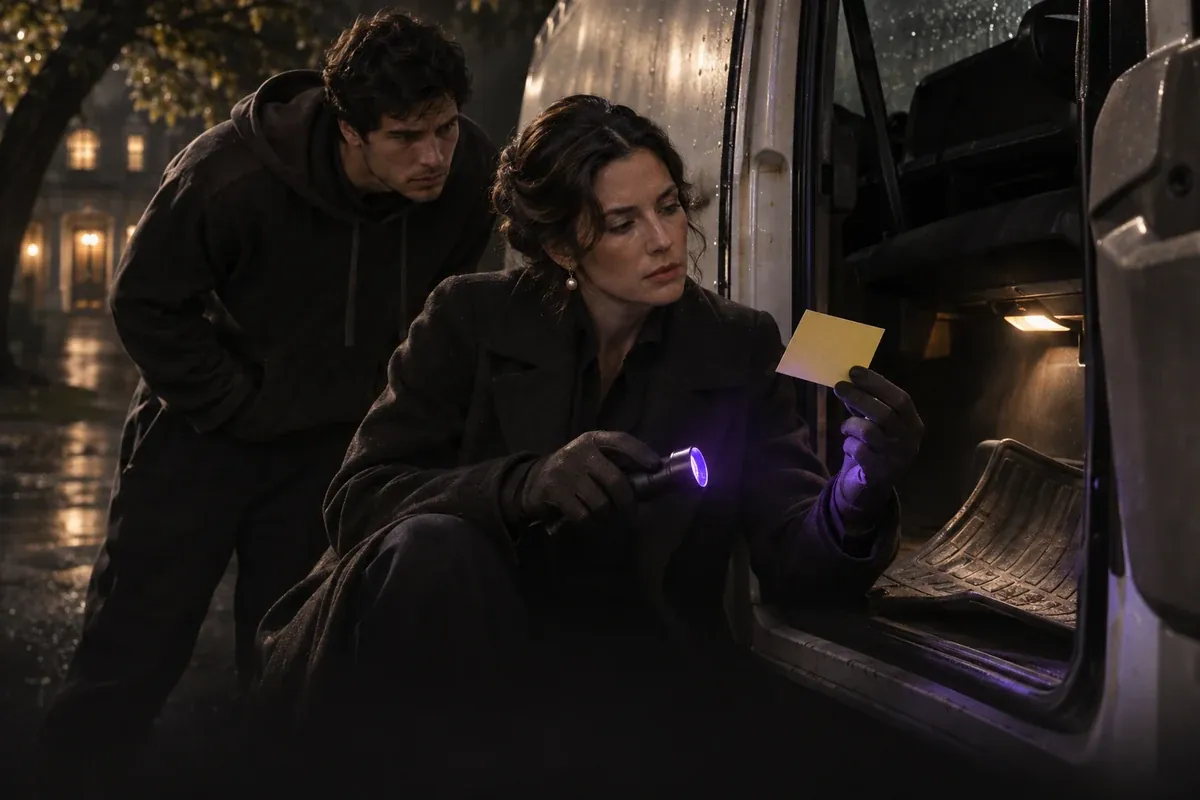
They look at the box truck on Thursday night, the three of them, if you count the one who isn’t there. Lena and Beau go down to the grounds shed with flashlights and a cover story about winterizing, while Calder, a voice in her earpiece and a pair of eyes through a telescope, narrates with the tight patience of a man being forced to watch someone else open his own luggage.
The truck is a white eighteen-footer with a roll door, GREYWATER GROUNDS in tasteful green on the flank. Beau knows it by touch. He thumps the cab, runs a hand under the dash, pops the glovebox with the heel of his palm. “Logbook’s gone,” he says. “There’s always a logbook. Mileage, fuel, who drove it. Somebody took it.”
“Somebody took it,” Lena agrees, “and somebody didn’t take the thing under the logbook,” and she lifts the rubber mat from the passenger footwell and holds up, between two gloved fingers, a flat yellow carbon slip the size of a playing card. A freight transfer receipt. The ink is a ghost, but the UV lamp in her kit lifts it clean off the paper like a drawing coming up through water: a ZURICH FREEPORT bonded-storage stamp, a date in April, and a consignee line that reads, in block capitals, ATTN: R.F.
Beau reads it over her shoulder. “Who’s R.F.?”
In her ear, Calder, very quietly: “Don’t say anything. Don’t react. Is the slip in good enough shape to photograph?”
“Photographing,” she murmurs, and then, to Beau, brightly, “Initials on a transfer slip. Could be a Swiss clerk. I’ll flag it for Mr. Quill.” The lie goes down easy, and that bothers her more than she can afford to examine, because three weeks ago she was a woman who’d have flagged her own grandmother for a mislabeled teapot. Now she is a woman running a source.
“Quill’s good,” Beau says, unselfconscious, zipping his hoodie. “Whoever he is. I know I never meet him. But I’d, I don’t know. Buy him a beer.”
“I’ll let him know.”
In her ear, the sound of a man trying not to laugh at a funeral that is also his own. “Tell him I’m a stout man,” says the dead husband. “Tell him I’m very hard to buy a beer.”
Beau drives off at midnight in the Carrera with the headlights off until the gate, which is the most naturally suspicious thing a person can do, and which Lena is beginning to recognize as his version of tact. Alone in the shed, she turns the yellow slip over under the lamp and reads the initials again. R.F. She has no idea who he is. She has a very strong suspicion that Calder does.
Denny, meanwhile, calls at seven on Friday morning, which is never a good sign, because her brother treats mornings like a rumor.
“There’s a woman at the shop,” he says. “Nice. Really nice. She wants to buy the franchise rights back from me, cash, thirty percent over what I paid. Lena, I could clear Harlan with that and still have money left.”
The floor of the hall drops a quarter inch. “What’s her name?”
“Ms. — hang on, she gave me a card. Ms. Prewitt? Meridian something.”
“Denny.” She speaks carefully, the way you talk to someone walking on a frozen pond. “Don’t sign anything. Don’t give her anything. Don’t even take the card out of your pocket again. If she comes back, you tell her your sister’s lawyer will be in touch, and then you call me and say the word ‘coffee.’ Can you do that?”
“Why coffee?”
“Because it’s the only word you’ve ever remembered under pressure.” A beat. “Denny. I love you. Say no to the nice woman.”
“Okay,” he says, small and unconvinced, and hangs up, and she holds the phone against her breastbone for a moment as if she could keep him warm through it. She does not tell Calder, at first. This is her mistake, and she knows it the minute she makes it — that she has started doing for her brother what her brother does for himself, which is to hope a problem will wait politely in the corridor.
The trouble arrives Friday, wearing cordovan loafers.
Lena is in the estate office doing legitimate widow business — signing the household accounts, a job she has taken to with suspicious pleasure — when Mrs. Okonkwo shows in a man in a quiet suit who introduces himself as representing Meridian Capital Recovery, “servicing partner for a portfolio recently acquired from Harlan Credit Partners.” It takes Lena four seconds to understand, and the four seconds feel like a lift cable snapping.
“Acquired,” she repeats.
“Last Tuesday. Portfolio of distressed personal obligations.” He sets a folder on the desk, squared to the blotter’s edge, a man who does this all day to people with worse lawyers. “Including the obligations of Dennis Marsh. We’re aware of a standstill arrangement executed by the prior holder. Our position” — the smallest pause, relishing — “is that the standstill was personal to Harlan and did not travel with the paper. We’d be open to discussing terms with Mrs. Voss. Given the family connection.”
“Who owns Meridian Capital Recovery?”
“We’re a private partnership.”
“Of course you are.” Her voice stays level while the rest of her does inventory at speed: last Tuesday — three days after the will reading. Someone watched her inherit nine figures on paper and went out and bought her brother. Not to collect. Two hundred forty thousand dollars is a rounding error to everyone in that library. They bought the ability to squeeze, bought a handle shaped exactly like Denny, and they did it through a shell because they wanted her to feel the hand without seeing the arm.
“Terms,” she says. “You’d like to discuss terms with the widow.”
“When convenient.”
“Here are the widow’s terms.” She stands, and some voice comes out of her that she last used on a Driscoll board member, the day before the restructuring. “The standstill travels with the paper — Mr. Pruitt will send your partnership the controlling authority by Monday, along with a records demand for your beneficial ownership, which you will resist, which will tell us everything we actually want to know. Until then: my brother’s number comes out of your telephones. If anyone in a golf shirt photographs his shop, his car, or his person again, I will treat it not as collections activity but as a message to this estate, and I will answer it as one. Mrs. Okonkwo will see you out. She enjoys it.”
The loafers leave. Lena sits down and discovers her hands are shaking, and makes herself watch them until they stop, because that is data too: they bought Denny to find out what the widow does under pressure. The widow just showed them. She hopes the price was worth it to both sides.
At widow hours, Calder is incandescent in a way she hasn’t seen — not at her, around her, pacing the little kitchen like the room owes him money.
“It’s elegant, is what enrages me. It’s exactly what I’d have advised someone to do.” He stops. “This wasn’t in my plan. Pruitt doesn’t know who moved on the Harlan paper; he found out when you did, which means someone outran my own counsel inside one week of the will reading. That’s not Beau. That’s not even Grant’s litigator — Grant would simply sue, he finds shells vulgar. Buying the brother is—“
“Patient,” Lena says. “Methodical. Comfortable.” The decanter words. He hears it too, and stops pacing.
“There’s a second problem,” she goes on, because there is, and she’s been turning it over since the loafers left. “Whoever bought the debt priced me as the widow before the world had finished deciding I was real. No due diligence lag, no hesitation. They moved like someone who already knew the will would survive its challenges. Like someone who knew the marriage would hold up.” She lets the next sentence stand in the room a moment before she says it. “Calder, who knew about me before the reading? Not the cover story. Me, by name, as the instrument.”
The answer is a short list and they both know it: Calder. Pruitt. And whatever Pruitt’s office is, downstream of Pruitt — paralegals, filing clerks, the notary, the quiet machinery of paper.
“Pruitt’s run that office thirty years,” Calder says slowly. “Three attorneys, two paralegals, and a clerk for the filings. Tam Okaro. Smart kid. New — fourteen months.”
Fourteen months. The exact age of her fictional marriage; the exact window of the freight invoices. Coincidence is a word appraisers use right before they lose their license.
Monday morning answers before they can ask. Lena is halfway through coffee when Pruitt calls, and for the first time in their acquaintance the lacquer is off his voice.
“Tam Okaro didn’t come in. Not this morning, not Friday afternoon, as it develops — he signed out early with a records box for offsite storage. The box is logged as closed files.” A breath. “Mrs. Voss, I’ve just completed an audit of the Voss folios. Everything is accounted for. Everything except one item, which was photocopied and returned so cleanly our tracking tape re-sealed, and I’d not have caught it at all except the copier logs its page counts, and there are two pages I can’t explain.”
Lena closes her eyes. The hall lantern. Lot one, anonymous correspondence, attribution pending. The whole chessboard tips four degrees and shows its slope.
“The signature page,” she says. “He copied the marriage certificate.”
“The signature page,” Pruitt confirms, “and the notary block. Someone now holds a reproduction of the one document this entire estate stands on — and Mrs. Voss, I filed the original myself, and I am very good at my job, which is why it grieves me to say I can no longer be entirely certain what it is they think they can prove with it.”
She thanks him, hangs up, and finds she has pressed her palm flat against the desk’s blotter, the way you steady a table at a séance. On the corner of the blotter, Calder’s initials, C.V., in a fast slanted pencil hand she has been pretending not to recognize for a week: someone, ages ago, left a note to himself about a dental appointment. It’s the only thing in the room that smells of an actual person. She almost laughs, and does not, because a laugh at this moment might not stop.
Outside the morning window, the lawn runs green and empty down to the carriage house, where a dead man is presumably hearing this in his earpiece and recalculating everything, and Lena thinks, with the cold clarity of a final sale: they’re not trying to break the marriage.
They’re trying to own the proof of it.