

Before they dial, there is the matter of whether to.
It is Pruitt who raises it, from a borrowed phone in a borrowed office, his voice thin with a week’s worth of stale coffee and stricter conscience. “I am suspended,” he tells Lena at nine on Monday morning, over the library speaker, “and I am forbidden, by the rules of my profession and by a certain delicacy in my own nature, to advise you in the matter of a witness. I will therefore say only what a private citizen might say to a friend. If the man in Antwerp is frightened, do not ask him to be brave. Ask him to be correct.”
“Ask him to be correct?”
“A frightened man will lie to protect himself. A man who is asked only for accuracy has nothing to defend.” A long, dry pause. “I once cross-examined a bank teller on those terms for four hours. At the end she wept and gave me everything.”
“That’s the cruelest advice I’ve ever heard.”
“It is the kindest, madam. It takes cruelty to be that gentle.” Another pause. “The bar inquiry has been set for the nineteenth. I intend to plead guilty to every charge. I should like very much to see how this ends. I am too old to be left out of the last act.”
“You won’t be.”
“I believe I’d hoped you’d say that.” And the line clicks off, leaving Lena with the strange affection one feels for a man who has done something terrible out of love, and has no idea how to stop apologizing.
The number rings seven times before anyone answers, and when someone does, there is no hello. There is only a long careful silence, the kind a man leaves when he has been waiting eight years to pick up a telephone and is no longer sure he wants to.
They have gathered in the carriage house because it is the only room at Greywater nobody can overhear, and because Calder has said, with the exhausted wryness of a man who has learned to joke at the edge of the abyss, that if the walls must have ears, they should at least have his. Beau’s clean burner lies on the desk between two laptops, on speaker. Odette sits on the camp bed with her cardigan pulled tight. Grant has taken the one good chair. Lena stands at the corkboard with her notebook, a pen already uncapped, and her heart going like a small drum.
“Mr. Verhoeven?” she says.
Nothing. The faint electric hiss of a transatlantic line. Somewhere behind it, a church bell.
“I’m calling from America. My name is Lena Marsh. I’m an appraiser. I found your number in the notebook of a young man named Julian Voss.”
The silence changes. It does not break. It draws in, as a breath draws in, and when the voice finally comes it is thin and dry and very old, an accent like cobblestones, every consonant carefully set down.
“You should not have this number.”
“I know.”
“The young man is dead.”
“I know that too. I’m sorry.” She keeps her voice level. “Mr. Verhoeven, I’m not the police. I’m not with the family office. I’m not with anyone who wants to hurt you. But I need to ask about the bonds.”
“I do not discuss my clients.”
“I understand.”
“I have not discussed them for eight years.” A sound that might be a laugh. “I closed my shop, mevrouw. I moved to Mechelen. I sell stamps now, to Japanese tourists. I am a very quiet man.”
Odette leans forward on the bed. She has been sitting very still, with her fingers clutched together in her lap, and now she says something, softly, in a language Lena doesn’t recognize. Three words. A little halting.
The line goes dead silent.
“Goedenavond,” Odette says again, in a voice trembling at its edges. “Mijnheer Verhoeven. It is Odette. The woman in the green coat. I paid you in cash, nine years ago, in a café, and I cried onto a cheese roll, and you gave me your handkerchief.”
For a long moment there is nothing at all.
“The green coat,” says the old man, in English, slowly. “With the very good buttons.”
“Yes.”
“I kept your handkerchief.” A dry rustle that might be a breath. “I mean, you left it. I have it still. It is in a drawer. I thought perhaps one day it would be a thing I would return.”
Odette puts her hand over her mouth. Calder, across the room, closes his eyes.
“Mijnheer,” says Odette, “I need your help.”
It takes forty minutes. Pieter Verhoeven is seventy-six, a retired engraver of banknote plates for three European central banks, a man who spent his life making paper that people trusted and never once asked what they did with it. He tells it in short precise pieces, as a man lays out tools. He has the careful voice of someone who has rehearsed a confession in an empty room so often that the words have worn smooth.
“The first order was yours, madam. Seven hundred pieces. Voss Holdings, 1998 series, ten thousand dollars face. I did it with love. It was a sad job, and a beautiful one. The paper was very difficult.” A pause. “I took no payment beyond cost, and you remember this.”
“I remember.”
“The second order was five years ago.”
Lena’s pen stops.
“A man called me. American. A warm voice. He said he was a friend of the lady in the green coat, that she had spoken of me with great respect. He had a larger project.” The old voice thins. “He wished for the same series. The same plates. Not seven hundred pieces. Six thousand three hundred.”
The room goes absolutely still.
Grant says it first, in a bare dry whisper, because it is his arithmetic and he cannot help himself. “Seven thousand bonds in the original issue. Seven hundred in the vault. The other six thousand three hundred were sold to investors in 1998 and redeemed in 2008.”
“Redeemed and cancelled,” says Calder.
“Cancelled and destroyed.” Grant’s face has gone gray. “Which means that someone has printed an entire cancelled issue, serials intact, as if it had never been redeemed. Six thousand three hundred bearer bonds with a face value of ten thousand dollars each.” He doesn’t need a pencil. “Sixty-three million dollars.”
“Plus the seven hundred in the vault,” says Lena slowly. “Seventy million. The entire series. On paper, in perfect condition, with perfect serials, as if the Voss family had never paid a single holder back.”
“Collateral,” says Calder.
He says it very softly, to the corkboard, and then he turns, and she sees it hit his face the way the answer to a long problem hits a man who has been doing the sum in the dark. “A bank doesn’t lend against a family’s good name. It lends against securities. If you can show a lender seventy million in bearer paper with a clean audit trail and a living chairman’s letter of authentication, they’ll advance a very large sum.” His hand is flat against the board. “Royce didn’t steal the money. He borrowed it. Against my own family’s bonds. And he’s been paying interest on the loan out of the foundation’s wires, in my sister’s handwriting, for fourteen months.”
“Verhoeven,” says Lena. “Do you know the lender?”
“I know that the American mentioned a bank in Portugal. Once. In passing.” A dry rustle. “He said it was very patient. That it would wait for its inspection.”
“An inspection of what?”
“Of the vault. At maturity. He said the bank was a very old-fashioned institution; it insisted on seeing its collateral with its own eyes once, at the end, and in the meantime it would trust a gentleman’s word.” Verhoeven’s voice has gone brittle. “I thought, how charming. I thought, how unlike a bank. I did not think what a gentleman’s word is worth when the gentleman is dead.”
Lena looks at the laptop screen where Beau’s clean phone hums, then at the pale wall calendar behind the camp bed, some horse-racing promotion Calder has never taken down. She counts. She counts again.
“Thirty days,” she says. “Maybe less. Banks round to the quarter. Royce staged a funeral and a probate fight to freeze the estate so that nobody opened the vault until the maturity date. And at maturity, an inspector from Lisbon walks into Greywater and finds seven hundred counterfeits and a family named in a wire trail. He doesn’t need us to live. He needs us to be in the middle of an estate dispute while the clock runs out.”
“And then?” says Beau, from the door. He has been standing there for ten minutes in his stocking feet, and his voice has gone very small. “What happens at the end?”
“The bank calls the loan. Casa Fenn can’t repay forty-odd million. The bank sues the guarantor, which is Voss Holdings. The company goes under. Everything we own is seized to cover a debt that never produced a dollar of Voss profit.” Calder speaks very evenly. “And the only name on the paper trail is Odette’s.”
Odette doesn’t flinch. She sits with her hands in her lap and her chin up. “And Royce is in Lisbon,” she says, “with the money.”
“Where is the money?”
“That I don’t know,” says the thin old voice on the speaker. “But I know one more thing, and I have waited a long time to say it to somebody who could use it.” A rustle of paper, a chair creaking. “I am an honest forger, mevrouw. I make perfect paper, and I make a record of every job. I have the invoice. Signed. R. Fenn, in a very handsome hand. I have the original plates. And I have something else. A second invoice, much newer.”
“Newer how?”
“Six months. A different client. A Mr. Hale.”
Lena turns, very slowly. Across the room, Odette’s face has gone absolutely white.
“He wished for a small piece of equipment. Not paper. A die. For embossing. A notary’s seal, of the Haverleigh County pattern, to a very specific impression.” The old voice is steady now, steady with a terrible calm. “He sent a sample on a page. I noticed that the sample had a small nick at the four o’clock position. I said, this is a flaw in your original. He said, yes, please put the flaw in the wrong place. Two degrees to the left.” A pause. “I made it. I made it very well. It was the best die of my career. I am ashamed of it.”
In the library of Lena’s memory a seal glows in raking light. A ring of two point one, no nick. A better tool than the original.
“You made the die that forged the marriage certificate,” she says.
“I made the tool. I did not know the use. I do not say this to excuse myself.” He draws a long breath that rattles. “But I am seventy-six, mevrouw, and I have a bad heart, and I have never once in my life gone to America. I would like to confess to someone who can arrest me. And I would like to bring the plates.”
“Mijnheer,” says Odette.
“Yes, madam?”
“Come on Friday.” She is crying again, without making a sound, and smiling, and her voice is the steadiest it has been all week. “I will meet you at the airport. I’ll wear the green coat.”
“It will look very well with the river,” says Pieter Verhoeven, and hangs up.
Beau is the first to speak, from the doorway, where he has been standing like a man at a roadside accident. “So the gift for the wedding,” he says, in a faint voice. “That was a die. A notary stamp. My uncle ordered a tool to forge my cousin’s marriage and we all signed the card.”
“Hale ordered it,” says Lena. “On Royce’s behalf.”
“Same thing.” Beau rubs his face. “He’s been in this family for twenty-two years. He taught me how to throw a spiral. I thought, that guy is solid. I thought he was the only one of us with a spine.” He drops his hands. “Is it dumb that I still kind of hope he’s got a good reason?”
“It isn’t dumb,” says Odette, very gently. “It’s the one thing about all of us that’s worth keeping.”
“There’s a reason,” says Grant, from his chair. “There always is. It’s usually money.” His gaze flicks to his nephew. “But the reason doesn’t matter in a courtroom, Beau. It matters in a mirror. You will have time to decide what you do with it.”
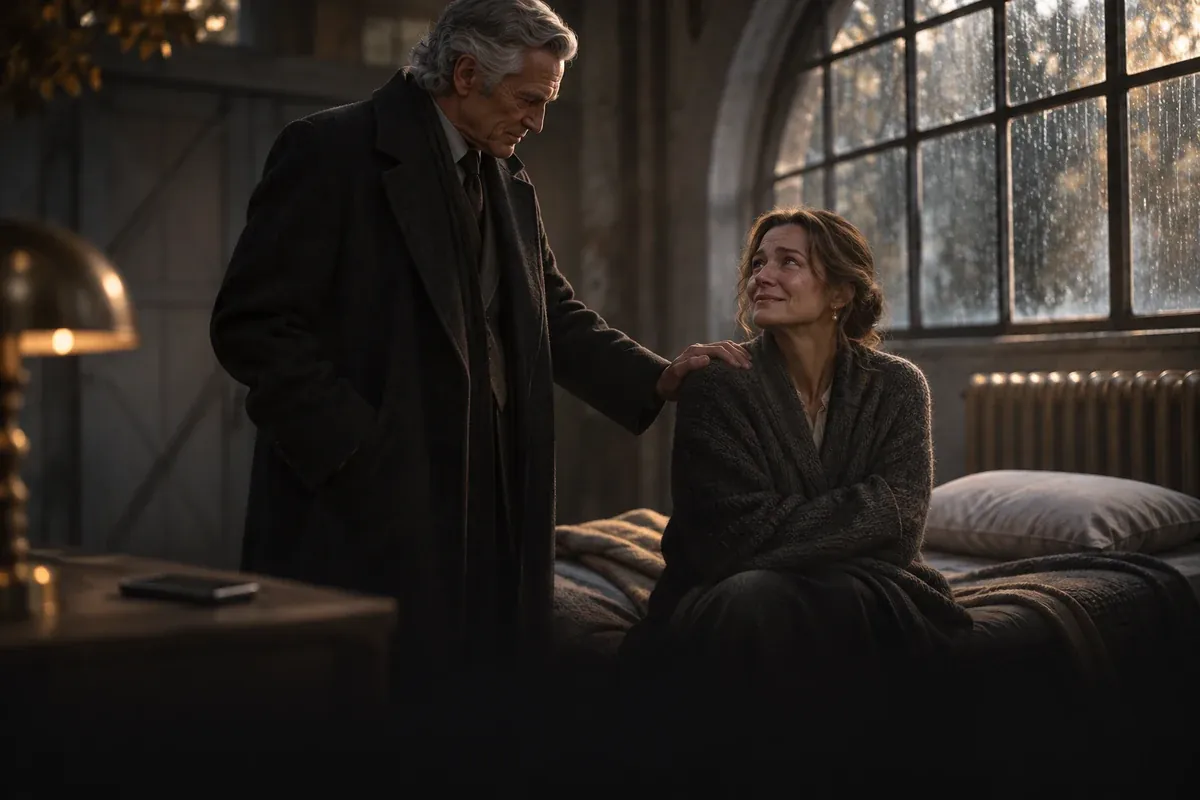
For a time nobody moves. The carriage house settles around them, the radiator ticking, the bright thin November light slanting through the telescope window onto the floor. Then Grant Voss stands, very slowly, and crosses the room to the camp bed, and puts one gray hand on Odette’s shoulder.
“I shall go with you,” he says. “To the airport. I should like to meet the man who kept your handkerchief.”
And Lena, at the corkboard, takes the red pin out of the old calendar and sets it, very carefully, on a date three weeks hence, and writes underneath in her small honest hand: Maturity. Inspection. The only deadline that matters.
Mrs. Okonkwo arrives at noon with a tray, and takes in the room at a glance, the board, the pins, the tearful Voss women, the grim gentlemen, the open laptops, and sets the tray on the one clear surface without a word. Tea. Sandwiches cut in triangles. A plate of the small hard ginger biscuits Lena has learned are only brought out in the presence of crisis.
“Madam will need a room prepared,” she says, to the air, “for a gentleman from Belgium.”
“How did you know?”
“I listen at doors, Madam. It is the principal duty of the senior staff.” She straightens a napkin. “He will want a firm mattress, an eiderdown, and a window that does not face the road. I have found that elderly European gentlemen require a view of something that does not move.” She pauses. “Also a good lamp. They always read.”
“Thank you, Mrs. Okonkwo.”
“Mr. Calder’s grandfather also kept a printer in the east wing, Madam,” she adds, from the door, in an even tone. “A Belgian. For the bank notes of the family’s old tannery. He was a very quiet man. I mention it only as a precedent.”
The door closes behind her. Beau looks at the biscuits. “She knew,” he says, in awe. “She knew about the tannery printer.”
“Mrs. Okonkwo,” says Odette, with a wet laugh, “knows about everything. She’s the only member of the Voss family who has never been in debt, never lied, and never needed to.”
Calder picks up a biscuit and bites it in half with the grim neatness of a man who has just discovered how much he needs the sugar. “He expects me to come to Lisbon alone,” he says, mostly to the corkboard. “And hand him my signature on a letter of authentication. He needs the chairman’s hand to make seventy million dollars of paper real. That’s what the invitation is. It isn’t an offer. It’s a lien.”
“Then we bring something he doesn’t expect,” says Lena.
“Such as?”
“The truth, in a form a bank can read.” She taps the red pin. “Verhoeven’s plates. His invoices. The wire trail. And a surprise witness he’s counting on being dead.” She finishes the sentence. “You.”
Calder looks at her for a long moment, chewing. “You’ve been planning this since the basement.”
“Since the library. The phone call. When he said the word ‘photograph.’” Her mouth tightens. “He thinks I’m the weak point. The appraiser with a secret. He thinks the Rothko photo’s a card he holds against me. I’d like to see his face when I put it on the table myself.”
“You haven’t told him.”
“I haven’t told him anything,” says Lena. “That’s the whole advantage. I’m the only person in this house he can’t predict.”
“That,” says her husband, very quietly, “is the most frightening thing you’ve ever said. And I mean it as the highest compliment.”
Then she turns to her husband, and says, in the voice of a woman reading the last line of a condition report, “Calder. I think we should accept the invitation.”