

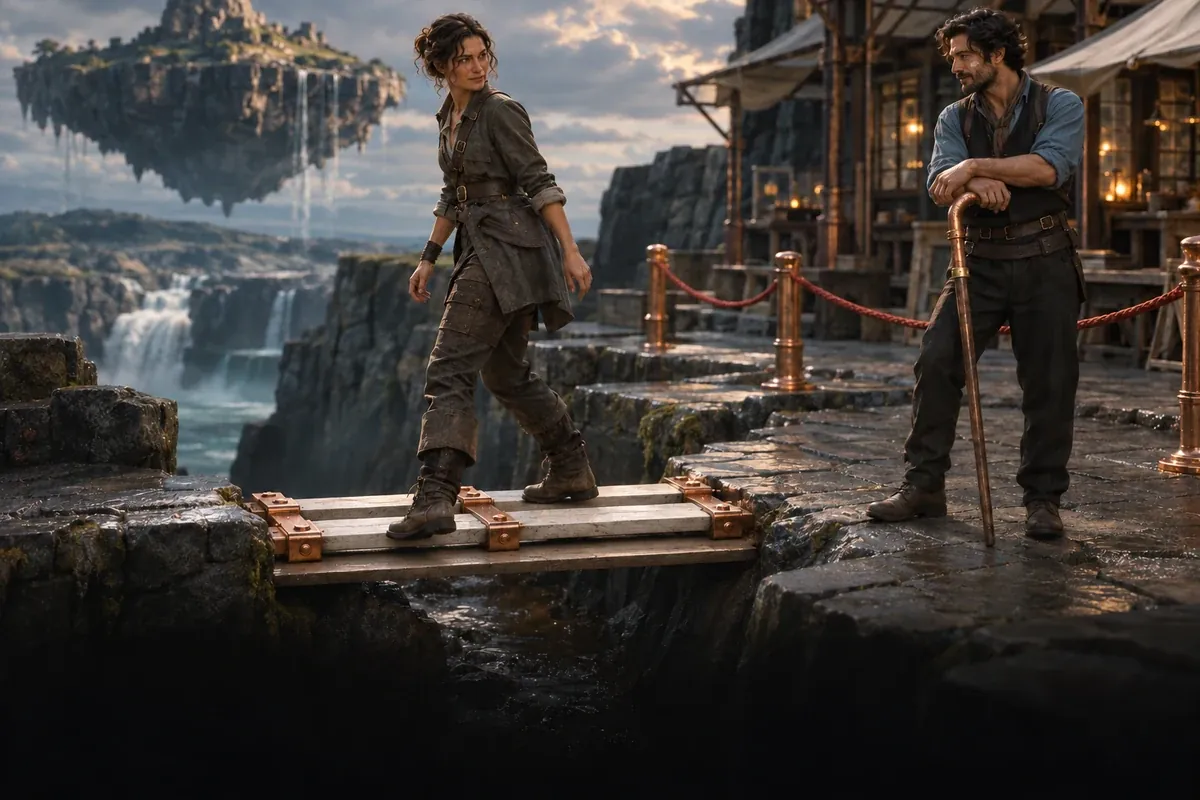
Nessa put them in the granary because it had a large table and nobody would climb seventy feet to throw stones through its windows.
“At least nobody who’s met our stairs,” she said, setting down a loaf, a pot of bean stew, and the island survey. “Eat. Then explain how we keep our feet.”
Hollis took the chair farthest from Iva. His cane clicked against the table leg. He hadn’t mentioned Low Hook again, which left her trying to remember every sentence she’d said there. So far she remembered the lies more easily than the questions.
The survey showed Pell as a neat brown oval. Under it, the heel appeared in blue ink: a cone of spellstone fitted into the island’s deepest root. It made the basalt light enough to float, though not light enough to drift. Three mooring chains held it within the caldera.
Beyond the eastern edge, the paper was blank.
“No landing?” Iva asked.
“Sea,” Nessa said. “Mostly. A strip of mainland three miles north. Scrip House owns the ferry route and the landing rights.”
“The warrant says the original landing.”
“Then your warrant knows more than our maps.”
Iva touched the survey with her left hand. Paper didn’t hold an intention unless its making was enchanted. This paper was only expensive.
Hollis pushed a bowl toward Nessa. He didn’t offer Iva one.
“Why have you stayed?” Iva asked him.
He took a moment before answering. “I was hired to repair a rain gutter. Then a stair. Then the lift. People kept paying me in things I could eat.”
“He’s terrible at leaving,” Nessa said.
“Only places with good stew.”
Iva tried not to notice his smile. It changed his entire face, and it hadn’t been for her.
Before they left, Nessa made Iva walk the granary’s long aisle. Names were scratched into its doorframe at different heights. Flood marks, Iva thought, until Nessa put her hand beside the lowest line.
“My son at seven. He made me check every summer. Said the island was sinking and he wanted to make sure he was getting taller faster.”
“How old is he now?”
“Twenty-four. Works on the mainland. He sends invitations.”
“You could go to him.”
“I could. I might. I want that to mean visiting my son, not escaping a machine.” Nessa brushed flour from the name. “People keep confusing those things.”
After lunch, they descended a stair cut through the island’s interior. Moisture beaded on the walls. Little brass plates marked stress fractures; several bore dates from the past week. Hollis touched each plate with two fingers, counting quietly. He moved more slowly on the steps, unwilling to accept the arm Nessa offered.
At the bottom, a maintenance chamber surrounded the heel. Iva’s lamp showed a polished gray cone as wide as a wagon. Seven claim knots clasped its iron housing. A thick drain pipe ran through the outer wall toward the sea.
“That pipe isn’t on the survey,” she said.
“Added twelve years ago,” Nessa said. “Pressure relief. They told us not to interfere.”
“Did anyone ask where the pressure went?”
“People asked. Then the fees went up.”
Iva knelt and put her fingertips on the heel’s original bronze socket.
A voice filled her mouth without moving her tongue. Ada’s voice, younger than Iva remembered, giving practical instructions to a mason.
Hold them until they can go home. Keep the ledge clear. Thirteen years should pay the work.
Iva took her hand away.
Nessa had stepped closer. “What?”
“Who lived here before the lease?”
“Most families. Some newcomers. Mine came later. Why?”
“Where did the island sit?”
Hollis looked at the floor. “In this caldera. The storm washed out the soft rock beneath it. They lifted the cap before it could break apart.”
Ada had brokered rescue work. Iva knew that much. Her mother had told the story every spring when the lease dividend arrived: a clever loan, a whole community saved, people grateful enough to send her smoked fish.
“There’s a ledge,” Iva said. “There was supposed to be somewhere to set it down.”
Nessa laughed once, with no humor. “They’ve been telling us for forty-three years that there isn’t.”
Hollis put his palm on the housing. He heard nothing; Iva could tell from the way he watched her.
“Tell me the exact words,” he said.
She did. This time she didn’t translate them into a technical category.
Back in daylight, he took her to a split in the quay where rainwater had cut away a step. He laid three salvaged white slats across the gap, then bolted a broad catch-board an inch beneath them.
“A demonstration,” he said. “The loose slats may slide. The board beneath is fixed. You can watch instead.”
Iva checked the bolts and agreed to try. The copper joints curled together, leaving a span scarcely longer than his cane.
“Walk,” he said.
She stepped forward. The bridge slid sideways.
He steadied her upper arm as her boot met the catch-board. His hand was warm through her coat. She found herself looking at a small burn below his collar, pale against brown skin.
“The board caught me. The bridge didn’t even try.”
“I told you about a demonstration. I hadn’t offered a crossing, with its own terms.” He let go. “This crossing will take one adult. It is unfinished; the joints may shift. You can go around by the stairs.”
The bridge steadied.
Iva stepped onto it. At the middle she stopped. “I changed my mind.”
“Then come back.”
The slats held until she returned. Only then did the far joint loosen.
“Consent doesn’t mean you get to pull the ground out when somebody regrets a choice,” Hollis said. “It means you owe them the way back.”
“And if the danger changes?”
“No new travelers until I explain it. The ones already on it get everything I’ve got.”
He crouched to retrieve the slats. His knee wouldn’t bend fully. She started to help, then waited until he nodded.
On the far side of the square, a girl was chalking circles on a wall. A man gathered laundry with one arm and carried a sleeping dog in the other. None of them looked at the long open space under their home.
“You could evacuate,” Iva said.
“To a landing they charge to use, on a ship they own, with debts for the fare.” Hollis stacked the copper joints. “That’s a direction. It isn’t much of a choice.”
“What would be?”
“Somewhere you can say no without falling.”
Nessa found them by the chalk wall. She carried an old tin and had acquired a sharp-eyed woman whose hands curled inward at the knuckles.
“Enid maintained the heel for thirty-one years,” she said. “She’s been asking me why nobody ever looks under the pressure gauge.”
“Because you’re all young,” Enid said, “and young people think gauges are honest.”
In the tin lay a rolled copy of the original survey. A corner had gone soft with damp; a repaired tear crossed the caldera’s eastern rim.
Iva held it flat with a copper joint.
There was the ledge, broad and hatched with load lines. There was a sheltered basin where Pell could rest while the tide moved beneath it. A path led outward across the rim toward a low shoulder of mainland.
Someone had cut the name of that shoulder out of the paper.
Under the missing name, in Ada’s small, decisive handwriting, stood three words.
Always keep open.