

The sound that gets me out of the lobby chair is a bag of ice hitting carpet, followed half a second later by something heavier.
It is 6:12 on the morning of October 29th, the sun is due at 7:05, and I have spent the night on the California side of the front desk trying to prove I am not watching Calder Finch.
He has spent it on the Nevada side, at the end of the Sagebrush Room bar, drinking cranberry soda out of a pint glass and trying to prove he is not watching me. We have kept this up for nine hours and taken turns being bad at it. When the noise comes down the stairwell from the second floor, we both stand up so fast that Ines drops a pen.
“Two-twelve,” Ines says, already reading the board. “Ice alcove. Del...”
I am on the stairs. Behind me boots hit the lobby tile and then the first step, and a hand that is neither of mine takes the banister one rail below my own. We climb together. Fourteen steps to the landing, fourteen to the top, and I count them aloud under my breath, because if I do not count I will think about the sound.
The ice machine on the second floor stands in a little tiled alcove across the corridor from the east stairwell. It is on the Nevada side, which makes it the closest thing the Stateline Hotel has to a back alley. There is a bag of ice split open on the carpet, a scatter of cubes melting in the pile, and beside the machine, with one shoulder against its humming white side, an old man in a gray cardigan with elbow patches.
He is sitting up. That is the first thing. He is sitting with his legs straight out in front of him like a boy in a classroom and his right fist clenched on his knee, and his glasses have slid down to the tip of his nose.
“Mr. Tran,” I say.
“Hollis,” says Calder, at the same moment, and then, to my astonishment, he goes down on both knees in the melting ice. “Mr. Tran, it’s Calder Finch. I was in your third grade.”
Hollis Tran turns his head. He is seventy-one years old and has taught half the county to read, and his face has gone the color of chalk. Behind the lenses his eyes are enormously, terribly clear.
“Finch,” he says. “You never could do long division.”
“No, sir.”
“Del.” He finds me. His left hand comes out and closes on my wrist with a grip like a dropped wrench, and I realize he is cold, as cold as the ice. “Del Kowalczyk. Good. Good girl. I called your house. Your grandfather didn’t... I tried... I have something that belongs...”
“Don’t talk. We’re here.”
“I can’t open this hand.” His fist, on his knee, is white at the knuckles. “Isn’t that funny? A man spends fifty years telling children to let go of things.”
“Mr. Tran, I’m going to ask you to lie down.”
“I’d rather sit.” He smiles at me. It is a lovely smile, absent-minded and sweet, the smile of a man excusing himself from a party. “Tell the boy... tell Mateo he did well. Tell him...”
His grip loosens. His head tips toward the ice machine as if he were listening to it.
I say, “Mr. Tran?”
I have said that name to the dead more times than I can count, and I have never once been answered. This time I say it twice. His glasses slide the last quarter inch and drop into his lap. Beneath the gray cardigan, the chest that was lifting stops, and the old man’s shape goes soft at the edges, like paper held to a flame.
Calder says very quietly, “Don’t look away. It’s worse when you look away.”
So I look. The change comes the way it always does, without a sound. The cardigan slides off the shoulders as the shoulders broaden and thicken and take on a coat of long, thin, silver hair. The knees fold. The nose lengthens, and a long delicate muzzle comes down onto the gray wool of the sleeve, and an old schoolteacher is a very old wolf, thin as a coat rack, white to the eyes, lying beside an ice machine with one front paw tucked under his chin.
His right paw is still closed.
“Six-sixteen,” I say. My voice has dropped into its professional register with a thud, like a coffin lid. “The remains are... The decedent is Hollis Walter Tran. Time of death is six-fifteen. We have forty-nine minutes.”
“Forty-nine,” says Calder.
I look at him. He has gotten to his feet. One hand is on the tag gun at his hip, and his face is as still as I have ever seen it. I know exactly what he is thinking, because I am thinking it too.
We are in an alcove on the Nevada side of the second floor. The body is wholly east. Hollis Tran has no tag in his ear that I can see, but the Specialist for the Dry Ladder district has a gun on his belt, a roll of orange tags in his pocket, and forty-nine minutes of legal right.
“Check his ears,” he says.
I stare at him.
“Both. Quickly. If there’s a forged one in there, I’d rather you found it than me.”
I kneel. I turn the old wolf’s head in my hands. His fur is dry and light and smells of chalk dust and peppermint, and I run my thumb along the inside of each ear, over the thin hot skin, and find nothing. No metal. No plastic. No wet. A lanyard clip hangs from his belt loop with nothing on it, the way a hook hangs when the coat has gone.
“Clean.”
“Good.” He lets out a breath. His hand comes off the gun. “Then I’d say he’s yours.”
“You could have tagged him while I was...”
“I could have.” He is looking at the wall. “That’s on me too, I suppose. Let’s move him.”
We move him. That is how I would describe it to a judge. What it is, at the time, is the strangest forty minutes of my life.
The first problem is the elevator. The service elevator is one corridor away on the west side, and its doors are open, and it has a laminated sign taped to the frame that says OUT OF SERVICE, MAINTENANCE, in Rudy Hale’s neat print. The sign is fresh. The tape is still shiny.
“It was working at midnight,” says Ines on the house phone, high and breathless. “Del, I checked. I did the audit. It was working.”
“Then someone broke it between midnight and six.”
“Rudy’s on the dock,” Ines says. “He says it’s the cable.”
“Of course he does.” I put the phone down on the sill. “Ines, get Tina, get a laundry cart, get my grandfather. Tell him the registrar is needed on the second floor and the second floor will come to him.”
“Del, the stairs...”
“I know about the stairs.”
The fire stairs on the west side drop twenty-eight steps to a landing and twenty-eight more to the lobby, with a turn in the middle too tight for any cart that was ever built. Tina Ruelas arrives with a wheeled linen hamper the size of a bathtub.
Calder and I lift the old wolf into it between us, a hundred and ten pounds of soft silver fur on a bed of towels, and cross the corridor with the hamper bumping the strip, and stop on the west side with the brass behind us like a wall.
It is 6:23. At the head of the stairs Calder looks down at the first flight and says, “You take the head. It’s lighter, but it’s the end he’ll bump if we drop him.”
“Why do you say that like it’s happened before?”
“It has.” He gives me a look so brief that I almost miss it. “Two years ago. A rodeo man, Eddie Ng. I was late and you were on the clock. We carried him down the back stairs of the Silver Fox in a blanket. I wasn’t supposed to be there.”
“You were there?”
“I was a bad shadow. Take the head.”
I take the head.
Twenty-eight steps. The old man’s body is a long slow pendulum between us, and every time one of us steps down, the other takes the weight. I count aloud. Calder counts with me, one beat behind, and then two, and then a beat ahead, and somewhere around the fifteenth step I realize that we are speaking in the same rhythm and that I have not once heard him make a joke.
“Don’t count the steps,” he says on the twentieth. “Count him.”
“What?”
“The weight. You count the weight. Hundred and ten. Hundred and ten. Keep it hundred and ten, and the steps happen by themselves.”
I have been counting steps since I was nine years old. Nobody has ever told me to count anything else. I try it. A hundred and ten, a hundred and ten, I say to myself, and my arms stop shaking.
“Better?”
“Yes.”
“Good. My sister taught me that. She carried the feed sacks at the ranch.”
I want to ask. I do not ask. We reach the landing and turn the corner with the hamper balanced on the rail, and one of the old man’s front paws slips out from under its towel and hangs, the closed one, the right. Calder reaches across me and tucks it back in. It is a very small gesture. He does it with the hand that has the glove on it.
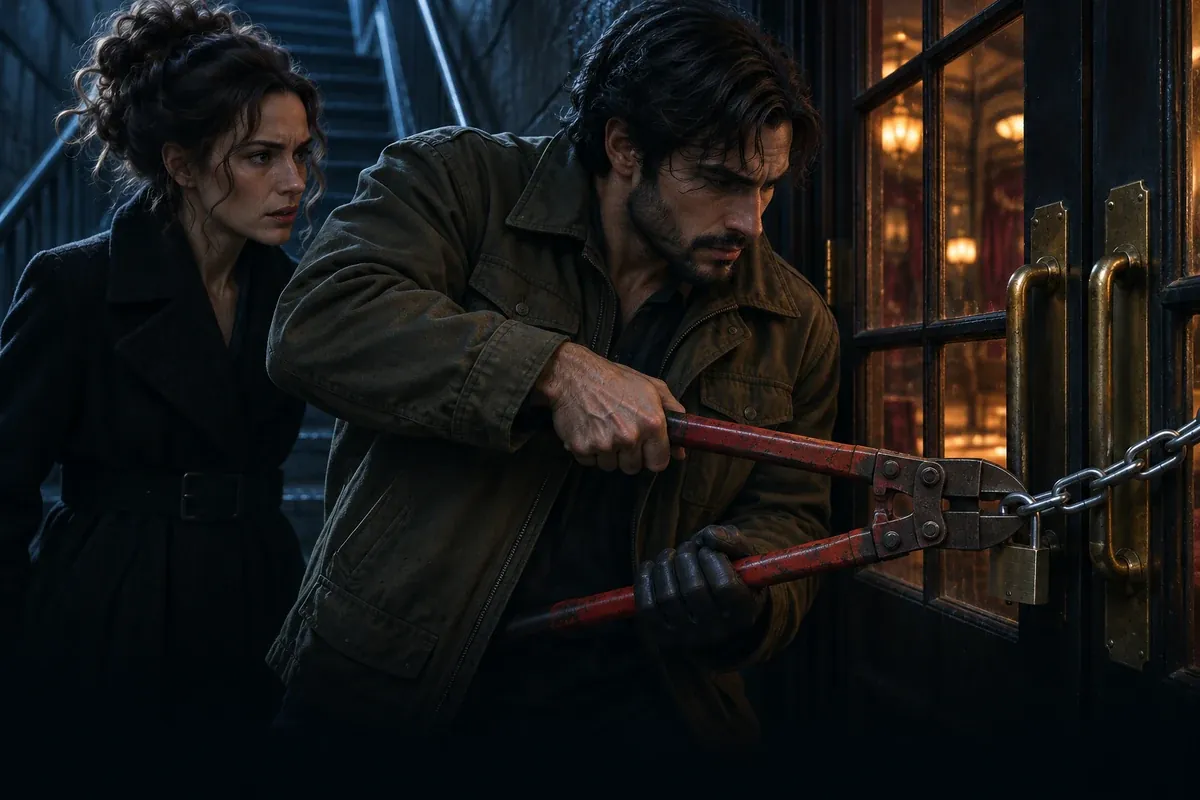
6:41. 6:44. A dull bang from below: the lobby door to the stair is chained shut, with a padlock on a loop of silver chain that was not there at midnight, and a paper sign taped to it. HALLOWEEN DECOR. DO NOT BLOCK.
“Rudy,” I say. I say it with my teeth.
Calder looks at the padlock. Then at me. He unclips a pair of long-handled cutters from his utility belt, state issue, meant for fence wire, and sets them on the third link of the chain. He leans. The link shears with a flat bright crack, and the chain slithers off the door and onto the floor with a ring that I will remember all my life.
“State property,” he says. “I’ll file for the damage.”
“You’re destroying private property.”
“I’m a district Specialist in pursuit of a carcass. It’s the fourth paragraph of the Predator Code. I’ve been looking for an excuse to use it for six years.”
Tina Ruelas is waiting with the cart at the foot of the stairs, and a face like a held door. We load the old man onto it, and she and Ines take the hamper through the lobby at a run with the whole front of the hotel watching. It is 6:50. The lobby clock reads 6:51.
My grandfather is standing at the desk.
He has the almanac pinned down with his stapler and the form already in front of him, with the embossed seal at the top and the line for the decedent’s name filled out in his own hand. His cardigan is buttoned right today. His breath comes quick and short and I know what it means. He has been standing there since before I called, with a pill under his tongue.
“Seven minutes to the clock,” he says. “Dessie. Where is he?”
“He’s here, Grandpa. Almost.”
“Measure.”
We measure. The lobby floor has a pattern in it, a checkerboard of black and white marble, and we lay the old wolf six full squares to the west of the strip, in the bright pool beneath the chandelier. Ines kneels at his head. Calder, who has no business being on the California side, stands behind the desk with his thumbs in his belt and his single glove folded on the counter.
Nobody tells him to leave. I write the form in my square, steady hand. Hollis Walter Tran. Retired teacher. Place of death, Stateline Hotel, second floor corridor. Cause, natural causes. I look at the last line a long time. Then I write it anyway, because on paper it is true enough.
“Mr. Tran,” says Stan, kindly, in his dry, careful voice. “You are a man. We’re going to say so now.”
The pen is out. The ink is black. Forty seconds is a long time.
At ten, Tina Ruelas starts to hum. It is an old tune and I do not know it.
At twenty, my hands begin to shake again, and a very large warm one lands on my shoulder and tightens. I do not look to see whose it is.
At thirty, I look at the clock. It says 7:00. Five minutes to the sun.
At forty, the old wolf lets go.
It is gentler than Gil’s. Hollis Tran has the fur of a very old animal, so thin that the cardigan shows through it like a pencil drawing under tracing paper, and when it lifts and flows back there is almost nothing under it. A thin old man in a gray cardigan and a plaid shirt and corduroy trousers lies on the marble with his glasses in his lap. His hair is white and rumpled. His eyes are shut. His left hand lies flat on his stomach.
His right is still closed.
“Hollis Walter Tran,” says my grandfather. His voice breaks on the last syllable. “Rest easy, old friend. You taught my daughter to read.”
“Stan.” Ines has her hand on his elbow. “Sit down.”
“I’m going to get the stretcher,” says Stan. “It’s in the hearse. Nobody touch him.”
“Grandpa, I can...”
“I’ll get it.”
He goes. The lobby door swings behind him, and the cold from the street comes in and lifts the almanac page against the stapler. Ines goes to call Hollis’s niece. Tina goes to get a sheet. For one long breath, the lobby is nearly empty, except for the dead man on the floor, and me kneeling beside him, and Calder Finch behind the desk, who has not moved.
Hollis’s fist opens.
I do not touch it. It opens on its own, the way a flower opens in a film, one finger at a time, the thin brown knuckles relaxing as though they had finally been given permission. The palm is lined and soft and dusted with chalk. In the center of it lies a small bright orange rectangle with a loop of metal through one end.
It has a number stamped in black.
0417.
I know that number. It is stamped in my memory like a date of birth. It is on a file card in the vault under our chapel, in my grandfather’s handwriting, in the drawer for the family dead: A. Kowalczyk, my mother, tag 0417, the Nevada tag that beat my grandfather’s pen by forty seconds on the morning she died on the wrong side of a county road. I have heard that story every year on her birthday, and Stan has never once finished it.
It should be in the ground. Or in a case. Or in nothing. It should be fourteen years old and dull as an old coin, and it is not. It is bright. It has no scratches. When I put my fingertips next to it, not touching, I can feel heat coming off it, the dry soft heat of something just taken off a body.
“Del,” says Calder. He has come around the desk. “Don’t.”
I pick it up.
It is warm. It is as warm as a hand. It is as warm as a cup that someone has just set down, and it pulses, very faintly, under my thumb, like the first beat of a heart I am holding in my fingers. My own hands, which were shaking, stop. I think: this is not possible. I think: this has been on a hook in a cold cellar for fourteen years.
Wrapped around the loop of the tag, folded twice and tied with a thread, is a strip of paper no wider than a finger. I unwind it with fingers that I can no longer feel. The paper is old, soft at the creases, the color of tea. It has been written on with a ballpoint. The ink is black, the lines are small and slanted and a little shaky, and I would know that hand in a burning building, because it taught me my letters.
She doesn’t know. Keep it that way.
I read it twice. I read it a third time, with my lips moving, like a child. The lobby clock ticks on above me. I do not look up until a shadow falls across the paper, and then I do, and Calder is standing at my shoulder with his gloved hand over his mouth.
He has read it too. His eyes move from the strip to the tag to my face, and I can see him do the arithmetic, and I can see the exact moment he gets the answer. He lowers the hand.
“Whoever she is,” he says, very low, “she’s the one they’ll tag next.”