

The man in room 214 is dead in two states at once, and I have fifty-one minutes to make him dead in only one.
I introduce myself first. It is the oldest rule my grandfather ever taught me, older than gloves or clean cuffs. “Mr. Pruitt, my name is Del Kowalczyk, I’m with Kowalczyk and Son, and I’m going to move you now.”
Gil Pruitt does not answer, being a wolf at the moment. He is a big gray-brown one with a split left ear and a muzzle gone white at the edges, and he lies on his side across a queen bed with his head on the pillow and his back legs tucked toward the headboard, like a dog who meant to get up in a minute.
The bedspread is gold polyester, the kind that has survived every bad night in the building. Beneath the bed, between the two front posts and out through the north wall, a strip of brass one inch wide runs through the carpet where somebody cut it in 1931.
His nose is in Nevada. His hips are in California. The Line has never been fair to anyone, but it is especially unfair to Gil.
“He was alive at midnight,” Ines says from the doorway. She has her night auditor’s blazer on over a sweatshirt from the volunteer fire department, and she is smiling, which is how I know she is about to cry. “He came down for ice.
Ice is free, but he bought a bag of peanuts anyway, because he said it was rude to take from a machine and not give to a person. The peanuts are six dollars. The water is four. I told him four dollars is robbery, and he said, Ines, it’s the Line, everything costs double on the Line.”
“Ines.”
“Six dollars, Del. For peanuts.”
“I know.” I do know. I put two fingers on her wrist, because nobody else in that doorway is going to, and I look at the clock on the nightstand. It says 6:13 in red numbers that do not care about any of us.
The almanac taped inside the hearse says the sun comes up over Dry Ladder at 7:04 this morning, and the sky does not matter. The sky can be the color of a peach and the Line will go on calling it night until the printed minute arrives.
Fifty-one minutes. Then whatever is not written down gets written for us, and the Line only knows one handwriting.
“Hearse,” says a voice behind Ines. “You have forty-eight.”
Marguerite Hale does not come into the room. She stands in the corridor with her silver collar up around her chin, seventy-one years old and as upright as a fence post, and she counts the way other women pray. She owns the Stateline Hotel and everything that sleeps in it. The collar is not fox, though nobody has ever told me what it is. She has never called me by my name, only by the thing I drive.
“Forty-seven by my watch,” I say.
“Then you’re running a minute behind, aren’t you.”
She is right. I am always running a minute behind on the mornings that count. I take my left shoe off, which is what everyone in my family does on the Line, and I put my foot on the brass where it shows between the bed and the wall.
It is warm. Brass is always a little warm at night, like a dog’s flank, but this morning it is warm enough that I notice. I file the thought behind my teeth and go back to work.
The trick with a decedent is that you do not lift him. You persuade him across a floor. Ines and I get the bedspread out from under the pillow end, hand over hand, so that Gil rides on it the way a patient rides a sheet, and we start walking him toward the west side of the bed.
A hundred and forty pounds of wolf. His fur is cool and thick and smells of cedar and engine oil and a little of sawdust, the way a barn smells when the doors are closed.
“Almost, Mr. Pruitt,” I tell him. “I’ve got you.”
Fourteen steps from the elevator to this door. Four to the bed. Eleven to the Honeymoon Exit, the closet door Augustus Hale built into the west wall so honeymooners could slip out of the Nevada half into the California corridor without getting their feet cold. I counted all of them coming up. I count everything. It is how I keep the dead from being a crowd.
Behind me the stairwell has filled up. Nobody speaks. The Pack stands on the landing in robes and housekeeping smocks and one man’s pajama bottoms with ducks on them, each of them holding a coffee cup in both hands, and none of them drinks. Among the knees at the top of the stairs there is a small face in dinosaur pajamas, and I look at it long enough to say Mateo, bed, with my eyebrows. The face does not go.
The door on the Nevada side opens.
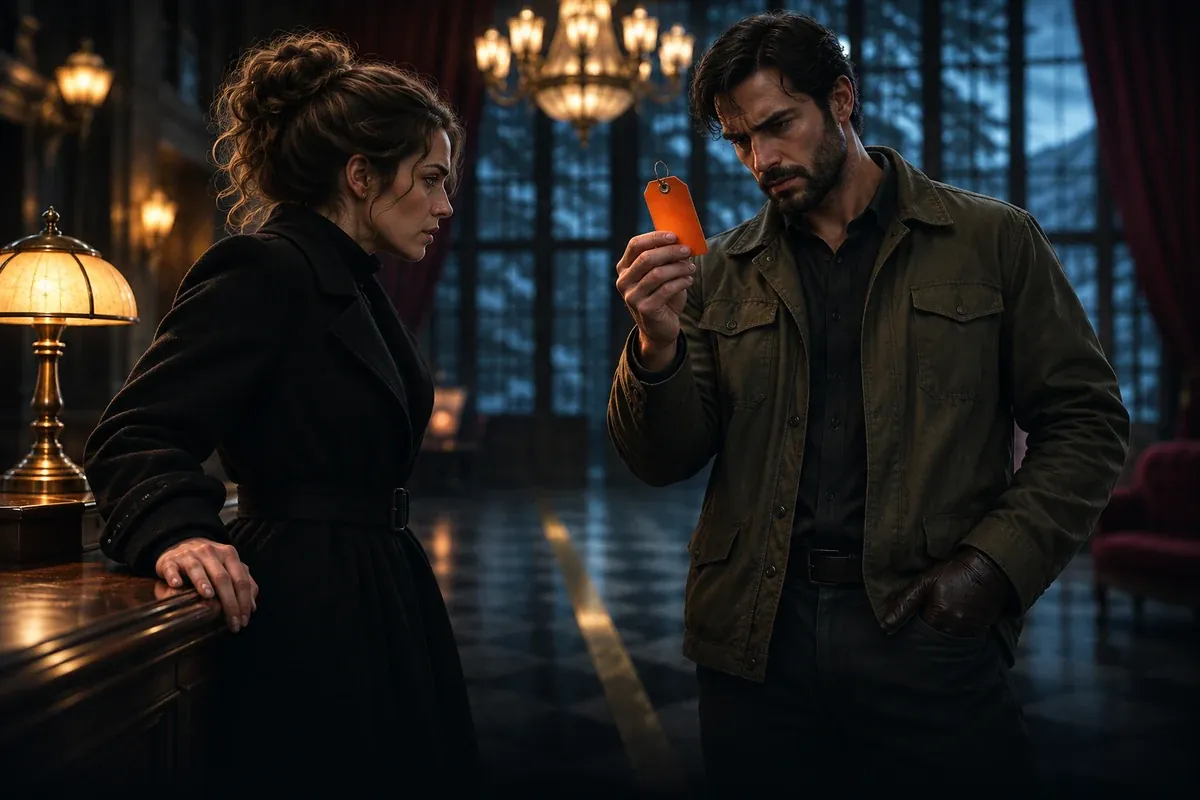
The state jacket comes through first, olive drab, with a patch on the shoulder I have been told to ignore. Then the man. Then the left hand in its single leather glove, and the right hand bare, rolling an orange tag over its knuckles like a bar coin.
Calder Finch is twenty-eight and the best-looking trouble in Halloran County. If he were not so good at his job I might feel sorry for him. I have not decided if I feel sorry for him.
“Morning, Del.”
“Specialist.”
“Forty-two minutes.” He looks at the bed, at Gil, at the brass, and his mouth goes sympathetic in a way I resent. “I see you’ve made the traditional choice to start without me.”
“The traditional choice is to start when somebody dies. You’re the one who shows up late.”
“The state sets the hours. You set the mood.” He crosses the strip in two strides, the way only a living human can, and plants a boot on the leg of the bed. Humans can cross the Line without a thought. It is the one fair thing about it. “Body found in an even-numbered room of a licensed Nevada property belongs to the district until a Registrar says otherwise. Two-fourteen is even.”
“He is on the line.”
“He’s on a mattress. The line’s underneath it. That mattress was entered on the Nevada furniture rolls in 1964, because Hale wanted the slot machine tax break for the whole second floor.” The tag stops on his knuckle. “I didn’t write the statute, Del. I just carry it.”
“You carry it very gracefully.”
“Thank you. I practiced.”
Marguerite says, “Thirty-nine,” to the air.
He takes the head of the bedspread. I take the foot. And for the next ninety seconds we do something nobody in Dry Ladder has a word for in either state, which is a tug of war over a dead man, with Ines whispering peanut prices into her own fist.
I pull west. He pulls east. Gil’s body slides one way and the other, a few inches each time, and every inch rides over the brass strip with a faint dry whisper like a page turning. My shoulder starts to burn. I plant my bare foot on the strip for traction, and the warmth of it comes up through my arch, and I think, stupidly, that the Line is enjoying this.
“Specialist, you do know he has a family.”
“I know he’s got a widow. I’ll send flowers.”
“Send them to the right state.”
“Pull, Del.”
He pulls. And because Calder Finch is stronger than I am, the head end of the bedspread jumps east, and Gil’s body goes with it, and the whole length of him slides over the line until his hips are in Nevada and his rib cage and his shoulder and the long gray muzzle follow.
The left ear, the split one, flops free of the pillow.
There is an orange tag clipped through it.
It is the size of a postage stamp, a bright little rectangle of plastic on a metal loop, and it has a number stamped in black, and the number is 0912. The loop is bright and unscratched. The ear around it is still a little wet.
The first thing I think is that Gil is nearly all the way east. A hand’s breadth of him is still on the brass.
The second thing I think is that a body in Nevada with a tag in its ear does not need a Specialist. It needs only to be wholly on the right side of the strip. If Calder drags another six inches, Gil Pruitt stops being a man who will have a funeral. He turns into fur on a bed, and nothing inside it, and four thousand dollars of somebody else’s morning.
“Stop!”
I have never shouted in a room with a decedent. It comes out of me like something thrown. Calder freezes with the bedspread bunched in his fist, and the whole stairwell breathes in.
“Look at the ear,” I say. My voice has gone very formal. “Please. The left ear. Without moving the remains.”
He looks. I watch his face while he does it, because I am looking for the lie, and I am an expert on that particular shape. There isn’t one. His face goes the way a wall goes when someone takes the paint off it.
“That’s not mine,” he says.
“I know it isn’t yours. You’d have been in the door by now with the gun out and your whole stupid speech.”
“Del.” He looks at his own bare hand on the bedspread, then lets go of the cloth very slowly, as if it might bite. “I was about to pull him all the way. I would have...” He doesn’t finish.
“Yes. You would have.”
“That’s on me.”
“Then do something about it. Hold the lamp.”
He holds the lamp. That is the strangest part, and I only understand it later: the Tag Man of Dry Ladder standing in a hotel room at six in the morning, holding a gooseneck lamp over a dead man’s ear, while I take the embalmer’s scissors out of my coat pocket. I always carry them.
They have a blunt tip for hems and a hooked bit for stitches, and the blade on them is the width of a nail. I fit it around the loop of the tag, behind the little orange flag, and I say the thing I say to every decedent before I cut or sew.
“This will only take a moment, Mr. Pruitt.”
The loop parts with a click like a stapler. The tag falls into my palm.
It is a felony in the state of Nevada to remove a predator tag from any animal found within the district. I know that because it was on the first page of the examination binder I have been memorizing since I was nineteen. I close my fist around it anyway.
“You saw that,” I say to Calder.
“I saw a woman doing her job.” His eyes stay on mine a second too long. “I’ll need that tag, though.”
“After he’s filed.”
“Thirty-one,” says Marguerite. Her voice has not changed at all, but it has gotten very quiet. “Hearse. You are spending his minutes.”
She is right again, and I hate it.
We do it in a rush after that. Ines takes the head, I take the foot, Calder, God help us all, takes the middle with his one glove and his one bare hand, and the three of us slide the bedspread west across the carpet, over the brass, into the California half of the room, and through the Honeymoon Exit into the west corridor, where the carpet is a different pattern for no reason anybody has ever explained.
The luggage cart waits there with its squeaky left wheel. We heave. The wheel squeals like a gull. Gil lies on the brass bed of it with his big gray head resting on a folded towel I have put under his chin, and I tuck the spread around his shoulders so nobody in the hall has to see a dead wolf unless they insist.
“You carried him?” asks a voice, very small.
Mateo has come down four steps. He is nine, and he is holding the banister with both hands, and he is looking at Gil with the particular flat attention children give to things that are not going to be explained to them.
“Bed, buddy,” says Ines, in her night auditor voice, and then in a different voice, “Mateo Jose. Now.”
He goes. He takes one step backward for every one he goes up, so as not to lose sight of the cart.
It is 6:41 by the time we reach the elevator. The service elevator in the Stateline Hotel was installed in 1958 and has been apologizing ever since. It takes us down at the speed of an old man deciding. Rudy Hale is waiting at the bottom, in a fleece vest with the hotel crest on the chest, and a ballpoint pen in his fingers that goes click, click, click.
“Del, hey, can we not do this through the lobby?” He is forty-six and neat, and sounds permanently as though he is about to refuse a refund. “It’s breakfast. We have a tour group from Ohio. They came for the slots and the haunted well.”
“There is no haunted well,” says Marguerite, behind us.
“There’s a brochure about the haunted well.”
“Then they will be disappointed in a number of ways. Office, move.”
Rudy moves. His pen clicks twice more, as he steps aside, and I notice that he does not look at the cart. He looks at Calder’s hand, the one with the tag gun on its hip. Then at mine.
The lobby is beautiful at that hour, and I have never once stopped being angry about it. The brass strip runs the length of the checkerboard floor like a seam in a dress, under the brass chandelier and the stuffed elk’s head and the oil painting of Augustus Hale looking proud of nothing.
On the east side, past the strip, the Sagebrush Room’s slot machines glow amber and sing to themselves. On the west, the front desk, the wedding chapel doors, the brochure rack. A woman in a pink windbreaker holds a plate of eggs and stares at a gray-brown wolf on a luggage cart.
“Laundry,” says Ines, from somewhere behind my shoulder. “We start early.”
“That’s a very big dog,” says the woman.
“He’s a very big laundry.”
My grandfather is standing at the desk. Stanislaw Kowalczyk is seventy-four years old, and he wears the mortuary-gray cardigan he has worn since before I was born, buttoned wrong by one hole. He has the almanac page flat under his hand, pinned to the counter with a stapler. His other hand holds a certificate form so heavy with embossing that it looks like a wedding invitation for something terrible. He looks at me, and at the cart, and at the clock above the desk.
“Six forty-six,” he says. “Eighteen minutes, Dessie.”
“I know, Grandpa.”
“Measure twice.”
“Bury once. I know.”
We roll Gil to the west of the brass. Not to the strip’s edge, which is where an amateur would stop, but a good six feet farther, past the end of the desk, into the pool of the chandelier’s light where there can be no argument. I have measured it with my feet already. The brass is warm under my sole, and then it is not under my sole at all. I stand in California in one shoe.
Stan takes out the pen.
It is a cheap ballpoint, black, with a dented clip and the logo of a bank that has not existed in thirty years. He has signed every certificate of the Line with it. I fill out the form for him in my small square handwriting, because the Registrar signs and the apprentice writes, and he has told me all my life that a form is a courtesy to the living.
Decedent’s name: Gilbert Aloysius Pruitt. Date of birth. Place of death. I leave the cause of death blank, and he looks at it, and he writes natural causes with his spidery hand, and the heart of the form fills in.
“Mr. Pruitt,” says Stan, kindly, to the wolf. “You are a man. We’re going to say so now.”
He signs. The ink is the slow kind, the old kind, made for us by a man in Carson City who may be dead. It takes exactly forty seconds to dry on a good morning. I have never in my life counted so slowly.
At eleven seconds, Rudy’s pen clicks.
At twenty, a trucker comes out of the Sagebrush Room in his socks and looks at us, puzzled, and goes back in.
At thirty-one, the ink on the form shifts from wet black to flat black, the way a puddle goes to dust, and the form seems to take a breath. I look at the lobby clock. It reads 6:58.
At forty, the wolf changes.
I have seen it nine hundred times and I could never describe it to anyone who had not. There is no sound. It is more like a form being filled in. The fur goes first, lifting at the edges and flowing back from the face as if a cloth were being drawn off a table that was already set.
The bones under it rearrange themselves with the faint politeness of furniture. Where the muzzle was there is a jaw, and a wide worn mouth, and a nose that has been broken twice. Where the gray-brown pelt lay there is a man in his late fifties in a rodeo shirt with pearl snaps, jeans, and a belt with a buckle the size of a saucer that says CHAMPION CLOWN, BATTLE MOUNTAIN, 2004.
His eyes are closed. His hands are folded, because I folded them before the ink dried. He has been dead since a little after four. He has a name.
“Gilbert Aloysius Pruitt,” says my grandfather, to the man, and the last of the wolf goes out of the room like a draft from a door that has finally been shut. “Rest easy.”
Ines makes a sound I will hear again at three in the morning for a week. Marguerite bows her head one inch and says, in the voice of a woman closing a ledger, “Six minutes to spare. Add it to the Balance.”
The woman in the pink windbreaker drops her plate. Nobody picks it up. Ines, in her blazer and fire department sweatshirt, goes and kneels on the California side of the lobby, and takes the dead man’s hand in both of hers, and tells him the price of the peanuts one last time.
I stand there with one shoe off and my pulse in my ears. I have just committed a felony in the state of Nevada, and I have saved a human being from becoming a rug. It is 6:59 in the morning. I should feel something clean. Instead I feel what I always feel in the first minute after the ink dries, which is that I have been handed a very heavy thing by someone I can’t see, and told to keep it level.
“Del.”
Calder has not left. He stands on the east side of the strip with his boots on the Nevada bricks and his toes an inch from the brass. In his bare hand he holds the tag I gave him, held up to the chandelier like a stamp he is checking for a watermark. He is not looking at me. He is looking at the number.
“Nobody issued this,” he says.
“I assumed it was yours.”
“Mine start at oh-one-one-oh and I’m on oh-five-eighty-four this year. Everyone in the Predator Office signs for every tag they use, and the book stops at 0600.” He turns the tag over. His thumb stops on the back of it. His voice is very level, and I have learned over two years that this is how Calder Finch sounds when he is angry. “Zero nine one two doesn’t exist, Del. Someone is printing tags.”