

On Saturday forty-eight, I begin with a truthful request for more butter.
This is not the most impressive response to discovering the laws of my prison, but the toast is dry and I need a success.
At breakfast, my mother asks whether I want the wedding. I say, “I don’t know how to answer that yet.”
She looks hurt. Nothing resets.
I have confused those two outcomes so thoroughly that I sit very still while they separate.
“I thought we’d talked about it,” she says.
“We talked about the deposit.”
She looks down at the chart. I do not apologize for the sentence. I do apologize for saying it sharply. Both things can be true, which is an annoying discovery to make when you have been treating truth as a single blunt instrument.
At nine thirty, I find the photographer in the side room, checking batteries. She asks how I am. I almost answer automatically, then settle for hungry. I am hungry. It is a safe fact with the advantage of explaining the toast in my hand.
“Didn’t you eat?”
“It’s been a long morning.”
This is so true it deserves a certificate.
I have written a list on a fresh piece of paper. Possible triggers: statements known to be false, inaccurate statements, unwelcome feelings, jokes, any words that fail to match an unknowable universal truth.
The last possibility would be impractical. People live on approximation. Most wedding schedules are a work of speculative fiction.
“Your mother is in the kitchen?” the photographer asks.
“Yes.”
My mother walks in from the garden carrying a dry vase. She has been outside for twenty minutes. I was mistaken. The room does not vanish.
I put a small tick beside honest error.
“What are you writing?” my mother asks.
“Things I’m trying to understand.”
She studies me, then the toast. She decides to begin with the problem she recognizes.
“There’s jam on your sleeve.”
At ten, we do the photographs that do not require the dress. The photographer wants the bridal shoes on the dock beside the bouquet, which strikes me as inviting two separate forms of aquatic loss. I carry the shoes myself.
“Pretend you’re the queen of the lake,” she says. “You’ve just arrived to inspect your kingdom.”
“My subjects are primarily ducks.”
“Very loyal ducks.”
“I command this whole shoreline,” I announce, sweeping one arm outward.
Nothing happens except that a gull objects. The photographer laughs and takes the picture. We both understand it is a game. I am not trying to persuade her that I have acquired real authority over the ducks.
I add transparent fiction to the list. Peter appears on the path before I can put the paper away.
“Research?” he asks.
“Yes.”
He looks at my face rather than the page. There is something tired around his eyes, although it is only ten sixteen and he has had as much physical sleep as a person can repeatedly receive.
“What are you researching?”
I consider telling him. Yesterday he suggested a doctor. The Saturday before, he stayed with me for hours, talking carefully, and then the hours disappeared. It is hard to ask somebody for help when you already remember being disappointed by an earlier version of the request.
“How to get through today without saying something I don’t mean.”
He looks toward the lake.
“That sounds difficult.”
“It is proving surprisingly administrative.”
He smiles, but not for long.
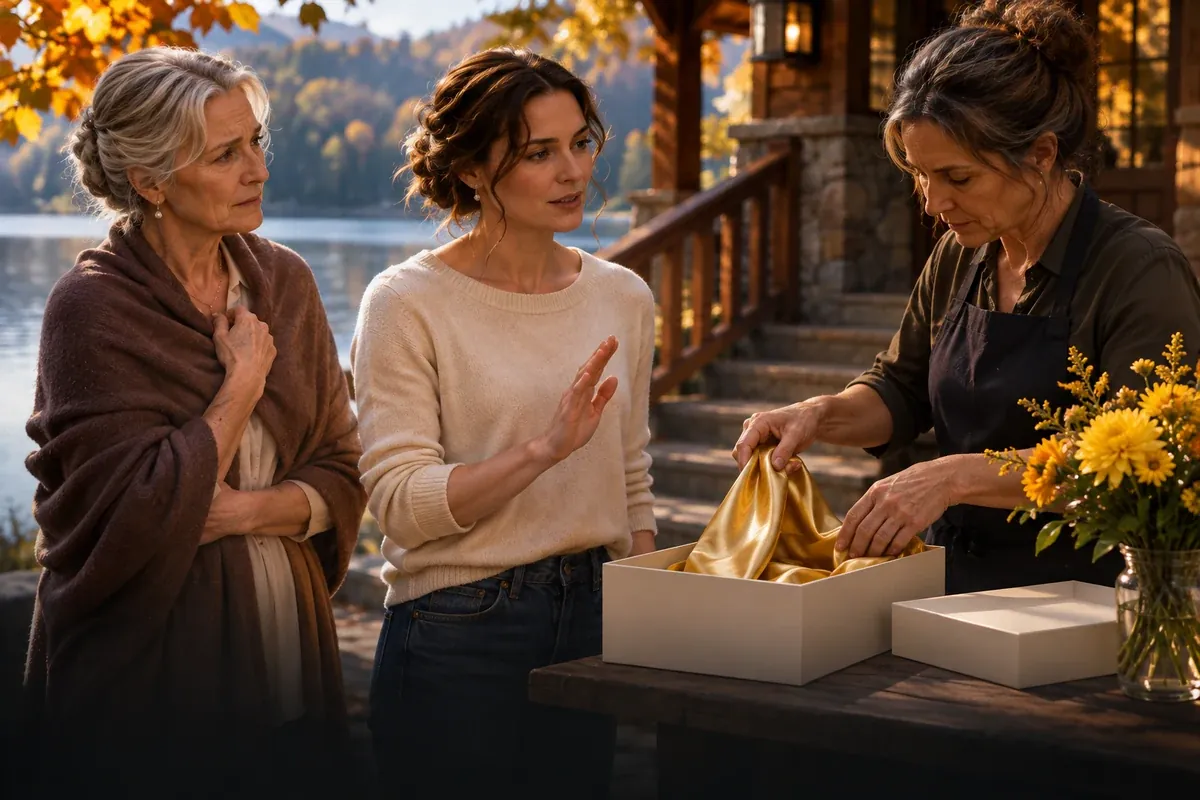
The florist arrives with the remaining yellow flowers and my mother’s gold sash. She wants to know where I want them. For forty-seven days, I have allowed this to be a question about delivery rather than preference.
Today I touch the sash. Heavy, shiny, a small curtain for a person.
“I don’t want to wear it,” I say.
My mother is close enough to hear. Her shoulders lift.
“We chose that together.”
“You showed it to me. I said it was lovely.”
“You could have said you didn’t like it.”
“Yes.”
It would be more satisfying if she were wrong about that.
The florist folds the sash back into its box. No alarm rings. No spoon falls. My mother looks at the closed lid for several seconds, then asks what I would prefer.
“No sash.”
She nods once. We all survive.
Then she picks up the box and walks toward the lodge. I follow because surviving isn’t the same as finishing a conversation.
“I liked choosing things with you,” she says by the steps.
“I liked being with you. I should have said more about the things.”
She holds the lid closed with her thumb.
“You make it hard to know when you’re agreeing.”
There is no accusation in her voice now, only work she would rather not have to do. I recognize it. I have spent the morning trying to discover whether words can be trusted, and she has been trying to discover the same thing about mine for years.
“I’ll try to be clearer,” I say.
I mean to try. I don’t promise I will always manage it. The steps remain underneath us while she carries the sash back indoors.
I expected honesty to announce itself more dramatically. Instead it has removed one accessory from a wedding budget.
I walk to the dock alone and read my list. It matters what I believe. It matters what I intend another person to believe. An error isn’t a lie. Neither is a game if the other person knows we’re playing.
And a truth can hurt without breaking the day.
The lake moves beneath the boards. A man on the far bank casts a fishing line, misses his intended spot, and tries again. I envy his limited definition of beginning over.
On my phone, the residency email sits beneath florist receipts. Accepted. Start date. Travel instructions. My own answer, sent two weeks before the wedding, still looks like the work of a more courageous person.
I open a message to Peter. There is something I need to tell you about Philadelphia.
I don’t send it. The silence does not reset anything either. I make myself write that down. Whatever this day is testing, it hasn’t provided me with a conscience I can outsource.
I can leave that message unsent forever and still call myself accurate. Peter would remain unaware of a decision that changes our first weeks of marriage. The discovery feels less like a loophole than an unpleasantly clear mirror.
At eleven, the florist returns with the bouquet. Yellow roses, little white flowers, a ribbon my mother tied herself. She has worked for three hours, and she looks relieved to place something finished in my hands.
“There,” she says. “Is that what you wanted?”
I like blue wildflowers. I have liked them since I was a girl who pressed them badly in cookbooks. My mother knows this but yellow photographs better, and at some point that became a sufficient reason.
I look at the florist’s scraped thumb, the little white line from a thorn. I cannot bear to make one more person’s morning harder.
“I’ve always loved yellow roses,” I say.
Six twelve.
The alarm plays its three notes. The kettle clicks.
I sit up and press my palms against my eyes while the spoon completes its little journey upstairs.
Forty-nine.
An ugly truth about a gold sash left the whole world intact. A pretty lie about a flower took it away.
I look at my fresh stationery.
The wedding is full of flowers.