

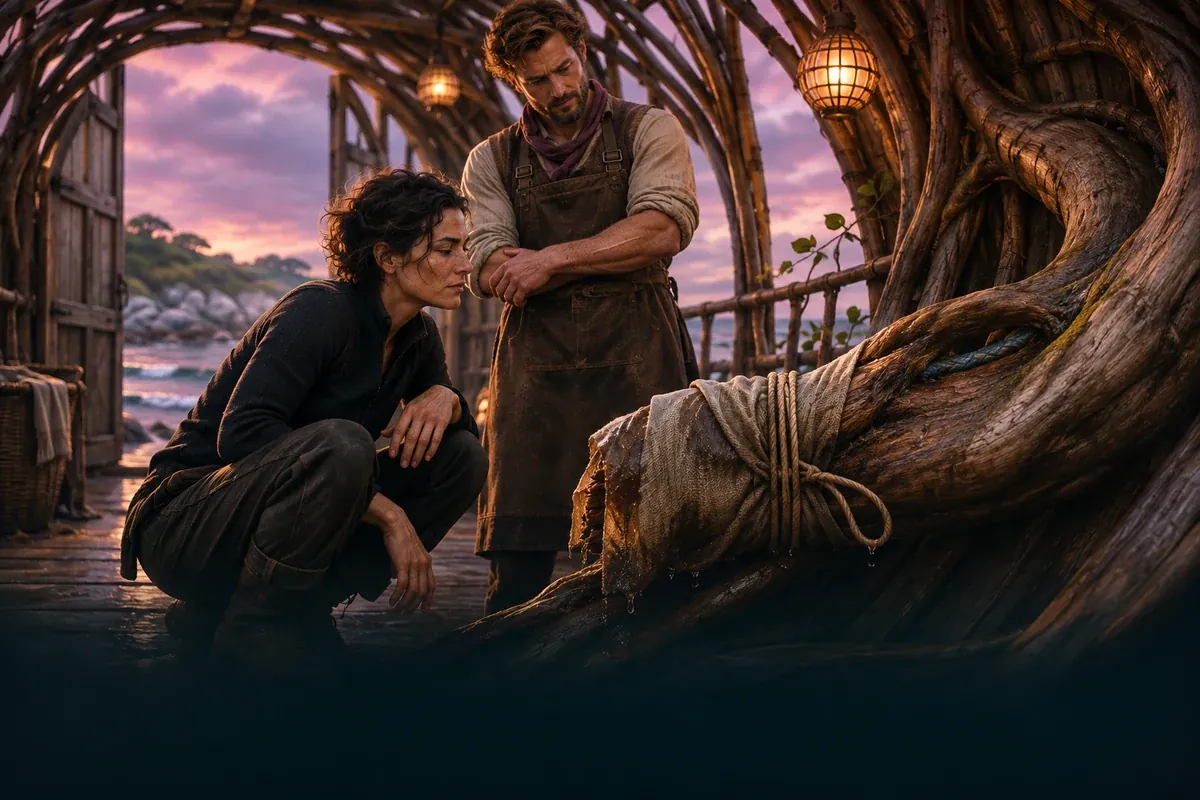
The island was leaving without its pier.
Leda Vale noticed the gap before anyone aboard the mainland packet stopped waving. Six feet of green water separated Saltwake’s pilings from the root-woven shore. The bakery, the white houses, the hillside cemetery: everything moved west together. The pier stayed behind, holding a boy in an orange work vest.
Then the shore gave another lurch.
Leda dropped her bag. “Stop the propeller.”
The captain argued that he hadn’t started it. She pointed at the black line rising through the water, stretched between the boy’s ankle and the departing island. His vest was caught on the rail. The line tightened. He went down on one knee.
A man on shore threw a knife. It fell short.
She knew him by the throw, the angry economy of it. Iven Sayer had always expected an object to arrive where he put it. Six years had broadened his shoulders and done nothing to improve that expectation.
Leda dragged a lifering from its bracket. “Put us alongside those piles. Slow.”
“Are you qualified to give orders on my boat?”
“Qualified to retrieve what falls off it.”
The captain looked at the boy and turned the wheel.
She tied the ring’s line around her waist with room to breathe, handed the bitter end to a deckhand, and made him repeat her signals. No diving into unfamiliar water. No loose loop around his wrist. The ordinary instructions settled her. Panic had very little space left when she gave it a job.
The packet nudged a piling. Leda stepped across, dropped beside the boy, and pressed his shoulder against the rail.
“I’m going to cut your vest. What’s your name?”
“Odo. You’re Leda.”
“That saves introductions. Hold the ring.”
She cut the orange fabric, then the line around his ankle. Released, it whipped into the water with a crack. Odo stayed beside her, shaking. Across the gap, Iven braced against a post that had already tilted fifteen degrees.
“There’s a ladder on our stern,” she called to him. “Can you reach it?”
He looked once at her face. Then he nodded and began directing the people behind him away from the failing bank.
They ferried Odo to shore twenty minutes later. The island had stopped moving. Its new waterfront consisted of a broken fish stall, half a stairway, and a long clot of roots dragging through the shallows like wet hair.
Nessa Fel, still dusted with flour, wrapped Odo in a blanket. “One job,” she told him. “Count the splinters in that bench until your knees work.”
“I’m nineteen.”
“Then count quietly.”
Leda took her bag from the packet. Everything she owned on this trip fit in it: dry clothes, a compact dive harness, a medical kit, and Bram’s last letter. Come before the crossing, he’d written. Something under the east bell is breathing.
After that, three letters unanswered. A message sent by packet captain. Her brother missing for nine days.
She had arranged a mainland job beginning the following week. Find Bram, get him treated, get back to work. The sequence had comforted her on the packet. Here, with the street uprooted and Iven standing beside her, it looked less like a plan than a list of things she couldn’t yet bear to consider.
Iven waited while the packet backed away. His left sleeve was rolled to the elbow, exposing a scar that climbed his forearm in a pale, irregular seam. He held his left hand close to his body. Cold weather, then. A storm that hadn’t reached the sky yet.
“Where’s Bram?” she asked.
“If I knew, my letter would have said.”
He’d written the message. She had recognized the severe upright letters and managed, on the mainland, to pretend that meant nothing.
“His room? His gear?”
“Untouched except for a spare line and the east bell key. Della says he went off on a survey and missed his return boat.”
“Bram sends a note if he changes his lunch.”
“I know. I’ve searched every low tide.”
The correction had no sharpness, which made it worse. Iven knew her brother as a man. Leda still saw a nineteen-year-old she had lifted into a boat, coughing water.
She looked out toward the eastern shoal. “I need a tender. Someone who can keep a line.”
“You’re not going in today.”
“I didn’t ask you to decide that.”
“No. You asked for a tender. My answer is no until we test the water. It brought the wreck back last night.”
For a moment she heard only the gulls.
“Wreckage?”
“The whole thing. Same broken mast. Same lights. It went through my skiff and left everything dry.”
He watched her take that in. She wished he’d looked away.
The ferry house stood farther up the shore, its wide doors open. Inside lay Kindly, the living willow ferry that had carried Saltwake residents across the Cut for three generations. Its hull should have been silver with healthy bark. Instead, cracked gray plates lifted from the ribs. A handful of leaves clung to the rail.
Leda hadn’t seen it since the wreck. She’d refused a bed near the harbor while she recovered, then left before she could walk without a cane.
“You kept it,” she said.
“It was alive.”
Iven laid his good hand on the gunwale. A leaf turned toward him. The intimacy of the movement hurt her in an unexpected place.
“I need it working before the crossing,” he said. “Three days. The little boats can take people off in good weather, but they can’t carry them through the Cut in a storm. Kindly can.”
“Have you started evacuating?”
“Yes. Eleven left yesterday. Most won’t leave while their houses are moving. We’ve stocked the old quarry landing as a temporary refuge. It’s on this side of the Cut. Small boats can reach it inside the harbor, before we commit to deep water.”
“Houses can be replaced.”
“You can tell them. They might enjoy hearing it from somebody who got out.”
She deserved some of that, though not all. Before she decided which part to answer, he pointed beneath the bow.
A thick root lay curled inside the hull. Someone had wrapped its broken end in a wet sack and tied it with a distinctive knot: two turns, a small open loop. Leda’s knot. She’d invented it at seventeen so she could release a line one-handed.
“Bram brought that back,” Iven said. “He thought it might take a graft.”
Leda crouched. Deep inside the old root was a length of blue cord, blackened by seawater. Six years ago she had tied that cord to the rescue chain. Six years ago she had cut it.
“Could he have found this in the wreck?”
“That’s what I hoped you’d tell me.”
She reached toward it. The root twitched away from her fingers.
Outside, a bell rang three times. Paused. Rang twice.
Leda stood so fast she hit her head on a rib.
Bram’s signal. As children they’d used it through the floor: three taps for are you awake, two for come and get me.
She ran to the open doors. Across the shoal there was no boat, no bell tower, nothing but flat water. The east bell had sunk with the old pier six years earlier.
Three strokes. Two.
Beside her, Iven gripped the doorframe.
“Tell me you heard that,” she said.
“I heard it.”
The water beyond the broken pier lifted into the shape of a staircase. A wet footprint appeared on its lowest step. Then another, climbing toward them.
Leda set her bag down again.
“Show me your tests.”