

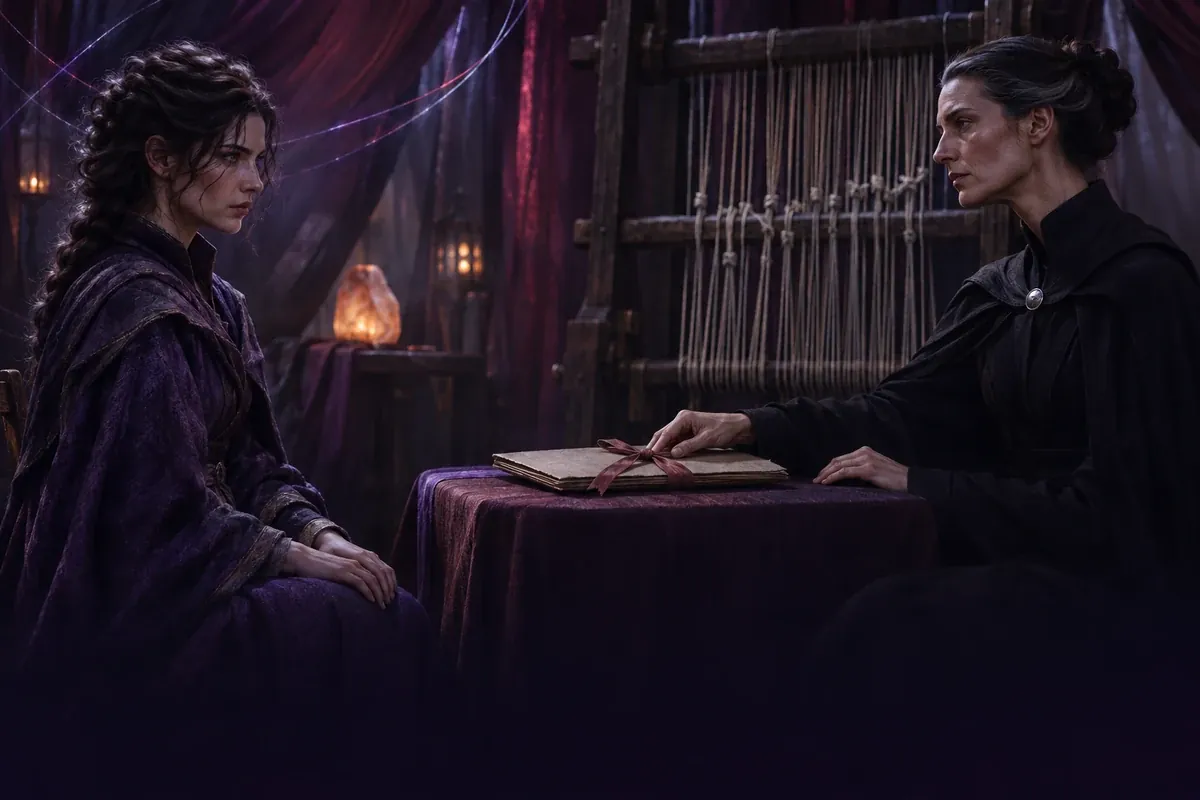
She asked for me by name, in writing, under a flag of truce, and she asked for the camp’s chapel tent, which the Iron Fold kept for the soldiers who still believed in anything.
“Do not go,” said Brannic, in the flat voice that meant he had stopped sleeping. “It is a trap with incense.”
“Of course it is a trap,” I said. “She has a file on my mother. If I stay away, I will spend the rest of my life guessing what is in it.”
“The chapel is eighty paces from His Majesty’s tent,” said Pell, who had been drafted into the argument as a unit of measurement. “Inside the radius. Close enough that he could hear a shout.”
“Then I will not shout.” I looked at the king, who stood at the map table with his hands braced on it and had not yet said one word. “Majesty. I would like your consent, not your permission.”
“Is there a difference?”
“A large one. Permission is for subjects.”
Something that might have been the ghost of a smile touched his mouth and left. “You have it,” he said, “and if you are not out in an hour, I will take the chapel apart with my hands. Veska Lor knows I am capable of it. She will behave.”
The Order’s chapel in the Iron Fold was a plain tent with a plain loom in it: an old frame of dark wood, warp threads strung from lintel to floor, a shuttle on a cord. Soldiers who still believed in anything tied a knot at it before battle. There were a great many knots at the bottom of the frame, small and crooked and soldier-shaped, and I found that I did not want to look at them.
Veska Lor sat on a camp stool in front of the loom with her hands in her lap. She had taken off the pilgrim’s gray. She wore the black of the Shear Court, severely cut, with the silver loom at the throat, and without the vigil’s white behind her she looked smaller, and older, and a good deal more dangerous. A table stood between us. On it, a plain folder tied with a faded ribbon, thick as a Psalter.
“Maren Vael,” she said. “Sit. I will not poison you. It is a wasteful method and it makes for dull theology.”
I sat. I kept my hands on my knees, where the coil lay quiet under my cuff, and I did not look at the folder. “You wanted to see me.”
“I wanted to see how you look at it. Everyone does, you know. The folder. Even those who say they do not care.” Her mouth moved, without humor. “You have your mother’s trick of not looking. She stared at the ceiling the whole of our one interview. I counted the cracks with her.”
I had been braced for many things. Not for that. “You met my mother.”
“I interviewed her. Eleven years ago, in a cellar under the Basilica, for three days. She was thirty-eight years old.” Veska Lor smoothed the folder’s ribbon with one thumb. “She had been hired by the Order, through intermediaries, to sever a dynastic thread in the Calde succession. She did the work. Then she came back to ask who held the other end, which is the kind of question the Order is allergic to, and I was sent to ask her why.”
“And why was she there, in your cellar?”
“Because she would not stop asking.” She said it simply. “That is all a heretic is, Cutter. A person who will not stop asking.”
I made myself breathe. “Where is she?”
“I do not know.”
“You have her file.”
“I have the file. It stops on the third day. After that, there is a transfer order signed by the Reader-Superior and a line that says the matter has been resolved.” Veska’s gaze held mine, level, unhurried, and I had the sudden unsettling sense that she was not enjoying this. “I was twenty-nine. I believed in the file. I did not look for the rest of it. I have been looking since.”
“Why?”
“That is what I came here to tell you.” She leaned forward an inch. “Seven years ago I was Read, as inquisitors are, in the ordinary course. The Reader-Superior himself. A great honor. They told me my thread ran to a man named Aldous Frell, a magistrate in Harrowmere, and I wept, because I was thirty-three and had not thought it would be anyone.
I went to meet him. We were married in the autumn.” She paused. “In the winter I found a letter in my husband’s study. It was a receipt, Cutter, from an office I had never heard of. For the arrangement of a match. Paid in full. The line item read: one gilded thread, rooted, for one inquisitor of the Shear Court, to ensure continued zeal.”
The tent was silent. Behind her the loom frame hung with its soldiers’ knots.
“I did not tell anyone,” said Veska Lor. “I buried it. I buried him, in fact, two years later, of a fever. I told myself that the Weaver’s ways were hidden and that I must have misread the paper. I did not say, even to myself, that I had spent seven years being pointed at the work by a rope someone else tied.”
“Warp Office,” I said.
“You know the name.” Not a question. Her eyes sharpened. “Of course you do. Brannic’s chancery has been asking in four cities. I wondered when it would reach you.”
“If you know what the Order is doing, you could stop it.”
“I could be the loose thread they pull out of the weave. They would not kill me. They would find me a new husband.” Her smile this time was thin and utterly without joy. “I am not here to be saved, Maren Vael. I am here to buy something. I would like your testimony.”
“On what?”
“That the King of the Four Rivers procured the severance of his own thread, by heresy, in violation of the Weaver’s order, in the presence of a witness, with the cutter acting as his hand. A short statement. A signature. The Shear Court would then take him under its jurisdiction, in the matter of a dynastic crime, and a king under the Court’s jurisdiction cannot be married to a gilded princess without the Court’s approval.” She spread her hands. “Which the Court, naturally, would withhold. For as long as it takes me to find the loom.”
“You want to use the Order’s own law to freeze him.”
“I want to use the Order’s own law to keep him alive and unmarried while I find the room where these are spun,” said Veska. “In return, you receive immunity under the Court’s seal. A full pardon, entered in the register of Reader-Superior Hale himself, who owes me two debts. You receive the file.” Her fingers rested on the folder. “And you receive my word that I will not call you a heretic in any court I attend.”
For a moment, I let myself want it. I will be honest about that. I have been honest about so little else. I looked at the folder, thick as a Psalter, tied with a ribbon, with my mother’s last three days in it, and wanted to pull it open and read until my eyes went.
Then I thought: a signed statement that Cassian Dreth procured his own severance is a confession. It is also true. And a true confession in the Order’s hands is not evidence. It is a leash.
“No,” I said.
“You did not weigh it.”
“I weighed it.” I stood. My knees were not entirely steady, which I hoped she would put down to the heat. “You are asking me to hand a man to the Court because the Court may be more careful with him than the Order. I do not think the Court is careful. I think the Court is what the Order uses when it needs its enemies to stay still.”
“That is a heretic’s view.”
“It is a cutter’s.” I picked up my gloves. “You came to tell me about the receipt. I believe you, Inquisitor, and I am sorry. I would very much like to read my mother’s file. I will pay you for it. I will not pay you in him.”
Veska Lor did not move. She looked up at me, and for one heartbeat the careful face cracked, and I saw the thirty-three-year-old woman who had wept at her own match. Then it closed, like a door.
“Then I will have to take both, in time,” she said. “I regret it. Take my regards to your king.”
I walked out into the evening, past the soldiers’ knots on the loom, with my hands very steady and my throat tight as a purse. Cassian was standing outside the tent, under the lantern, with his sword on his hip and his hand nowhere near it, and when he saw my face he did not ask a single thing.
He walked me back to my tent, the long way, around the horse lines. It was the first time I understood that a silence can be a courtesy. When we reached the flap he said only, “Eat something,” and I laughed, once, in the dark, and he turned to go.
I did not sleep. I lay on my cot with the coil warm on my wrist and my mother’s face in my head, the way she looked when she pressed her thumbnail into her arm, and sometime past the third bell the dream began.
Not mine. I knew that even asleep. It was a dream in the colors of other people’s weather: a long corridor, a door warm to the touch, smoke thin as a rumor under it. A hand on the lock. A small voice calling, and calling. Somewhere above, a window with no glass in it, and past the window a garden I could not reach.
I woke with the taste of ash in my mouth, which was not mine either, and the sound of my own breath going fast in the dark. The coil was hot. Not fire. A pulse, a slow steady thud, like a second heart laid against the wrist. And on it, faintly, like a note slid under a door, a feeling I could put no name to except that it was not grief and not fear. It was attention. Someone, a hundred and some paces away, was awake and had tasted me.
I got up. I put on my coat. I walked out into the cold, and I did not look at the king’s tent, and I walked to the edge of the lines where the old fairground fence ran out to the dark, and stood with my arms around myself like a person waiting for a ferry.
“I did not mean to,” said Cassian, from behind me.
I did not turn. “The thread is a gossip.”
“It is.” He came to stand beside me, not too near, which in our case was a thing that had to be calculated. The night smelled of horses and woodsmoke. “I woke up tasting salt and a cellar and a woman’s voice. I think you were dreaming of your mother.”
“Your window was in mine.”
“I know.” A small silence. “I am sorry for that. I would have kept it, if I knew how.”
“You said you would learn the difference,” I said, and I heard my own voice crack. “Between fear and care. I am trying to learn it too. It is very hard to tell, when the arm is the one that tells you.”
He did not answer. He stood there, a tall plain man with a burned neck, looking at the dark beyond the fence, and the coil on my wrist went quiet and warm and total, the way it does when he is near, and I thought: this is the leash. This is the thing I want to cut. And I did not want to cut it, in that moment, and I was ashamed of how much I did not.
I turned. He was closer than I had thought. The lantern behind us put a halo of light on the edge of his face and left the scarred side in shadow, and he was looking at me with that terrible attention, the thaw-flood in the gray, nothing held back, nothing for once arranged. I saw him see me see it. I saw his hand come up, slowly, as though I were a thing that might startle.
“Maren,” he said.
“Majesty,” I said. It was meant to be a rebuke. It came out a question.
“MAREN!”
We sprang apart like a pair of thieves. Down the dark row of tents, a figure was running, arms windmilling, coat open, a whistle on its lips that had stopped being tune and become terror. Jory skidded to a halt in front of us, red-faced and out of breath and entirely without tact, and he looked from my face to the king’s and back again, and for one of the very few times in his life, said nothing at all.
“What,” I said, “is it.”
He swallowed. “The camp is saying,” he got out, “the whole camp is saying, and Brannic’s runners are saying, it was in the dispatch, it is official. The betrothal. The king and the princess. It is in six days, Maren. At the Basilica. In front of everyone.”
Cassian said nothing. Beside me I felt the coil go still, absolutely still, as though the thing on my wrist was holding its breath, and then, very slowly, begin to burn.