

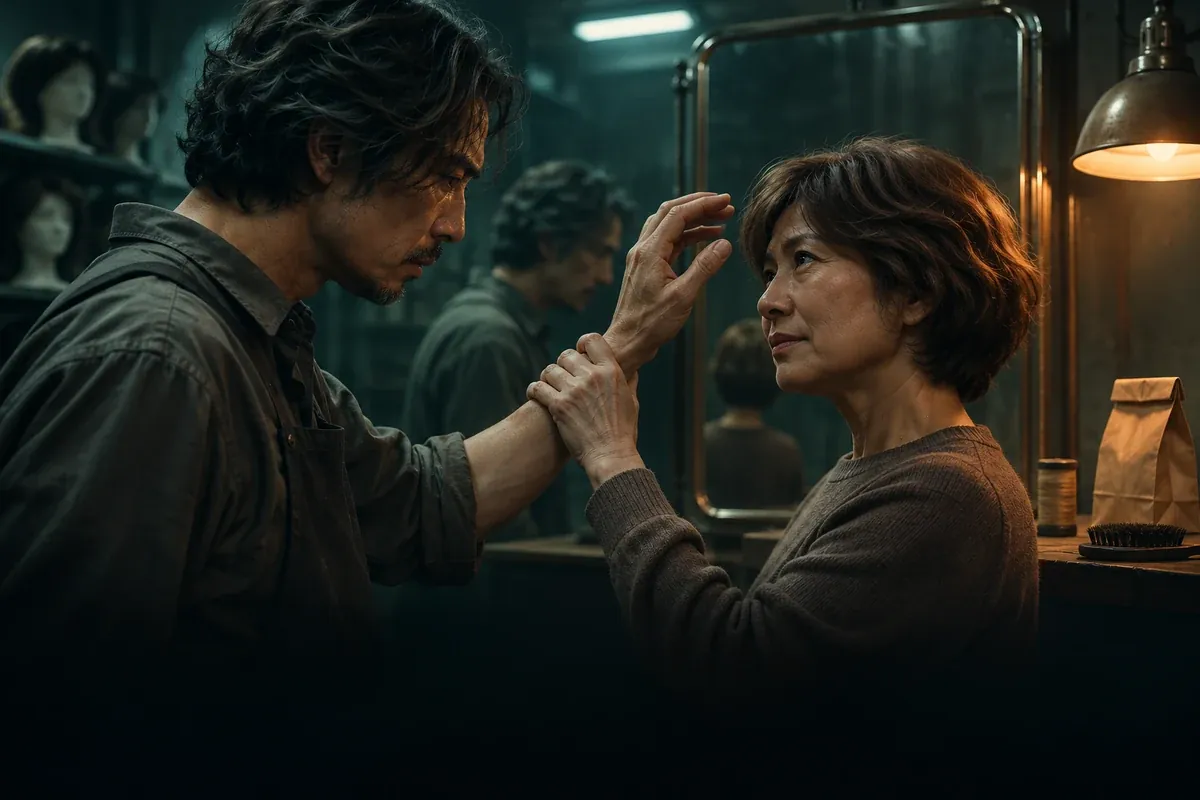
Rena arrived wearing a knitted hat with a hole near the crown. Through it Gareth could see the bare patch of scalp she had never minded him seeing, provided he didn’t treat it as an invitation to be sad.
She put a paper bag on the reception counter.
“Lunch. You said workshop problem. That usually means you forgot.”
He didn’t want food. He wanted her to look in the drawer and tell him the eye was some obscure natural consequence of materials stored too long in an unheated room.
Instead he brought out her wig.
It was a plain brown piece, shorter than the one she had worn for years. She lifted it onto her head, made one adjustment at the back, and turned to the mirror.
Gareth’s left hand came up toward her temple.
She caught his wrist.
“Ask.”
“There’s a strand across the corner.”
“I can see it.”
“It takes one second.”
“So does asking.”
He lowered the hand. She let go. The first time she’d done that, years ago, he’d considered her difficult. He had since learned that difficult was often what he called a person who hadn’t hired him to make every decision.
Rena moved the strand herself, left it somewhere he wouldn’t have chosen, and smiled.
“That’s better. Now, what’s wrong?”
He showed her the drawer.
She looked for a long time. Then she stepped away, took the new piece off, and put it on the counter.
“Is mine doing that?”
“No.”
“Have you checked?”
He had checked its underside that morning. He checked it again in front of her, using his right hand. It was mesh, clean knots, a small strip of elastic. Nothing warm. Nothing looking back.
Rena examined it herself. She put it in the paper bag and folded the top.
“I’m leaving that out here.”
That was her first practical decision. Gareth felt ashamed of how much calmer it made him.
The cap in the drawer had two eyes now. Both held the same whorled ridges. The face between them was shallow, as though someone had pressed a soft material onto the back of a hand. It had no nose yet, only a long raised line.
Rena leaned forward without touching the bench.
“Who did you make it for?”
“Nobody. I taught from it.”
“Does it look like someone?”
He wanted to say no. He wanted more badly to say yes, because a resemblance would give the thing a category. But the shape wasn’t a former customer or a remembered face. Its eyes were his thumbprints. The ridge between them followed the curve of his knotting tool.
“It looks like work,” he said.
Rena didn’t laugh.
He told her what his hand had done. She asked whether it was still doing it. While he considered the answer, his left fingers brushed the bench in a small sweeping motion. It was how he cleared clipped hair from a working edge.
There was no hair there.
“Sometimes,” he said.
She pushed a chair behind him and sat in the other one. She didn’t ask permission to sit. The distinction, under the circumstances, was welcome.
He explained that the cap had been unfinished for perhaps twenty years. He had begun it while teaching a young man who hadn’t liked the work and had left after a week. Later apprentices had practiced on separate scraps. Gareth was the only person who had resumed this one.
“So this isn’t someone’s hair remembering a dead person,” Rena said.
“We don’t know what it is.”
“No. But you don’t get to make one of the women who donated hair into the reason.”
He looked at the drawers full of ordinary cut hair. She was right. Nothing in them had changed. The only thing with a face was the sample he had been working every evening, knot after knot, until his wrists ached.
They tried a new piece of mesh with hair from the same packet. Gareth made one knot with his right hand. It remained a knot.
He stopped before habit could turn the test into a row.
Rena put the little test square on a clean saucer, away from the drawer. They watched it while the clock above reception clicked through five minutes. Gareth expected some response he could compare: movement, warmth, a change in the mesh. The square remained a damp-looking collection of hair and thread. Rena moved the saucer farther away. Nothing changed.
He found a second sample he’d made the previous month. Ordinary too. Its knots were equally neat. It had been worked by the same hands, from similar materials, and it refused to offer him an explanation. He wrote its date on the saucer’s paper liner. Rena watched him resist adding another sentence that would have turned a small observation into reassurance.
The old cap twitched.
Rena asked for a glove. He gave her a soft cotton one used for handling finished pieces. With the tweezers, she laid it beneath the cap’s narrow edge.
The face relaxed. Gareth hadn’t noticed how tightly it had been drawn until its cheek flattened.
His own left fingers loosened at the same time.
“Can you move them?” she asked.
He spread them. They obeyed.
She lifted one corner of the glove. The face tightened. His thumb bent toward his palm. She lowered the cloth immediately.
They sat without talking for a moment.
“It feels attached,” he said.
“But I can’t see anything between you.”
He couldn’t either. In the strongest light, when he held his hand at the right angle, a line seemed to run from the puncture beside his nail into the cap. Then it vanished against the air.
Rena took her coat off. Gareth told her she didn’t have to stay.
“I know. What are you going to do?”
“Remove the perimeter. That’s what I added this week.”
“Will that hurt you?”
“I don’t know.”
“Then you don’t start by pulling.”
He had been about to pull. He set the tweezers down.
He showed her how the teaching cap was built. The dense hairline was separate from a narrow continuous tacking strip around its outer edge. It was his own old method, elegant and needlessly exact. Once removed from its final knot, the strip could be opened a short section at a time. Repaired from inside, then turned back.
Rena asked why he didn’t simply cut the strip.
“In an ordinary piece, I could. But it leaves more ends to secure.”
“Does this look ordinary?”
He had no answer. He did have scissors. He fetched them and laid them on the bench.
A message arrived from Colm confirming the value assigned to the training stock. Gareth answered with his right thumb. It took longer than usual. Rena opened the sandwiches and put half of one beside him.
While he ate, his left hand found a pencil.
He watched it move. He had not decided to write. The pencil rested between his fingers in the tight grip he used when marking a fitting form. It made a neat box on the paper, then another beneath it.
Inside the first box, his hand wrote a time.
Inside the second, it wrote CUSTOMER.
There was no name. The word seemed to refer to whoever would sit in the chair.