

"Don't go," my mother said.
She was standing at the bottom of the stairs in her bathrobe at eleven-forty, arms crossed, the way she used to stand when I came home past curfew in high school.
"I have to." I zipped my coat to the chin. "If I don't, he comes here. And if he comes here, he sees her again, and he's not stupid, Mom. He saw her thumb thing this morning. I watched him see it."
Something moved across my mother's face. Fear, but something else too. Something I didn't have time to read.
"Then tell him," she said quietly. "Tell him yourself, before that awful account does it for you."
"I will." I wasn't sure it was true. "Lock the door behind me. Check on her every hour."
"Laney—"
"Every hour, Mom."
The river path ran from the bottom of Front Street along the water for half a mile, past the ferry slip, past the old cannery, to where the town ended and the Ashcroft land began. I could have walked it blindfolded. I'd walked it every night that summer, barefoot, sandals in my hand, heart in my throat.
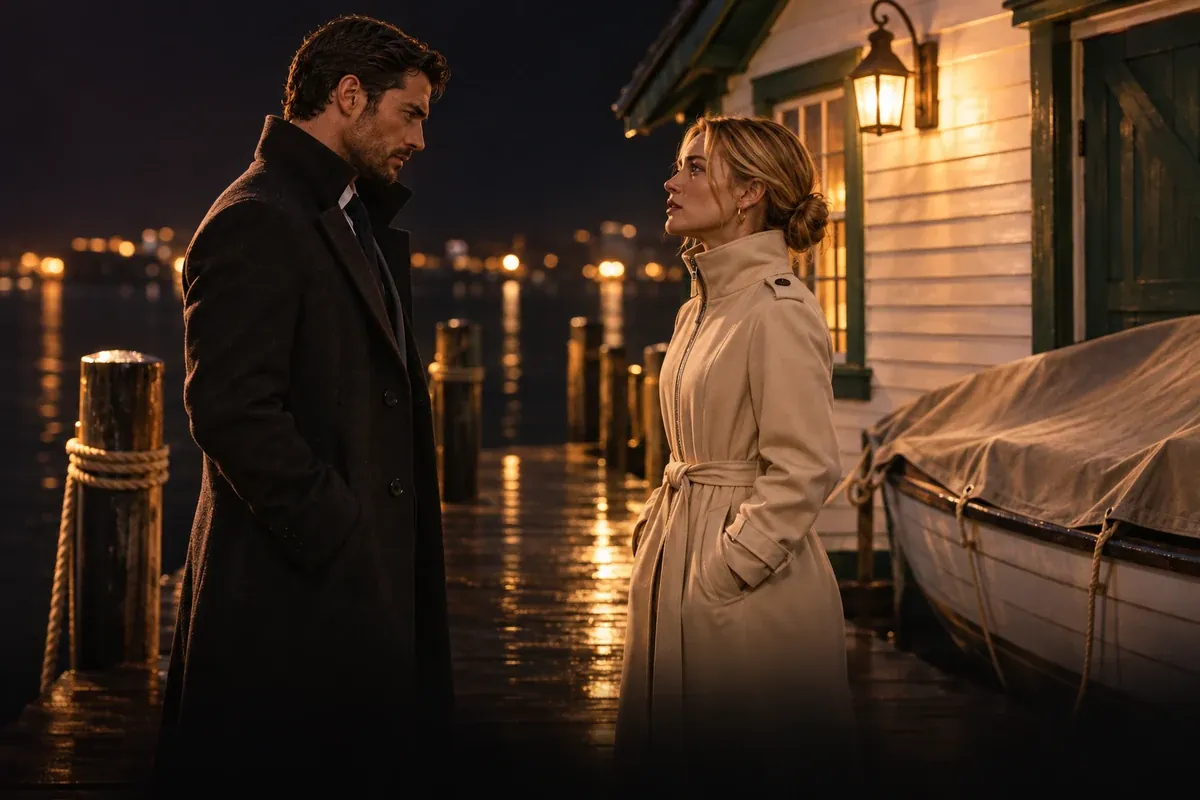
The boathouse sat at the edge of the Ashcroft estate where the lawn rolled down to the river. White clapboard, green trim, a long wooden dock stretching out into the black water. A single lantern burned on the porch.
He was waiting at the end of the dock with his back to me, coat collar up against the wind. Beside him, under a canvas tarp, I could see the curved hull of a small sailboat.
He'd kept the Marigold.
That almost undid me more than anything else.
"You came," he said without turning around.
"You threatened me."
"I asked you."
"You asked like a hostile takeover."
He turned then. The lantern light carved his face into angles. "Sit down, Laney."
"I'll stand."
"Fine." He took a breath that looked like it hurt. "Then let's start with the easy part. Six years ago my father died on a Tuesday. On Wednesday, a terminal fire in New Jersey nearly bankrupted the company, and I was CEO by Thursday. I didn't sleep for three weeks. And the whole time, I called you. Every single day."
I stared at him.
"Your number was disconnected," he said. "So I drove up. I stood in your mother's bakery, and she told me you'd gone to California. With someone else. She said you'd asked her not to tell me where."
"That's not—" My voice cracked. "I never went to California."
"I know that now."
"And you didn't call. I called you. Fourteen times. Your office said you were unavailable. Then I wrote you a letter, and a month later you wrote back."
His brow creased. "I never wrote you a letter."
"Ashcroft letterhead, Gideon. Your signature. 'Mr. Ashcroft has received your message and wishes you well. He has no interest in pursuing this further.'" I'd memorized it. I'd read it so many times the creases had worn through. "There was a check for two hundred and fifty thousand dollars. In consideration of my discretion."
The silence that fell over the dock was so complete I could hear the river sucking at the pilings.
"I didn't," he said. Very low. Very dangerous. "I swear to you on my father's grave, Laney, I never sent you a letter. I never sent you a dime."
"Then who did?"
"I don't know." He stepped toward me. "But you took it. That's what my mother said. She said the Brooks girl took the money."
"I tore it into eight pieces and threw it in the trash!"
My shout bounced off the water. Somewhere across the river, a dog barked.
We stood three feet apart, breathing hard, and I watched him realize what I was realizing. Somebody had stood between us six years ago and cut every line. Somebody with his letterhead and his office and his mother's ear.
"What message?" he asked suddenly.
"What?"
"The letter. 'Mr. Ashcroft has received your message.' What was the message, Laney? What did you write to me that was worth a quarter of a million dollars to make go away?"
There it was.
I had stood in front of cameras and congressional aides and furious billionaires. I had never once been at a loss for words. And now, on the dock where he'd first kissed me, I opened my mouth and nothing came out.
Tell him. Just tell him.
"Gideon," I said. "I was—"
His phone buzzed.
He ignored it. It buzzed again, and again, a rapid stutter of notifications, and his jaw tightened as he pulled it out to silence it.
Then he looked at the screen, and his face changed.
I have watched men read the worst news of their lives. I know what it looks like. It looks exactly like nothing at all, for one long second, and then like a building coming down.
"It's from the account," he said. His voice was strange. "FerryTales. They sent me a file."
He turned the phone toward me.
It was a lab report. Clean white letterhead from a genetic testing company in New Jersey. Two names at the top.
Alleged father: Gideon Ashcroft.
Child: P. Brooks.
Probability of paternity: 99.98%.
Underneath it, a single typed message: She lied to you this morning. Ask her how old the girl really is.
The world tilted. Not because he knew. Because of what it meant.
Someone had gotten close enough to my daughter to take her DNA. A cup. A spoon. A strand of hair off a coat. Someone had stood near her, near enough to touch her, and I hadn't been there.
"Four," Gideon said. "Almost five. That's what you told me."
I couldn't breathe.
"Laney." His voice broke on my name. "Look at me."
My phone rang.
MOM, the screen said. At midnight.
I answered with shaking hands. "Mom?"
"She's gone." My mother's voice was a thin, terrified scrape. "Laney, her bed's empty, the back door is open, I only went to the bathroom, I swear to God, I only—"
"Poppy!" I spun toward the path, toward the town, toward the black ribbon of water that ran between here and there. "Poppy!"
And from the shadows at the far end of the dock, a small voice said, "Mama?"
She was standing near the edge of the dock in her pajamas and her yellow raincoat, Captain Biscuit dangling from one hand. Her feet were bare and muddy. She must have woken up, seen me from her window, and followed me down the river path in the dark.
"Mama, you left without saying goodbye," she said, her lip trembling. "You always say goodbye."
"Baby, don't move. Stay right there. Mama's coming."
She took one step toward me.
The boards were wet. Her bare foot slid.
I screamed. Captain Biscuit went flying. A small yellow shape tipped backward toward the black water, arms pinwheeling—
And Gideon was already moving.
He crossed the dock faster than I'd ever seen a person move. He threw himself flat, one arm hooked around a piling, and caught her by the back of her raincoat a split second before she hit the river. For one terrible heartbeat they both hung over the edge. Then he hauled her up and against his chest and rolled away from the water, and they lay there on the wet boards, both of them gasping.
I fell to my knees beside them.
Poppy wasn't crying. She was staring up at Gideon's face with enormous gray eyes, the same storm-cloud gray that was staring back down at her.
Then she looked past him, at the tarp, at the slim curve of the hull sticking out from under it, at the faded painted name on the stern. The Marigold.
"That's the boat," she whispered. "From my picture."
Gideon didn't move.
"You're the sailor," Poppy said, with complete, sleepy certainty. "Mama said you live far away on the water. But you were here the whole time."
Gideon looked up at me over my daughter's head. His phone lay face-up on the dock beside him, the lab report still glowing white in the dark.
"Laney," he said, and his voice was nothing but a ruin. "Is she mine?"