

RUNNERS, the air in front of my face says, in tall capital letters, and then, a second later, NOT INVADERS.
I am on the shelter steps at ten forty at night with a sandwich in one hand and the day’s herring math in the other, and Dennis is standing at the bottom of the boat ramp with the harbor lights on his back, tapping. Since Ines signed for him, the Lot has been translating. It does not give me his voice. It gives me his taps, spelled out and floating, with the patient precision of a court reporter who disapproves of the witness.
“Say again,” I say.
PIER NINE. SIX. THEY ARE COMING OUT OF THE TRENCH. THEY ARE TIRED. THE MAN WITH THE LONG GUN IS ALSO COMING.
“Which man?”
THE ONE WHO SMELLS LIKE DIESEL AND DOES NOT TALK.
I put the sandwich down on the step. Okay. Okay.
I do not remember getting into the van. I remember Dennis keeping pace along the seawall at a sideways scuttle that eats up a hundred yards a minute, and the radio saying that the Marguerite’s crew had been seen walking the cannery road in rain gear, and the fog, which had been a thin gray ribbon at dusk and has now come in thick enough to wrap the headlights.
Pier Nine is the old cannery pier on the north side, three hundred feet of rotting timber that the town has been meaning to tear down since before I was born. Nobody uses it. Everybody knows where it is.
I park at the foot of it, kill the engine and open the window.
The first thing I hear is the sound. It is low and wet and very large, a kind of blowing groan that I know from a documentary and from nowhere else, and it rolls up the length of the pier and makes the pilings hum. Then something answers it, higher, in a thin cracked bleat like a kid’s trumpet.
I take the pole, the headlamp, the freeze-dried liver. I leave the leash.
At the end of the pier, in the headlamp’s beam, is a walrus.
Adult female, I think, approximately two thousand pounds, hide scarred pink and gray, whiskers as thick as pencil leads. She has dragged herself up the last of the boat ramp onto the planks, and she has one tusk. The left is broken off at the root, a ragged brown stump, and the right has grown in a long spiral like a drill bit, the way a tusk does when it has nothing to wear against. She is breathing in great shuddering hauls.
Against her flank, pressed into the folds of her side, is a pup the size of a sofa cushion, gray-brown, eyes huge.
Behind her, along the planking, is the rest.
Three dogs, I think, and then I look again. They are the shape of Labrador puppies and the color of a wet slate roof, with webbed feet and a thick ruff along the throat, and under the ruff, opening and closing, is a row of narrow slits. Gills. They are huddled together in a knot with their tails over their noses, shaking, and when my light crosses them one of them lifts its head and lets out a bark like a foghorn the size of a coffee mug.
And last, in a line like kids on a school trip, a flock of puffins. They are the size of terriers. They are waddling up the ramp one after another, with their orange bills hanging low, their feathers soaked flat, their eyes round and bright and utterly done with the day.
Six, Dennis said. Walrus. Pup. Three dogs. A line of birds, which I suppose counts as one. I check my watch. It is ten fifty-three.
“Intake,” I say, under my breath. “Walrus, adult female, ruined left tusk, temperament poor. Pup, approximately six weeks. Three dogs, no tags. One flock of waterbirds, no tags.” I take a step. “Okay. Okay. I’m not going to hurt anyone.”
The walrus lifts her head and looks at me, and I feel it go through me like a bad road.
It is nothing like Dennis’s fear. Dennis’s fear was a patient pressure, an animal waiting to see what I would do. This one is raw and whole and huge. It slams into my chest as if I have stepped into a freezer and shut the door. I stagger, and it is not a figure of speech. My left knee gives. The pole clatters on the planks. I hear myself make a high, thin, ugly sound and I put out a hand and find a piling and hold on.
[Fear in range exceeds Calm. SPIRAL.]
The headlamp tilts. My hands tremble from the wrist, in a pattern I have seen in a hundred dogs in a hundred cages and never once had in my own fingers. My breath goes short. The planks are very bright. A cold, round ring of panic sits in the middle of my head, and every thought I try to have goes around it and comes back.
I have not impounded anything. I have not tagged anything. I have only walked up to a frightened animal in the dark with a pole, and the System does not wait for the Lot. A Warden feels any fear she is near, and I am near a great deal of it. Calm fourteen. A two-ton animal with a pup and a bone-deep dread of men with guns, and five more behind her.
“Okay,” I say. It comes out as a whisper. “Okay. Okay.”
Soft Voice. I think it at the three dogs, because the three dogs are the smallest piece of the pile and the only one I might reach, and I make my tongue work.
“Hey, you. Hey, little ones. It’s all right. It’s all right now.”
I do not know if it is the words or the voice or the skill, the way a net is not the cord it is made of.
It goes out low and warm along the planks. The first dog stops shaking. The second puts its chin on the first. The third crawls on its belly across the wet boards toward me, a few inches at a time, the foghorn in its throat gone down to a squeak. It puts its wet nose on my boot, and I feel its fear roll off and go, like water going down a drain, and the ring in my head loosens one notch.
[Soft Voice applied. Panic reduced in three targets.]
I can breathe. I can see. The walrus is still looking at me, and her fear is a weight I cannot lift.
“Okay,” I say to her. “Okay, Mama. I’m going to put a net on you. I know what that sounds like. I swear to you it’s the kind that holds you and doesn’t hurt.”
It is a stupid thing to say to a walrus. I say it in my best, softest voice. I raise the pole.
That is when the lights come up on the cannery road.
Three sets. High, white, coming fast, the beams swinging across the fog and turning it to milk. Engines. The crunch of tires on the gravel apron. A door. Another. Boots on the planks, three men, heavy, unhurried.
The walrus screams.
I have heard a lot of animals scream. I do not know how to describe this. It is the sound of the whole pier made into a throat. She heaves up on her flippers, the pup squealing under her, and the fear that comes off her this time is not a weight but a wave, and it lifts me clean off my feet and puts me on my back on the planking with my teeth clacking.
Somewhere in the next few seconds I lose track of the time, a missing piece like a skipped track, nothing so polite as a faint. When I come back, I am on my side, with my cheek on the cold wet boards, and the only thing I can see is a pair of black rubber boots, planted a yard from my nose. A bruise is coming up on my forearm, in a long curved row of marks the exact shape of a mouth that is not there.
Above the boots, quite far up, a man says, “Officer.”
I know the voice. It has said that word to me a hundred times at a hundred town meetings, always like a verdict.
“Get up,” says Calloway Varga. “Please.”
I get up. I do it badly, one knee and then the other, with the pole as a cane. Cal is standing between me and the walrus with a harpoon gun at his shoulder, in black raingear gone shiny with fog.
Behind him are two of his crew, Hollis and Dunn, big men in orange slickers, each holding a gun of his own. Their frames say CULLER. Under them, in the gray, I read Strikes: 0 and Strikes: 0. Under Cal’s name, the number is 31. It does not look good on him.
“Step aside,” Cal says. His voice is flat. His eyes are on the walrus. “Officer.”
“No.”
“It’s a hundred and twenty coin.”
“I’ll pay you a hundred and twenty coin.”
“With what?”
I do not have an answer. He knows it.
“Step aside,” he says again, a little lower. “The animal is a threat to the harbor.”
“She’s tired,” I say. “She’s got a pup. She’s scared out of her mind, and so is every one of them, and if you shoot her you’ll make it worse.”
“Worse how?”
“She’ll thrash. She’ll crush the pup.”
“Then the pup is a threat too.”
“Cal.” I have never used his name to his face. It is a strange feeling, like a coin I have carried a long time without noticing. “They came up out of the water. Something chased them. Look at them.”
For one second his eyes come off the walrus and go to me. Gray eyes, tired eyes, a face like a closed door.
He looks at my arm, at the bruise, at the dogs tucked behind my legs, at the puffins crowding up the planks in a long, orange-billed, shuddering line. Something moves across his face that I would not call softness. It might be pain. He has the look of a man who has been carrying a very large thing for a very long time and has just found out there is more of it.
“Ten seconds,” he says, quietly, for me. “Get your hands off the pole.”
“Cal—”
“Step aside, Officer.” Louder. For the crew.
He raises the gun.
I do the only thing I know how to do. I do not step aside. I step toward the walrus, between the barrel and the animal, with my arms out and my back to her, and I say the one thing in the world that I am sure of.
“I can’t hold her,” I say. “I can’t get a net on her while she’s like that. Cal. Give me one minute.”
He fires.
The harpoon leaves the gun with a flat clap. It goes over my left shoulder close enough to stir my hair, and I hear it hit the pier. It does not hit her. It hits the piling a foot to her right, the one the walrus has her whiskers against, and goes into the wood to the barb with a sound like a spike driven into a railroad tie. The line sings and goes slack.
For three seconds nobody moves.
Hollis says, “Cal?”
“Missed,” Cal says.
“You don’t miss,” says Dunn. “You don’t ever miss. I’ve seen you take a seal’s eye out at two hundred yards.”
“Wind,” Cal says. He lets the gun down. He does not look at either man. “The fog. Leave it.”
I am the only one on the pier who sees the other thing.
It is very small. It lasts a quarter of a second. Under Cal’s name, the gray number that says 31 starts to turn, a thin dark line rolling over to 32, and then it stops, and rolls back. It reads 31 again. Nobody else looks up at it. Nobody else can.
He pulled the trigger and the count started to climb, as if the Board had recorded his intent, and then the harpoon went wide and the count unwound.
I think of the spike in the piling, driven exactly where he wanted it. I think that Calloway Varga has not missed anything since 1998.
“It’s a hundred and twenty coin,” Cal says, to me, quietly, “and it will still be a hundred and twenty coin at dawn. So will every one of the rest.” His voice goes level. “You have until sunrise, Officer. Get them off this pier.”
Then he turns, and the three of them walk back up the planks into the fog, and the engines start, and the beams swing, and it is dark again.
I stand there with my arms still out and my heart going like a drum. Behind me, very softly, there is a wet, enormous sigh.
She is looking at me. The walrus. The fear has not gone, but it has changed, as a stove changes when you turn the knob from high to low. I turn around, and I open my hand, and I say in the very smallest voice I have, “Hello.”
She lowers her head. The pup squeaks.
“I’m sorry,” I say. “I’m so sorry. Can I put a net on you now?”
She does not nod. She does something better. She lets out a long slow breath through her nose and rests her whiskers against the wood, and I understand that it is as much of a yes as anybody is going to give me.
I throw the net.
It goes out pale and wide in the fog, and it settles over her like a bedspread over a very old woman, and she does not fight it. Pip squeals once and burrows in against her mother’s side, and the net drapes the pair of them together. I think it is the only way that this was ever going to work.
[Catch Pole: Net and Hold. Target held.]
I take a breath and think of the Tag. A gray form unfolds in front of me, with a line at the top. It wants a name.
The first thing in my head is Mrs. Hardesty, who taught third grade, had the same ruined-tusk look and never lost an argument. “Hardesty,” I say. “And the pup is Pip.”
[Name accepted. Tag issued. Hardesty, Pacific walrus, Level 24. Pip, walrus pup, Level 6. Status: IMPOUNDED (paired). Hold: 9. Temperament: terrified. Does not want to be moved. Wants her pup alive. Impound Lot: Kennel 1 occupied. Hold 9 of 14.]
Nine of fourteen. Not bad. Not bad at all.
Then I count what I have left, and it is not good.
Three dogs, which I call tidehounds because Dennis does, and which have clustered around my boots as though I am a warm stove. One flock of puffins, a dozen birds now, crowding the planks and trying to climb into the van. Two kennel slots in the Lot, and one of them is Hardesty and Pip. The other is Kennel Twelve, which is occupied, by something I have never seen, with a Hold I have never counted.
I open the Lot, and I read the second line, which I have not read since the first night.
[Kennel 12. Occupant 2: unknown. Days held: 184. Hold: 2.]
Nine and two is eleven. Three more would make fourteen, which is my whole Calm. A big frightened animal is heavy and three calm ones are light, and Soft Voice has made the tidehounds very calm. If I tag them and put them in a kennel, they might weigh three. They might weigh three each. I have no way to know.
There is no third slot. There is Hardesty and Pip in Kennel One, and a thing in the dark in Kennel Twelve, and I cannot put three pups in with a walrus any more than I can put a cat in with a pit bull. Sunrise is in seven hours, and Cal Varga is a good shot who missed on purpose, and there are two more men in orange slickers with nothing to be sorry about.
Tuck would say, It’s fine. It’s fine? I would say, nothing, and carry it myself.
“Okay,” I say, into the fog. “Okay. So that’s the problem.”
I look at the notice again. At the line that says, quite plainly, in the Pound’s own gray:
[Kennel 12 can only be emptied from the real door. The Warden’s key is required.]
The real door.
I do not have a key. I have never had a key. I have had six months of a slot, a pan, a good night, a padlock I have never touched, and a note on the office desk in Dr. Pruitt’s handwriting that I am not supposed to read.
It is in the desk. I know exactly where. In the second drawer of Dr. Pruitt’s office, beneath the dosage charts, there is a white envelope, sealed with tape and marked in his square capitals, FOR THE WARDEN. WHEN NEEDED.
I found it in April, three days after he left, and I looked at it for an hour and put it back. Back by freeze-up, said the note on the kennel. I thought: if he is back by freeze-up, I will have been wrong to open it. If he is not, I will have a reason to.
I look at the three pups. They are watching me, very dark-eyed, with their gills moving in the cold.
It is November in two weeks. I do not think I can wait for freeze-up.
“Okay,” I say, to the tidehounds, to the puffins, to the walrus under the pale net. “I’m going to need you to come with me. All of you. Please.”
It takes nearly an hour. It is the strangest hour of my life. I herd three wet puppies up a ramp by walking backward and saying the word good, I tuck a dozen puffins into the van one orange bill at a time, and the walrus and her pup disappear into the Lot in a soft shimmer, like a thing folding into a hand.
I am so tired that my own voice starts to sound like somebody else’s. At the end of it the van is full of birds and the tidehounds are asleep in a pile on the passenger seat, and I am so cold that my fingers do not feel like part of me.
At the shelter I put the pups in the empty run nearest the door. I stack hay around them. I bring the birds into the bay and shut the door on them. The tidehounds make a sound in their sleep like tiny tugboats.
Then I walk down the long row of kennels to the office and take the envelope out of the drawer.
It is lighter than I remember. There is a single sheet of paper inside, folded in three, and a brass key on a loop of string. I unfold the paper with a hand that is not entirely steady. There are four lines in Pruitt’s block capitals.
I read it standing, in the middle of the room, with the fluorescent hum above me and the sleeping pups behind the wall.
FEED TWELVE. DO NOT LOOK. IF YOU ARE READING THIS, YOU HAVE ALREADY LOOKED. QUARTER-CC OF PATIENCE, RONI. HE IS BETTER COMPANY THAN HE SOUNDS.
“He,” I say aloud.
The shelter is very quiet. I put the paper in my pocket and the key in my fist.
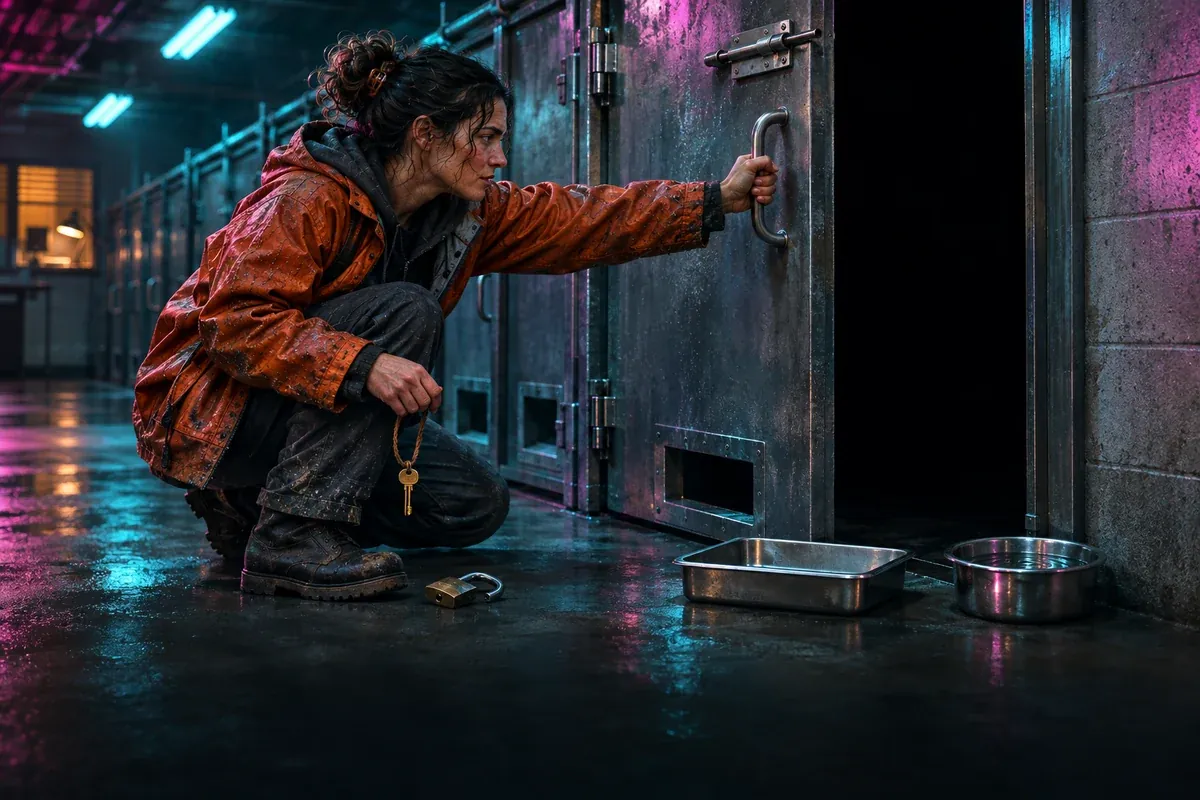
At two in the morning I am standing in front of the door with the padlock in my hand, the brass key in the other, and the pan in front of me, as I have stood in front of it for six months. The steel is cold on my knuckles. Out in the harbor, a long way off, a foghorn goes.
“I’m going to open the door now,” I say, to the dark. “I’m sorry. I’ve been meaning to for a while.”
The key turns easily. The padlock drops. I put my hand on the bolt and slide it back and, for the first time in 184 nights, pull the door of Kennel Twelve open.
It is very dark in there. A long moment passes. Then there is a small dry sound, like paper being smoothed, and a voice in the dark says, precisely, politely, and with the unmistakable air of a person who has been rehearsing something for six months:
“Officer Tolliver, I am so sorry. I believe I am the one who sent you the class.”