

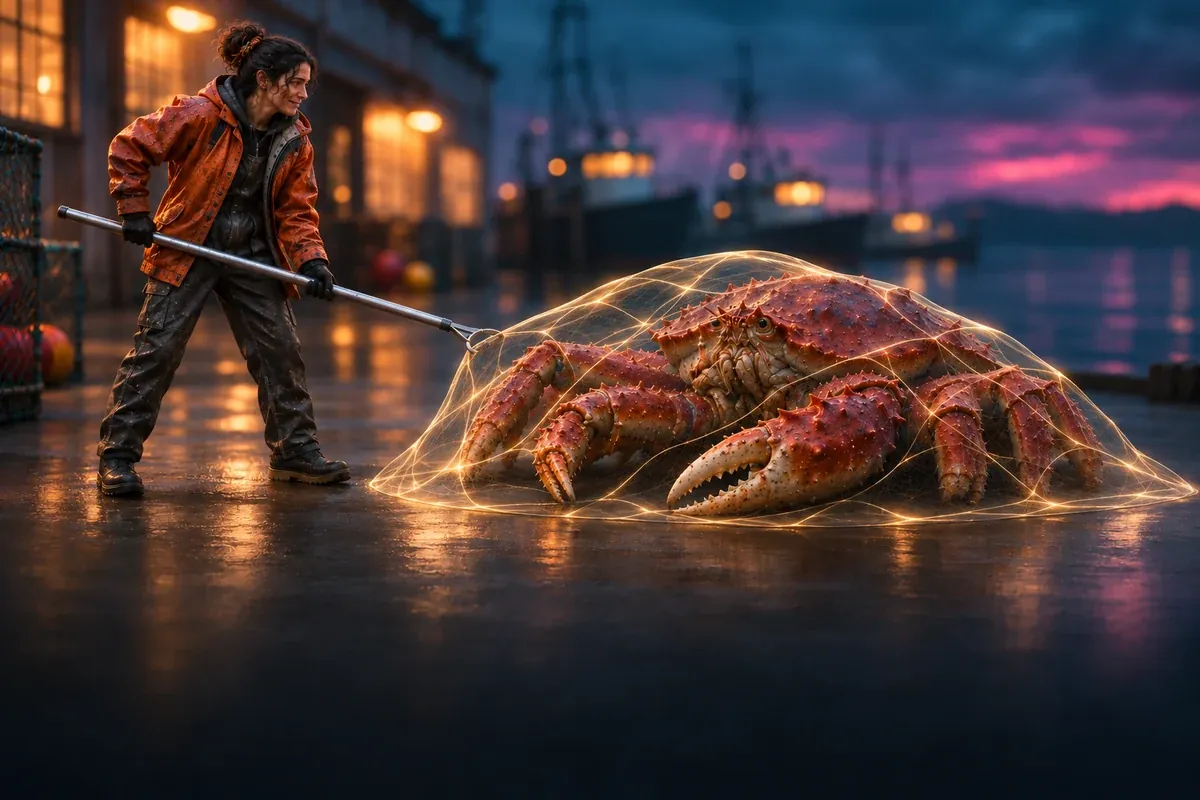
The dispatcher says the dog is the size of a dumpster, so I write DUMPSTER on the back of my hand with a ballpoint, because that is how people on this island describe everything that scares them. By the time Unit 1 rattles onto the cannery slip, forty people are standing in a ring with gaffs and boat hooks, and I have to revise the estimate. It is bigger than a dumpster. It is not a dog.
“Roni!” Odalys Reyes-Kuzmin is on the fish-house roof with a radio in one fist and a thermos in the other. “Whatever you brought, it better be a rifle!”
“It’s a catch pole,” I call up.
“Then you brought the wrong thing!”
I park crooked, kill the engine and sit for one second with my hands at ten and two. Unit 1 is a white 2009 box van with a cracked dash and a dent in the passenger door shaped like a harbor seal, a long story. On the seat beside me are a freeze-dried liver bag, a headlamp, a leash I will not need and a phone holding six thousand photographs of other people’s dogs.
Okay. Okay.
Then I get out and do intake, the way I always do when my knees want to fold. Subject: red king crab, adult. Size: hay bale, the big round kind. Color: brick going to rust, with a faint blue on the joints. Temperament: unimpressed. Tag: none.
Nobody has told me the last part. The crab has told me, by looking at me.
It sits at the top of the slip where the cannery’s concrete runs down into the water, its legs folded under it like a table somebody dropped. One claw is the size of a bowling bag. The other is tucked up against its mouth, and it is tapping that one against the concrete, slowly, in a pattern. Three, a pause, two, a long gap. Then again.
“Stand back from it,” somebody says, which is the first useful thing anyone has said all day, and then somebody else says, “Hit it from behind,” which is not.
The ring of people shuffles. I know every one of them. Rudy Almquist, who runs the fuel dock, has a boat hook raised over his shoulder like a man at a county fair. Two of the Marguerite’s deckhands have gaffs. A woman from the school cafeteria is holding a frozen turkey for reasons I do not ask about.
Behind them the whole harbor is lit up amber and orange, boats stacked three deep at the slips, because tonight is the night. October fifteenth. Red king crab season opens at dusk, and two hundred and fourteen crabbers are supposed to be casting off for the Bering Sea in about forty minutes.
Instead they are standing on the dock watching me walk toward a crab.
“Adult male,” I say quietly, to nobody. “Approximately forty. Temperament fair. No tag.”
That one is wrong. He is not male and not forty. It is a thing I say when I am scared, and the habit is older than the job. I say it about drunks at the veterans’ hall, about the guy who punched a window at the ferry terminal, about my own mother in the ER the night her hip went. Intake language keeps my hands busy. Then I say it twice and it goes away.
Okay. Okay.
“Roni.” A hand lands on my sleeve. Tuck Moreau, seventeen, junior deckhand on the Marguerite, sleeves pulled down over his hands like always. He is supposed to be aboard, doing something to a pot. His face is the color of the slip. “It’s fine? You’ve got this? It’s just a really big crab?”
“Tuck, why aren’t you on the boat?”
“I was. I came to see.” He swallows. “Roni, it’s, like, looking at you.”
“I know.”
“Is that a thing crabs do?”
“Go stand by the van,” I say. “Keep the door shut and keep your hands in your pockets.”
He goes. He does not go far. I would not have gone far either.
Up on the roof, Odalys has finally given up on the radio and is shouting at me with her bare voice, the one she uses at the fish auction. “You’re the animal control officer, Veronica! This is your animal! You’ve put down worse than this and you know it!”
That lands where she aims it. I have put down worse. Two hundred and twelve of them in eight years, because the council cut the vet contract and somebody has to, and the tags are in a coffee can under my kitchen sink. I have not used the kit since August. I think about it most days.
I do not look at her. I look at the crab, and the crab looks at me.
Then the air goes quiet. Not silent. It is the quiet right after somebody drops a plate, when every head turns to the sound that is about to come.
A bell rings. One note, flat, the kind a hotel desk uses, and it comes from everywhere at once. Every gull on the slip lifts off the pilings. Every dog on the island, and there are about nine hundred, starts barking in the same breath.
A voice says, apologetically:
[Good evening. We are very sorry to interrupt. This is a notice from the Intake. Your zone has been reclassified as Zone 4 and is now in our care. All living things within it are being assessed and entered into the record. This will take only a moment. We apologize for any inconvenience. Please remain where you are.]
The words are not heard so much as read. They sit in the air in front of my eyes, in square brackets, in a plain typeface like a city form, and when I look to the side they stay put. Everyone around me is staring at the same empty spot. Everyone is reading.
“What is that?” Rudy says. “What is that?”
Then the numbers arrive.
They come over people’s heads in thin gray frames, a name and a number and a line of small print. CRABBER, LEVEL 9, over Rudy. CAFETERIA STAFF, LEVEL 2, over the woman with the turkey. A gull going by overhead is a GUTTER GULL, LEVEL 14, which seems like a lot for a gull. Down on the slip a harbor rat the size of my forearm is a RAT, LEVEL 6, and it stops mid-scuttle and looks up at its own number with an expression I recognize from Rudy.
Over the fish-house roof, Odalys’s frame says HARBORMASTER, LEVEL 12. She has dropped the radio. Over the water, on the Marguerite’s foredeck at the end of the second slip, a tall man with a harpoon-scarred forearm is standing at the rail with both hands on it. CALLOWAY VARGA, the frame says, CRABBER, LEVEL 28. Cal has not moved since I arrived. He is looking at me with no expression at all. He has never needed one.
Over the crab, a frame opens. It does not give a name. It gives a number.
RED KING CRAB. LEVEL 31.
“Thirty-one,” somebody whispers. “It’s thirty-one.”
Nobody here is above thirty. I can see it in the way the gaffs start to wobble.
Then my own frame opens, and I have to read it twice, because it says things about me.
[Veronica Tolliver. Assessment complete. Class assigned: DOGCATCHER. Title: Warden of the Pound. Level 1. Grip 9. Calm 12. Nose 11. Paper 14. Skills: Catch Pole. Tag. Soft Voice. Note: a Warden cannot deal lethal damage to any living thing. We apologize. This is not a rule that can be waived.]
“Dogcatcher,” I say out loud.
Nobody laughs. A man with a boat hook said Warden to himself, trying it in his mouth. Somebody says it again, harder. Dogcatcher. It goes around the ring.
It is not the worst thing I have been called on this island.
Paper fourteen, I notice. Grip nine, which seems unfair. Calm twelve, which is probably generous. I read the last line again. A Warden cannot deal lethal damage to any living thing, and I think of the coffee can, and something in my chest goes very still and strange, like a dog hearing its name from another room.
“Roni!” Odalys is down off the roof now, shoving through the ring, thermos abandoned, reading glasses crooked in her gray hair. “Whatever it is you read, I do not care. That thing is thirty-one levels above anything on this slip and it is sitting on the only path to the fuel dock. Put it down.”
“I can’t,” I say, and it comes out before I know it is true.
“You can’t.”
“It says I can’t.”
“Veronica.” She says my whole name, the way she says it to the council. “The fleet is forty minutes from sailing. I have two hundred boats and eleven hundred people and a crab the size of a hay bale in my harbor. I need you to do your job.”
“Odalys—”
“Rudy!” Her head swings round. “Hook it!”
Rudy hesitates. He is a good man. He is also afraid, and in my experience those two things together make a person do something stupid and then spend a week apologizing for it.
He lunges.
The crab’s tapping claw stops. Its other claw, the great one, comes up off the concrete in a short, almost bored arc, and every person in the ring sucks in a breath, and Rudy’s boat hook goes spinning off toward the water.
He is holding both hands out in front of him. He is looking at them as if someone has handed them back wrong. The claw has stopped an inch from his ribs, not touching, and the crab is looking at Rudy with what I can only call patience.
“Back up,” I say, and my voice does something I did not expect. It drops. It goes soft and flat and a little bit slow, the voice I use for dogs in cars with the windows cracked, and the whole ring seems to lean toward it. “Rudy. Back up, please. Slow.”
He backs up. Slowly. Somebody lets out a breath.
[Soft Voice applied. Panic in range reduced.]
I feel it leave the air. It goes out of the crowd first, a loosening, like a swollen drawer finally sliding free, and then, a half second later, out of the crab.
A big animal’s fear has a weight. I have carried the weight of a lot of frightened dogs, and I know its shape. This is the same shape, scaled up by the size of the animal, and for a second it presses down on my chest so hard I have to put my hand on the van to stand.
Underneath the fear, though, there is a second feeling, and it is not fear.
It is attention. The crab is not panicking. The crab is waiting to see what I do.
Somebody behind me says, “Roni, move,” and two other people say, “Don’t move,” and Odalys says nothing, because Odalys is looking at the pole in my hand.
I did not know I had pulled it from the van. The catch pole is five feet of aluminum with a cable loop at the end, and I have used it on Rottweilers, raccoons, one goat and, last spring, a wolf hybrid that had never met a rule.
I raise it now because I do not know what else to do. I swing it, the way you swing a bat when the ump has made the wrong call. Not a hard swing. A swing at the idea of the crab.
It stops an inch short of the shell, with a soft, definite resistance, the way a magnet will not close against another magnet turned the wrong way. I push. The muscles in my forearm go hard. The pole does not move, and no one in the ring makes a sound.
“Well,” Odalys says faintly. “Hell.”
The pole drops. My arm shakes.
And then, because there is nothing else to do, I do the other thing. I flip the pole’s grip, and the loop at the end blooms into something that is not a cable loop anymore. It is a net, pale and wide and a little bit luminous, as if it has been woven from the light off the water, and it unrolls from the end of my catch pole in one clean throw and settles over the crab like a sheet over a piece of furniture.
[Catch Pole: Net and Hold. Target held. Target is now Held. Tag required to read its record.]
I did not mean to do that. My hands did. They have known the motion for four minutes and have apparently been waiting years.
The crab does not struggle. Its legs fold in a little tighter. The tapping starts again, slowly, three then two, under the net, against the cold concrete, and I understand with a cold clear certainty that nobody else on the slip is paying attention to the sound.
“What now?” Tuck whispers from behind the van. He has not stayed behind the van. “Roni? What do you do now?”
“I don’t know,” I say.
That is the truth, and it is the first honest thing I have said in a while.
“It wants to talk,” I say, not knowing why. “It’s been tapping the whole time.”
“Crabs don’t talk,” somebody says.
“Neither do dogs,” I say. “I’ve never had trouble understanding them.”
There is a pause. It is the pause of a whole harbor deciding whether I have lost my mind or found a talent, and I have no idea which way it goes.
“Tag it,” Odalys says. She says it quietly, almost like a favor. She has read the same notice I have. “Whatever you do, Roni, do it fast. The boats are getting restless.”
I look down at the notice still hanging at the edge of my vision. Tag required. I think, Tag, the way you think a word you have never said, and a small gray prompt unfolds in front of me, as if a clerk behind a counter has slid a form across.
[TAG: Enter a name for the animal to be entered into the Impound record.]
It wants a name. It is a form, and I fill out forms. That is, apparently, what I am.
The first name that comes into my head is the one on the mug in the cannery break room, which has sat on the same shelf for eleven years. Dennis. Dennis Hallorhan retired in 2015 and does not know any of this has happened, and I am sorry to him in advance.
“Dennis,” I say.
[Name accepted. Tag issued. Dennis, red king crab, Level 31. Status: IMPOUNDED. Grip 22. Calm 30. Nose 17. Paper 4. Temperament: Wary. Patient. Does not trust anyone yet. Holding Cost: 40 lb herring per day, payable by the Warden.]
“Forty pounds a day,” I say.
“What?” says Rudy.
“Nothing.” Forty pounds of herring is something over a hundred dollars a day at the dock price, and the shelter’s food budget for the entire month is two hundred and sixty. I do the math twice, the way I do for kibble, and it does not improve. “Nothing. Can somebody get me a pallet jack?”
“A what?” Rudy says.
“A pallet jack,” I say, “or a tarp, or a door off a hinge, or forty guys who will stop pointing sharp things at him.”
The ring, to my own surprise, breaks.
It breaks the way it does when people are given a job instead of a threat. Someone runs for a pallet jack. A wide kid named Pell, one of the Marguerite’s deckhands, lowers his gaff and says, “Where do you want us?” and I say, “At the corners, just hold the net up off his legs,” and they do.
It takes eleven minutes, and during those minutes I do not hear one boat engine start. A hundred feet away, two hundred and fourteen skippers stand on their decks with their numbers over their heads, watching a woman in a canvas work jacket and a hair clip argue with a crab about a pallet jack.
When the crab finally goes up the van’s ramp, it goes under its own power. I do not push it. I do not coax it. I say, “Okay, Dennis, in you go,” in the soft voice, and he considers me for a long time with one black bead of an eye, and then walks up the ramp sideways, folding his legs under him with a small dry clatter as he goes.
It is an unhurried walk. He is a refugee, and I think he is walking in on his own terms.
Unit 1 groans and settles two inches on its springs. A dozen people watch me close the doors.
“Roni.” Odalys catches the door. “That is not a pet. You understand that.”
“I understand he’s a Level 31 and I’m a Level 1.”
“That is not what I—” She stops. She pushes her glasses into her hair. “The Board is going to meet. The council. Tomorrow morning at the cannery. We are going to need to talk about this. About all of this.” She waves one hand at the sky, the numbers, the gulls. “I don’t know what we’re going to say yet. But you are going to need to be there, and I am going to need you to have an answer.”
“What kind of answer?”
“The kind where the thing in your van does not eat anybody.”
“Copy,” I say, because it is her word.
She almost smiles. It is not the smile of someone who is pleased.
“Fleet holds,” she says into the radio, switching back to the voice that gets people to move. “I say again, fleet holds. Nobody casts off. We’ll wait until we’ve got a picture of whatever this is. I want every skipper at the harbormaster’s shack in half an hour. Copy?”
The radio crackles. Two hundred and fourteen boats copy, some of them with a lot of words attached.
On the end of the second slip, the man at the Marguerite’s rail has not moved. Calloway Varga, Level 28, a man the island reads as menace and the island is not entirely wrong, because he is quiet in a way that makes people check what they said last. He is looking at the back of my van as the doors close. At the slow movement of the springs.
He does not nod. He does not shake his head. He looks like a man doing arithmetic.
Then he turns and goes below, and the hatch closes behind him with a very small sound.
I stand there a second longer than I should. A gull goes over. Gutter Gull, Level 14. It does not seem to know what to do with its number.
I know exactly how it feels.
It takes me twenty minutes to get back to the shelter on Dock Road, because I drive at nine miles an hour with kids on bikes and old men on porches lining the street to watch the van go by. At the corner of Fourth, Ines Petrovich sits at her front window knitting, as she has through every storm and tsunami warning of my lifetime. As I pass she lifts two fingers off the needles in a salute. I lift two fingers off the wheel.
The shelter is a cinderblock building with a flat roof, twelve kennels in a row, a steel-table back room and an office that used to be Dr. Pruitt’s. The sign says SAINT BRENDAN ANIMAL SHELTER, and under it, in marker, added over years, OPEN WHEN WE’RE OPEN. I back the van up to the bay door and sit there with the engine ticking.
In the back, something taps on the wall of the box. Three. Two. A long wait.
“I know,” I say. “I know. Give me a minute.”
Inside, the kennel row smells the way it always does at night, like bleach and wet wool and old dog. It is empty. Eleven kennels are empty. Kennel Twelve at the far end has a steel slot cut into its door, a six-inch gap for a pan, and a padlock on the bolt that I have never once had the key to.
I will get to that.
First I get Dennis in. I do it by dropping the ramp and stepping back and saying, “Whenever you’re ready, buddy,” and he comes down it sideways with the care of a man crossing a river on stones. The bay is a poured-concrete room with a floor drain and a hose, and Dennis stops in the middle of it and settles, folding his legs, swinging his eyes slowly around the room like a man inspecting a rental.
“It’s not much,” I say. “It’s what we’ve got.”
Tap, tap. A pause. Tap.
“I can’t read that,” I say. “I’m sorry. I think I’m supposed to be able to.”
He goes quiet. I decide to take that as forgiveness.
My phone buzzes. Tuck, again. you ok? it says. I type, fine, go home, and delete it, and type, I’m fine, I’ll call you tomorrow, and send that. Then I stand in the middle of the shelter with my hands on my hips and an enormous crab regarding me, and I let my shoulders drop for what feels like the first time in months.
A small gray tab labeled LOT has been hanging at the edge of my vision for ten minutes. I have been refusing to look at it, the way you refuse to look at a bill. I pour coffee from the pot I started at four, which is now a sort of tar, drink half of it standing at the sink, and say, aloud, to the empty shelter and the crab, “Okay. Let’s see it.”
[IMPOUND LOT. Opened. A mirror of your facility has been created. Capacity is limited by Calm. Kennel 1: Dennis, red king crab. Days held: 0. Kennel 12: Occupied. Holding Costs are payable daily. Unpaid costs are paid by the Warden in other ways.]
I read it, and then I read it again, and then I put the mug down because I do not trust my hands.
Kennel 1 is Dennis. That is right. Kennel 12 is the one in the real shelter at the end of the row with the slot and the padlock. The one Dr. Pruitt asked me to feed. Every night, at two in the morning, a pan of food pushed through a six-inch slot into the dark, a bowl of whatever he left me instructions for, a bowl of water. Do not open it. Do not look. Feed Twelve and do not look. Back by freeze-up.
Dr. Ansel Pruitt, silver crew cut, reading glasses on a cord, the man who taught me to hold a cat so it forgives you. Gone since April, with a duffel and a note taped to a kennel door. Six months of nights. I have never opened it. I have never so much as put my ear to the steel.
I have, once or twice, said good night through the slot. Nobody answered. I told myself it was the dark.
There is a second line under Kennel 12, one the Lot has just added while I was reading the first, and I lean in toward it with the whole stupid weight of my stomach.
[Kennel 12. Occupant 2: unknown. Days held: 183.]