

The dryers under my apartment buzz at 5:40 every morning, a flat, rude sound like a game-show wrong answer, and for six years I have woken to it and felt sorry for whoever was getting it wrong.
Today I am already awake. I have been awake since Tuesday afternoon, sitting on the edge of my bed with my coat still on and Osei’s slip of paper flat on my knee. The Suds and Duds Laundromat is on the ground floor, and I live in two rooms above it where the floor is always warm and everything I own smells faintly of fabric softener and other people’s socks.
The paper says: Odell Pruitt, Lock House, Number Two Dock. Below that, in pen, in the cramped slant of an old man’s hand I now know well from eleven nights of watching him sign forms with a shaking pen: “Ask him about the tonnage.”
I did not know until yesterday that Halvard Brandvold had a first door. I did not know he had nine. I do know the name Odell, though, and that is the part that has kept me sitting here in my coat since four o’clock yesterday.
Night Two, 4:05 a.m.
The midnight version had been tidy. I had written it down in my neat chaplain’s printing: “H. and his brother Anders dissolved the partnership in 1971. H. regrets they did not speak again.” A pleasant, rueful, boardroom sort of sorrow.
Then at four in the morning the pump had ticked and the window had gone gray, and the old man had turned his head on the pillow and begun to talk to the ceiling in Norwegian. Not to me. I know the difference. When he spoke to me in Norwegian, it was in short phrases, the way you speak to a child. This was the other kind, the speech people use to a wall, to God, to a brother who died or did not.
I understand perhaps one word in six. My grandmother on my mother’s side spoke it to the stove. Mostly I remember the rhythm, and a few words as solid as stones.
Anders. That one, many times.
Navnet. The name.
And in the middle, twice, a man’s name that I did not catch as a name until much later, in the car, when I kept turning the sound over: Odell. I thought at the time it was a place.
Wednesday, 5:22 a.m.
I let myself in through the fire door on the roof of Gull Point Hospice because the code has not changed in eight years. It is the date the building opened, 0412. I know that for the same reason I know a hundred other things I should not: I am a person who pays attention at three in the morning.
Thelma Rusk called me at nine last night. Thelma is the director of nursing, sixty-one, tall and tired and kind in a way that never shows up in her face. She said, “The board chair phoned me at home. Mr. Sandvig called the board chair. I am not supposed to tell you this, so you will understand if I say it fast. They are going to put you on paid administrative leave tomorrow. They’d like you to know it is for your own protection.”
“From what?”
“From whatever’s coming. Josephine, there’s a man in a gray car on the street across from the laundromat. He’s been there since six. He waved at me when I drove past.”
“He waved at you.”
“He was eating something out of a little paper wrapper,” Thelma said. “Peppermints, I think. I don’t like a man who looks that comfortable.”
I had gone to the window afterward and looked. A gray sedan, nothing special, engine off, and behind the windshield a heavyset man in a tan coat who lifted two fingers to me from the steering wheel, the way you greet a neighbor. It was a friendly gesture. That was the unnerving part.
I left by the fire stairs at five this morning. The sedan was gone. I assume that is worse.
The roof of the hospice is a flat expanse of tar paper and gravel bounded by a knee-high wall, with two vents, an air-handler the size of a pickup truck, and a rusted pair of lawn chairs the staff have been stealing back and forth for a decade.
At this hour the sky above Lake Superior is the exact gray of an old nickel. The ore dock lights have not yet gone off. A foghorn goes somewhere out in the dark, one long, two short. The signal for a vessel leaving.
Dane Brandvold is sitting on the wall at the east corner with his back to me.
I do not know how I know he will be here. I know it the way I know which stairs creak.
He turns before I speak. Of course he does. He has the hearing of a man who has spent his life listening to hulls.
“Fourteen minutes,” he says. “I’ve been up here fourteen minutes. I thought you might come at five. Then I thought, six. Then I stopped thinking.” He looks at his watch. “Five twenty-two. That’s good for me. I would have said six-ten.”
“Hello, Dane.”
“Hello.”
He’s in a work jacket now, canvas, brown, with the collar turned up, and the same boots. There is a single cigarette on the wall beside his knee. Not lit. Just lying there on the concrete, white, perfect, a small clean thing among the grit.
I stand a good distance away. I count the paces. Nine.
“You don’t smoke,” I say.
“No.” He picks it up and turns it over. “I bought this at four-forty this morning from a machine at the Gas-N-Go on Route 61. I haven’t bought one in eight years. The last one is somewhere in a coat in Mobile.” He sets it back down. “I needed something to put on the wall.”
“For us to not smoke.”
“Yes.”
I laugh. It is a bad laugh, the kind that comes out of a person like a cough. He almost smiles. Then he doesn’t, and the next thing he says is as quiet as I have ever heard a grown man speak.
“Eight years,” he says. “Three months. Eleven days.”
“Dane.”
“I’m sorry. I do that. I can’t hold anything without counting it.” He rubs his eyes with the heel of his hand. “I looked for you. I want you to know that I looked. I went to the hospice the next week and a woman at the desk said the volunteer lists were confidential. I wrote letters. I got a lawyer to write a letter. I wrote to every chaplaincy program in the state. Do you know how many people in Minnesota go by Jo?”
“A lot.”
“Four hundred and nine.” He looks at his hands. “I made a list. I kept it for a year. I called some of them.”
“You called some of them.”
“I said I was looking for a girl who wore a gray cardigan and who thought a pen callus was a kind of scar. Do you know how that sounds on the phone?”
“Like a man with a lot of free time.”
“Like a man with no free time at all,” Dane says. “Which was, I think, the point.”
I should be angry. I have rehearsed being angry for a year, in the dark, at the sink, in the shower. The anger is there, but it will not stand up. I have been calm for eight years in front of the dying. I am good at being calm. It is the one thing I have to offer, and it deserts me completely.
“I need to say something first,” I say. “Before you say anything else. Before the doors, before the old man, before the roof.”
“Say it.”
“I have terms.”
His eyebrows go up very slightly.
“One.” I hold up a finger and it is shaking, and I put it away in my pocket where it cannot embarrass me. “If I do this, I say only the confession the door asks for. Nothing else. Not the rest of the nights, not what he said about you, not what he said about anybody. One door, one confession. The rest stays sealed.”
“Agreed.”
“Two. You never ask me what I haven’t said.”
“I may not be able to promise that.”
“Then I can’t do it.”
A silence. The foghorn goes again, one long, two short, further off. He looks out at the lake as though it had asked him something.
“I won’t ask,” he says. “I’ll want to. I’ll be terrible at not asking. But I won’t.”
“Three. The roof.” I stop. I have nothing for three. I thought I had, but it was a feeling and not a sentence. “The roof is not on the table. Not unless I bring it up.”
“That’s not a term. That’s a request.”
“Then it’s a request.”
“All right,” he says. His voice is very careful. “Then I have one, too.”
“Go on.”
“You say the name your mother gave you,” Dane says. “The real one. Out loud. You say it to me one time. I have been calling you Jo to myself for eight years and I would like to know whether it’s a person or a story.”
I look at the cigarette on the wall. I look at the sky, which has gone from nickel to pewter. Nine paces. I do not close any of them.
“Josephine Marie Calloway,” I say. “Joey.”
“Joey.”
“Yes.”
“Joey Calloway.” He says it like a man trying a key in a lock to see if it turns. It turns. I watch it turn in his face. “I owe you,” he says.
“For what?”
“For all of it.” He stands up. He is much taller than I remember. “I don’t know how to say the other thing. I have never been able to say it. I’m told it runs in the family. I can say that I owe you, and I can say the number of days, and I can show up. I’m very good at showing up. I’m just always forty-one minutes late.”
The roof door bangs behind us. Neither of us moves. It is only the wind.
Odell Pruitt’s lock house stands at the foot of the old Number Two ore dock, a squat brick building with a copper roof gone green and a bell on the corner of it that has not been rung since the lock was decommissioned in the nineties. It is nine in the morning. Snow has begun to fall in fat, slow flakes. The dock throws its long cold shadow over the gravel lot, and red dust is already freckling the new snow.
Dane parks his truck beside a dumpster and looks at me. “I’m going to be honest,” he says. “I have no idea what happens in there.”
“Me neither.”
“I’ve never been more relieved to hear anything.”
The door is opened by a very old man with a face like a cliff. Eighty-one, spine as straight as a lamppost, a thick wool cardigan the color of mud, and one blue eye and one eye that has gone milky with cataract. He looks at me for a long moment, then at Dane. Then back at me.
“The chaplain,” he says. His voice is gravelly and entirely without surprise. “Come in. Mind the step. Mind the second step too, it lies about being a step.”
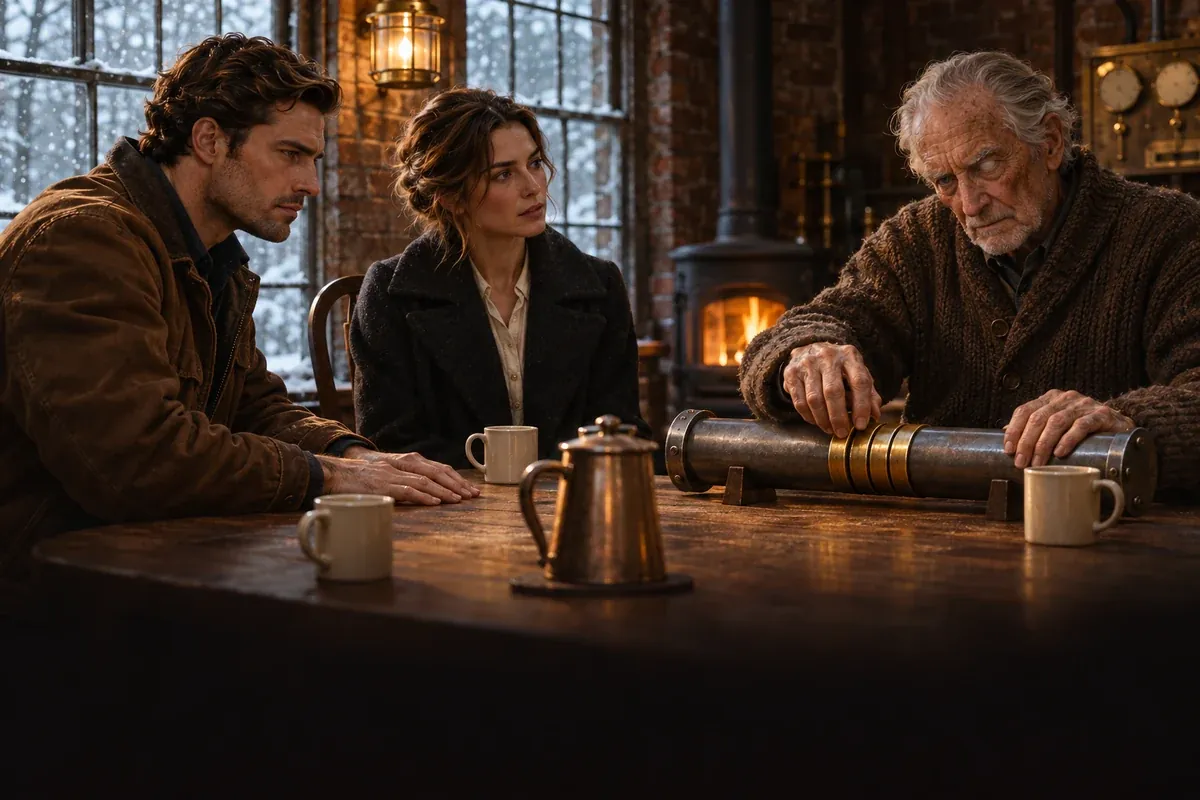
The lock house is one large room with a woodstove at one end and a brass control panel at the other, dials and levers polished by fifty years of hands. A table in the middle. Three chairs. A pot of coffee. On the table, beside the coffee, a plain steel tube about two feet long, capped at both ends, with a combination of old brass rings around its middle.
Odell Pruitt does not offer his hand. He sits, and he folds his own hands on the table.
“Halvard sent me instructions a year ago,” he says. “Typed. He said you’d come. He said you’d say it two ways, and that I’d know which one to take.” He taps the table. “The Ketil Lock, chamber one. Eight hundred feet long, eighty wide, a lift of nineteen feet. Thirty-eight thousand tons of water in a full chamber, and a good lockman can fill it in eleven minutes. I filled it eleven thousand times. I never lost a boat.”
“Mr. Pruitt,” I say.
“I’m telling you who you’re talking to.” He lifts his chin. “Go on, Chaplain. Say it. I’m eighty-one. I’ve had practice waiting.”
Dane has not sat. He stands behind my chair with his hands in his jacket pockets, close enough that I can feel the cold coming off his coat. Not touching. Taking up the space where a person would be if I needed someone.
I take a breath. I count to nine. I say the midnight version, the one I wrote down, in the voice I used at the bedside, quiet and level.
“In nineteen seventy-one my brother Anders Brandvold and I agreed to dissolve Brandvold Brothers. I bought out his half at a fair price. The harbor lease passed to my name in good order. My only sorrow is that we never spoke again.”
Odell Pruitt does not move.
But something in him moves. I see it. The straight back gets straighter. The good blue eye focuses on a place about four inches to the left of my face, the way you look at a wall to keep from looking at a person. One hand on the table slides a half inch toward the steel tube and stops.
“Is that all?” he says.
“That’s what he said at midnight.”
“At midnight.” His voice is gravel poured over glass. “Yes. I imagine he did.”
He is waiting. I understand with total clarity that he is waiting for me to say the other thing, and that if I do not, the old man will thank me, and show us out, and the tube will stay on the table, and eleven thousand jobs will go into the dark. And that I will walk out of here with my seal intact and a clean conscience and nothing at all.
I look at Dane. I do not mean to. He is looking at me with an expression I cannot read.
I close my eyes. I go back to a gray window, a ticking pump, a voice speaking to a wall.
It is like reaching for something at the bottom of a lake. You know it’s there by feel. The sounds come first, Norwegian, soft and fast, with the old man’s breath dragging through it. Anders. Navnet. Odell. I put the rhythm into my mouth like a stone and I try to turn it into English.
I do not have the words. I have the sense. A sense is not a sentence. But I have sat at four hundred bedsides and I know how to carry a thing across a gap I cannot see.
“He said,” I begin, and my voice cracks, and I start again. “He said that in nineteen seventy-one he took his brother’s name off the company and off the dock lease. With a pen that wasn’t Anders’s. He said he asked a friend to write the name. A friend who loved him too much to say no.”
“Chaplain,” says Odell Pruitt.
“He said he let Anders believe he had failed. That Anders would go to his grave thinking he’d lost the company by being a fool. He said,” and here my own throat closes, because I have never said it aloud and I hear it for the first time as the sentence it was, “he said you were the only man he ever trusted with his sin, and he never once thanked you for carrying it.”
The woodstove ticks. Snow lays itself softly against the window.
Odell Pruitt says nothing for what I count as sixty-three seconds. His good eye has filled and he does nothing about it. He has the bearing of a man who has not cried since before color television and is not about to start for a guest.
“Fifty-five years,” he says at last. “He never said it to me. Not once. I stood at his wedding. I stood at his daughter’s christening. I filled the lock for his ships. And he never once said it.” He looks at me. “You did.”
“I’m sorry.”
“Don’t be. It’s the first honest sentence anyone’s put in this room since nineteen seventy-one.” He wipes his face with the back of his hand, not ashamed. “There’s a question, isn’t there? He told me there’d be a question. A question inside the confession. He said I’d know it when I heard it.”
I hadn’t known I was going to say it until it was in my mouth.
“At the end of that night,” I say, “he said, ‘Ask the boy what I took from him.’”
I do not look at Dane. I do not need to. I feel him go still behind me, as if the whole room had been moved an inch to the left.
“Mr. Brandvold,” Odell says, and he sounds almost kind. “Heir. You’ve heard the question. Answer it the way you’d answer a person you loved. In your own words. I will know if you lie. I have been lying to myself for fifty-five years, and I can tell the sound of it from across a field.”
For a long time Dane says nothing. I think he may not be able to. Then I hear him come around the chair, slowly, and he sits down in the third seat, across from the old man, with the table between them.
He puts his hands flat on the wood. Long hands. Ink on the finger.
“Three hundred and eleven days,” he says.
“Go on.”
“That is how long my mother had after the doctors gave her the number. Three hundred and eleven days. I counted afterward.” His voice is level. It is the most frightening kind of level, the kind that has pressed every feeling flat to make room for the sentence. “My grandfather wanted me on the board.
“He wanted me to sign off on a merger of the shipping lanes that I thought was wrong, and I told him so, and he told me I was no grandson of his until I did. He said it on the phone, and he said it again every few weeks. He never once said it to my face. And my mother spent every one of those three hundred and eleven days in between us.”
Nobody says a word.
“She flew to the Gulf to ask me to come home. She drove to Skarsgard to ask him to call me. She stood in the middle, in a wig, because the chemo had taken her hair, and she defended him to me and me to him and never once said that she was dying and would like to spend it with her son.
“That is what he took. Not the company. Not the money. I did not want the money.” His jaw works. “He took the last year of my mother’s life and he made her spend it as a bridge.”
I find that I am holding the edge of the table with both hands.
Odell Pruitt closes his good eye. When he opens it, it is clear.
“That’s true,” he says. “Every word. I’d have known. Thank you, boy.”
He reaches out with one thick finger and turns the brass rings on the steel tube, three clicks, four, a pause, two more. It opens with a sound like a sigh. He draws out the contents one at a time and sets them on the table in a row.
A ring of seven heavy keys on a leather tag, each with a number stamped into the bow. A bank envelope, thick, with a single typed page folded around a cashier’s check: “Payroll and operating authorization, ten days.” And last, a stiff manila envelope no thicker than a book.
“Ten days of wages for the crews and the docks,” Odell says. “Not a minute more. He was very particular.” He pushes the manila envelope across the table, not to Dane, but to me. “That one’s yours, Chaplain. It says so on the front.”
On the front, in Halvard’s hand: “For the Counselor. Do not open in front of the boy.”
I look at the old man. He shrugs, with enormous dignity.
“He handed me that one himself, last winter,” Odell says. “I thought he was being funny. I’ve learned that with Halvard, funny was how you could tell it was serious.”
“I’m not going to open it,” I say.
“You’d best,” says Dane quietly. “If it’s addressed to you, it’s yours.” His face is the careful blank of a man who has made a decision to be generous and is paying for it by the second. “I’ll look at the keys.”
I get as far as the door of the lock house. The snow is thick now and the red dust has turned the whole lot the color of rust and roses. I turn the envelope over. It is not sealed. I slide out the single contents with two fingers and I stand there in the wind with my breath going white.
A photograph. Black and white, grainy, shot from high up and a long way off, with the flat green wash of a security camera’s night lens. A roof. Tar paper. The sky behind it almost white.
Two people at the edge of the roof, sitting side by side on a low wall with a foot of space between them. One tall. One small, in a gray cardigan, knees drawn up, face turned toward the other. A time stamp in the corner: 04:51:09. A date I could recite in my sleep.
He had known.
“Joey?”
Dane has come out behind me. I do not hide it. I do not have enough hands left to hide anything.
He looks at the photograph for a long time. He sees the cardigan. He sees himself. He sees the foot of space and the way, in that frozen frame, her face is tipped toward his as if she were listening to something very far away. I hear him breathe in through his nose and not breathe out.
“He had a camera on the roof,” Dane says.
“His foundation gave them the security system. The year before.” My voice sounds like someone else’s. “He asked for me by name, Dane. When he came into hospice. I didn’t know. Thelma told me last night, at the end of her call, after the part about the gray car. He said, ‘I want the one who sat on the roof.’ He had the volunteer log. He had this. He knew who I was before I knew who he was.”
“Why?”
“I don’t know.”
“He put a photograph of us in the first door.” His voice is flat and slow, a man reading an instrument that has just given a bad number. “He wanted us to see it first.”
“I think so.”
“Why does a man do that to two people he claims to love?”
I open my mouth to tell him that I do not know, and that I am afraid of the answer, and that I would like very much to sit down. Then behind us, on the gravel lot beside the dumpster, a car door shuts with a soft expensive click.
Footsteps. Unhurried. A man’s voice, warm and easy, with a trace of a smile in it, the voice of someone who has never in his life needed to raise it.
“Ma’am,” he says. “Don’t turn around until you’ve heard the offer.”