

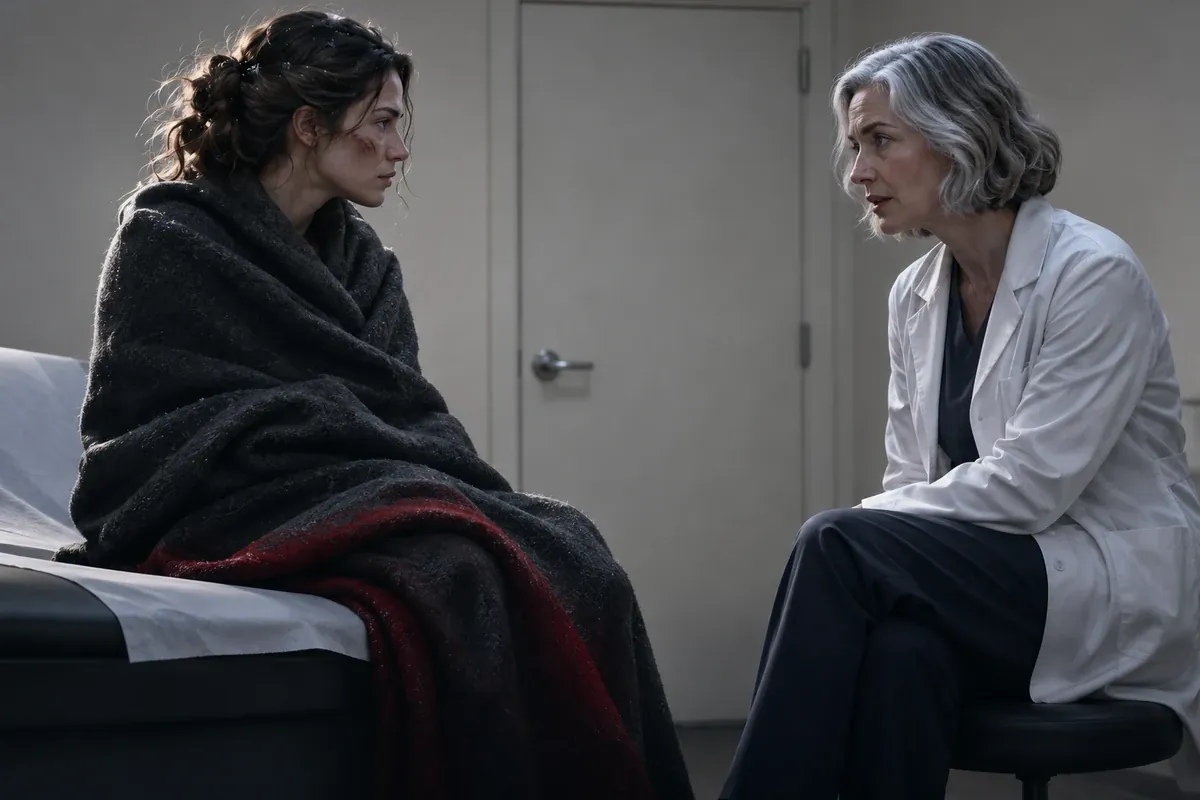
Dr. Venn cut the dress from my shoulder with the care of a woman defusing an expensive nuisance.
“Four thousand?” she asked.
“For the jump.”
“Ask for another thousand for the dress.”
“I don’t own it.”
“Excellent. Then you won’t mind this.”
She snipped through a line of pearls. They rolled across the examination-room floor while Ellis watched the ceiling with exaggerated interest. I still wore my leggings and a sports bra. He had seen more skin on arena posters. His determination not to stare was somehow more distracting.
The room belonged to the arena’s medical contractor. Through the thin wall came distant voices, chairs scraping, somebody insisting the show had been an extraordinary success.
My wrist throbbed. Every few beats, a second rhythm seemed to knock inside it.
“Tell me exactly what you feel,” Dr. Venn said.
I did. Heat. Nausea. A pressure behind my ribs whenever Ellis moved too far away.
He stopped beside the door.
“You can leave,” I told him.
“I’d like to hear the medical explanation, if you’re comfortable with that.”
I was comfortable with very little. At least he had asked.
Dr. Venn placed a paper divider between our chairs, then rolled Ellis’s chair behind it. We could still hear each other. His scent remained in the room. The pressure eased, although I couldn’t see him.
“Visual separation doesn’t change it,” she said, making a note. “Now I’ll put a neutralizing pad over each clasp.”
Cool fabric touched my wrist. Across the divider, Ellis let out a surprised breath.
The second pulse weakened.
I gripped the edge of the table. “What does that mean?”
“It means your symptoms respond to an external source. Genuine attraction doesn’t disappear beneath charcoal cloth.”
My face warmed for a completely ordinary reason.
“I didn’t say attraction.”
“No. You said pressure. Other people will use less careful words. Let’s establish ours first.”
Dr. Venn pulled a stool close enough that I could see the notes on her pad. She had drawn three columns. What I reported. What she observed. What still needed testing. None of the headings included destiny.
“Has anyone told you these symptoms mean you must remain with him?”
“Not in those words.”
“Other words count. I need to know what instructions you’ve been given.”
I repeated the voice from the arena, the announcement, the way people had stepped back from us as if the ribbon marked an enclosure. Ellis stayed silent behind the paper screen. I appreciated not having to argue about whether a helpful stranger’s advice had been meant kindly.
The doctor wrote it all down.
“My grandfather wore a concord clasp,” I said. “I remember him taking it off to repair the sink. Nothing terrible happened to my grandmother.”
“Then you already know more than half the people who will offer you an opinion today.”
I wanted to smile. My mouth wasn’t cooperating.
She offered me a choice between testing now and cooling both clasps for removal immediately. Testing might help identify the source; she wouldn’t delay treatment if I wanted it stopped. She explained how long the additional steps would take. Five minutes for readings, no attempt to make either of us tolerate more pain.
“Will taking readings make it stronger?”
“No. I’m measuring your pulse and skin temperature. I won’t stimulate the device.”
“Then five minutes.”
She set a timer where I could see it.
A cuff tightened on my upper arm. Behind the screen, paper rustled as Ellis shifted. The strange pressure rose, and the doctor asked him to remain where he was while she measured it. She asked me to describe the feeling without using a story somebody had supplied for it.
That was harder than it should have been.
“Like I’ve forgotten something,” I said. “Something urgent. I know I haven’t, but my body keeps asking.”
“Any thought that you must obey him?”
“No. I’m actually developing several objections.”
Ellis made a low sound that might have been a laugh. It caught in his throat.
“Any memory you don’t recognize?”
“No.”
“Any inability to say what you want?”
I looked at the ruined dress and the door. “That one didn’t start today.”
She didn’t turn it into a joke. She waited while I took another breath.
“I can speak,” I said. “I know where I am. I want the thing off.”
The timer sounded. She stopped the measurements at once, even though she had been writing a number. Keeping that tiny promise made it easier to believe the larger ones.
She handed me a blanket. I tucked it around my leggings, grateful that being cold could have an explanation as ordinary as a room with overenthusiastic ventilation.
She called Oren in from the hall. He carried his rig inspection case like he was considering hitting somebody with it.
“I checked both stage anchors at six,” he said. “The east upright was tagged out. They opened that platform without calling me.”
“Can you preserve these?” Dr. Venn pointed to the clasps. “No solvents. No heat.”
Oren peered through a magnifying lens. “Scent reservoirs.”
He said it softly enough that I wished he had shouted.
A concord clasp was ceremonial technology dressed up as destiny. Genuine pairs could choose to have their scents sealed together while they declared a commitment. The bells activated the seal and broadcast the combined scent to witnesses. It was a public record, a wedding ring you could smell.
A fake reservoir could broadcast a scent without the owner’s consent.
It shouldn’t also change a wearer’s pulse.
“Reflected response,” Dr. Venn said. “Cheap stimulation lattice under the lining. I’ve seen one in a novelty cuff. Never in a registered concord.”
“Can you remove it?” Ellis asked.
“Yes. Safely, once it’s cool. The pads will take half an hour. Then we remove the reservoirs, clean the residue, and allow six hours for the echo to clear.”
“Echo,” I repeated.
“A useful name for a temporary symptom. It doesn’t tell you who to love.”
“If only one of us takes it off?” I asked.
“The other reservoir can keep releasing the mixed scent. Both need containment. You don’t need to share a room, a car, or anything else.”
I looked at Ellis. “I’d like that written down.”
“So would I.”
Dr. Venn tore a fresh sheet from her pad. She wrote the removal plan in plain language and gave us separate copies. Mine went into the pocket beside my hook knife. Two practical tools. I needed both.
While the cooling pads did their work, Dr. Venn asked Ellis to wait outside for a private part of the examination. He left without glancing at me for permission to object on my behalf.
The door clicked shut. For an instant the pressure beneath my ribs sharpened. I watched it rise and fall against the steady hum of the vent. The doctor counted with me, then asked whether I wanted him brought back.
“No. Keep going.”
“Tell me if that changes.”
I loosened my grip on the blanket. I had wanted him gone and wanted him close, both at once. Having a reason for that contradiction didn’t make it pleasant. It did keep me from confusing it with a secret truth about myself.
She checked my knees and ankles, moving slowly over each bruise. I had no head strike, no lost time. The harness had done its job after the anchor failed. There would still be an incident form, follow-up instructions and a bill. Falling safely could be expensive.
“Who receives your medical information?” she asked.
“Me.”
“An emergency contact?”
I said Jessa’s name before I could consider how long it had been since I’d answered her last call.
The doctor wrote the number I gave her. “Do you want me to contact her now?”
I stared at the ceiling tile above the examination lamp. A square of newer paint marked an old leak. I had become very good at looking at things while deciding not to look at my life.
“I’ll tell her. Please don’t let her hear it from a producer.”
“Then do that soon.”
She left me her spare phone charger and stepped behind the curtain to wash her hands. I wrote three messages and erased two.
At rehearsal. A rig failed. I’m with the doctor, conscious and complaining. Call when you’re able.
I added that my phone might be needed for investigators, so she shouldn’t panic if I didn’t answer immediately. That was useful information. It also sounded exactly like an excuse I had used before. I added: I will call back.
The words looked much larger after I sent them.
Outside, someone addressed Ellis as Alpha. A man’s voice asked whether a car should be brought around to the private entrance. I heard Ellis say, “Not unless she wants one.”
I closed my eyes. His answer was good. I didn’t want to owe him relief for it. For a little while I let myself feel relief anyway.
When the private examination ended, Dr. Venn invited Ellis back. He returned to his chair behind the screen while she checked her notes.
My hands began to shake. I tucked them under my thighs, then took them out again. Hiding from a doctor was a waste of everybody’s afternoon.
“Someone put that on me.”
“Yes,” she said.
No softened version. I appreciated her more for it.
Ellis moved his chair out from behind the divider, slowly enough to give me time to object.
“May I sit here?”
I nodded.
There was a burn on his left wrist. He kept looking at mine.
“Stop doing that,” I said.
“Doing what?”
“Making the guilty face. Unless you did it. In which case improve the guilty face. It’s subtle.”
His mouth twitched, then flattened.
“I hired a wedding contractor. I signed off on the rehearsal schedule. I should have asked better questions.”
“You should have hired someone who didn’t cut ropes. Different problem.”
Oren set an empty evidence bag beside my knee. “Primary line, bracket, clasps, camera logs. I want the registrar to witness collection.”
The door opened before he finished speaking. The elderly registrar from the arena stepped inside, followed by a woman with a perfectly straight silver bob.
I knew Yvette Keene from backstage introductions. She had looked at me for three seconds that morning and said, Close enough from a distance.
Now she looked at the ruined dress.
“Maris will be devastated.”
“About the pearls?” I asked.
Yvette’s eyes flicked to Ellis. “Could we have a moment?”
“No,” he said.
She recovered quickly. “I mean with both of you. We need a coherent public statement.”
“The coherent statement is that someone tampered with safety equipment,” Oren said.
“An allegation can do a tremendous amount of damage.”
Oren opened his case. Inside lay the cut end of my line, bagged and labeled. Yvette stopped talking.
Yvette pulled an unused stool toward the counter. The scraping legs set my teeth on edge.
“Cleo, surely you understand that people have already invested in this event. There are crews who won’t be paid if the sponsors panic.”
“I understand unpaid crews.”
“Then help me protect them.”
It was a well-made trap. She had put the people least responsible for my fall between me and an accurate account of it. I saw the construction and still felt the pressure. A runner’s rent didn’t get cheaper because the producer was manipulating me.
“Pay them,” Ellis said.
Yvette turned. “It isn’t that simple.”
“Your contracted crew expenses aren’t conditional on Cleo’s statement. Send the invoices to the event office.”
“Will you personally cover every cancellation?”
“I’ll review contractual obligations. I’m not buying a version of what happened.”
I looked at him. There was a difference between those two things, and I suspected being rich made it easy to lose track of it. He held Yvette’s gaze until she looked back at me.
The doctor rolled her stool between us.
“We are in an examination room. You can discuss accounts elsewhere.”
Yvette inhaled as if she might explain the world to Dr. Venn. Then Oren asked for the production access roster. Her mouth closed.
“I don’t have it with me.”
“You have someone who does.”
She took out her phone. Watching her arrange a useful task was more satisfying than watching her be offended. I didn’t want an offended woman with connections. I wanted a list of people who’d had keys.
A nurse brought a camera to document the burns. She asked whether I wanted Ellis outside again. I said no, then asked for copies of every photograph. She checked the consent box herself and showed me where the images would go.
For two years, my body had mostly appeared in other people’s paperwork. They had cropped it into evidence of a bad decision. I was going to have a copy this time.
Oren set a clean work mat beneath both our wrists. The clasps weren’t ready yet. He left them alone and took pictures of their exterior markings instead. I watched him photograph the ivory bead. When his hand steadied the camera, I could see a small tremor at his knuckles.
“You’re angry,” I said.
“Yes.”
“At me?”
“No.” He lowered the camera just enough to meet my eyes. “Don’t volunteer for that job.”
I swallowed. For a moment I didn’t have anything clever to say.
The registrar introduced herself as Mara Pell. She placed a form on the counter, keeping it well away from both our hands.
“A provisional recognition can be challenged at the territory meeting in seventy-two hours. Tomorrow’s announcement has already been suspended.”
“Challenged by whom?” I asked.
“Either named person. No fee. No requirement that you remain together.”
That last sentence mattered so much I had to read it twice.
Yvette folded her arms. “The witnesses perceived a concord. We can’t simply order them to forget.”
“You can tell them they saw a crime,” Ellis said.
“And if the examination is disputed? Granite Run is voting on your renewal next month. Half the visiting delegates were in those chairs.”
There it was: the bill for his decency, delivered while the doctor cleaned my burns.
Mara looked at me. “You may make the challenge now, leave the territory, and provide evidence remotely. Your employment payment has no bearing on your choice.”
Ellis took his phone from his pocket, tapped twice, and set it on the table so I could see the receipt.
Four thousand dollars. The hazardous-stunt rider listed separately as due upon review.
“Your fee,” he said. “Earned. Whatever happens next.”
It would cover the money I owed Jessa. Some of it, anyway. I could leave, find a cheap room outside the Reach, and let rich wolves argue about what my body meant.
Then I pictured Beck covering his microphone.
He’d wanted me to say somebody else’s name.
“File the challenge,” I told Mara. “Put my actual name on every page.”
She slid the form toward me.
Yvette looked relieved. She shouldn’t have.
“I’ll stay for the hearing,” I said. “Until then, I want the camera feed, the original rig plot, and the name of whoever changed my clasp.”
Ellis met my eyes.
“Anything else?”
“Yes. Somebody needs to find your actual bride.”
His expression closed in a way the guilty face hadn’t.
“That’s the problem,” he said. “She didn’t come back last night.”