

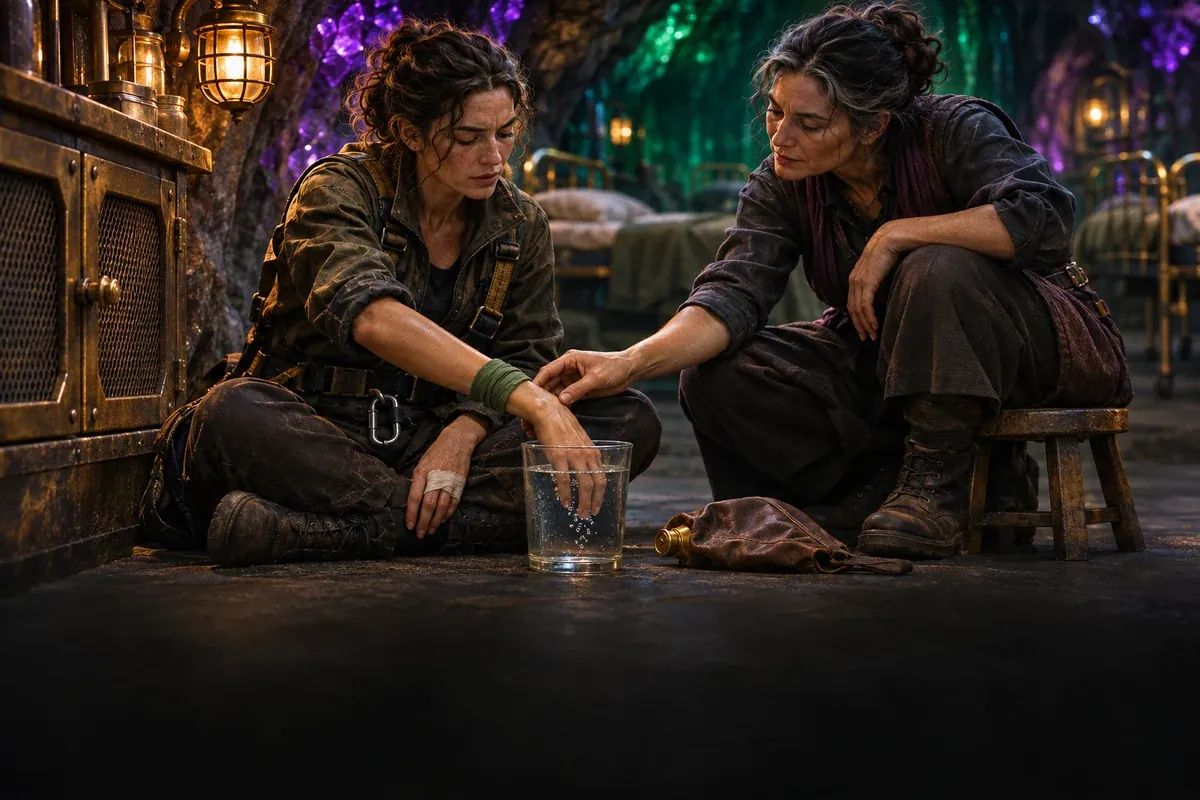
Sela filled a leather breathing bag with four liters of air and dropped it into Mina’s lap.
“That’s your miracle,” she said.
The bag was smaller than a loaf of bread.
Mina looked from it to the fresh white bandage around her ribs. Someone had cleaned the blood from her cheek. Her left hand had regained enough feeling to be unpleasant.
“I thought it would look bigger.”
“Most things do before you measure them.”
Sela pulled a stool over. The infirmary had eight beds, all occupied. Mina sat on the floor between a cupboard and a man who had lost three teeth when the intake threw him into a trolley. He was asleep with his mouth open. His breathing sounded enviably easy.
“Tell me how it works.”
“I hold air.”
“Where?”
Mina pointed at her chest, then moved her hand sideways. Neither location felt accurate.
Sela waited.
“It’s beside breathing,” Mina said. “I know that sounds useless.”
“It sounds like a class organ. We see them. A coilrunner stores heat somewhere no surgeon can find. That doesn’t stop the heat from cooking her. Does your reserve draw from your lungs?”
“From my hand. Through the cloth.”
“And the release?”
“Other hand.”
Sela placed a cup of water between them. “Fill the bag.”
Mina reached for the new hollow. Nothing happened.
She tried holding her breath. Pain tightened around her left ribs.
“Stop that,” Sela said.
“I’m trying.”
“Try without suffocating.”
Mina put one hand around the breathing bag’s neck. It had a one-way valve, a simple brass tongue inside a leather sleeve. She opened it and pictured a cup tipped into another cup.
A faint warmth spread beneath her bandage. The bag collapsed.
Captured: three point seven liters.
Pressure: local.
Contamination: unassessed.
“Three point seven,” she said.
“Good. Your miracle already has a leak.”
“It wasn’t full.”
“Better. You noticed.”
Sela guided Mina’s hand to the water cup. Mina released a trickle. Bubbles broke the surface. Her fingertips cooled, and the reserve diminished by a fraction she could feel without the words.
The water did not become air. The air did not become more air. When the reserve emptied, the bubbles stopped.
Sela made her repeat the exercise twice, slowly. On the third attempt, Mina became lightheaded.
“Enough.”
“I can do another.”
“That wasn’t a question about courage.”
The medic took her wrist and counted her pulse. Mina stared at the little bag. She could carry something like that on her belt. Every lock worker did. Whatever the Measure had seen in her, it had been unimpressed by the scale of Bellmouth’s problem.
Sela followed her gaze.
“A hand is small too. I’d still rather have two.”
From the next bed came a muffled laugh. Tessa was awake, ankle wrapped and elevated on a folded coat. She had been pretending to sleep through the whole lesson.
“You both know I can hear you,” Mina said.
“You needed the practice,” Tessa said. “The insult was a bonus.”
Sela put the breathing bag on the shelf behind her.
“No compressed capture. No hard discharge. No reserve held while you sleep. If the skin turns white again, empty slowly and call me. You can walk, eat, and sit somewhere useful. You cannot work a pressure boundary.”
“Useful narrows it down.”
“Try a chair.”
Sela moved to the toothless man’s bed. Mina stood carefully. Her ribs ached, but the new reserve did not. That distinction tempted her to distrust the instructions.
Tessa tapped the bed rail with her wrench.
“I found something in the lock,” she said.
“You found your boot.”
“Before that.”
She held up a scrap of pale fabric. It looked like the corner of a sack, until Mina saw the tiny brass weights sewn into its hem.
A flow flag. Filter crews hung them in ducts where a gauge was too expensive or too fragile.
“Blue stitch,” Tessa said. “Old intake system. Nobody uses that size up here.”
“Came through from below?”
“Against the draw, just before it reversed. Something coughed it up.”
Mina took the scrap. Dust had worked into its weave, gray on one side, white on the other. Old filter galleries lay below South Throat, sealed since the city had installed the new main line. Their pipes fed a cargo pit used mostly for scrap storage.
If the flag had come up, there had been flow in the old system.
If there had been flow, the whole lower column had not reversed at once.
There might still be a route down.
Tessa watched her finish that thought.
“I’m coming.”
“You have one boot.”
“I have a left boot. Right foot’s the injured one.”
“That solves everything.”
“No. It solves your first objection. Keep up.”
Mina looked toward Sela. The medic had her back turned, but she lifted one hand without looking around.
“Two hours,” she said. “Local pressure only. Orris goes with you. If you take a ladder, you take it slowly.”
Tessa put her legs over the bed’s edge.
“I was talking to Mina,” Sela said. “You get a wheeled chair.”
By the time they reached the cargo pit, Orris had found a chair with one squeaking wheel, a clean pressure bottle, and two bread rolls wrapped in paper. He gave one roll to Mina and kept the other for Tessa.
“You get lunch twice?” Mina asked.
“I lost mine in the throat. This is compensation.”
“You’re giving it away.”
“Compensation’s complicated.”
He wheeled Tessa into the freight lift. Mina held the gate. All three of them looked up when the lift’s air-driven brake hissed.
Orris put his hand on its manual lever.
“Taking the crank,” he said.
Nobody argued.
The cargo pit smelled of rope, old onions, and metal dust. Above, through the lift cage, Mina could see the undersides of houses bolted to Bellmouth’s lowest terrace. People had begun hanging cloth screens over cracks in their floors.
A dozen workers stood beside an open floor grate. One had a chain wrapped around his waist. Another held the chain’s free end, both hands shaking.
“Who’s down?” Mina asked.
A woman turned. “Garrin. Went for the sump pump. Grate dropped.”
“How long?”
“Five minutes.”
Orris stopped the chair. The squeaking wheel turned once more and fell still.
The grate opened onto a square service well. Twelve feet below, a man crouched in waist-deep gray dust. A diagonal brace pinned his left shoulder against the wall. He was breathing through a cloth pulled over his mouth.
Mina checked the little gauge beside the well. One mark. Local pressure.
A thin layer of heavier gas could still pool beneath ordinary air. She took the corded test lamp from the wall and lowered it. Its flame shrank at the bottom, blue becoming orange.
“Don’t pull the chain,” she said.
“We tried once.”
“I know.”
Garrin’s shoulder sat at the wrong angle. Pulling him from above would tighten the brace around it.
She turned to Orris. “Bottle.”
He handed it over, then caught her harness as she stepped toward the well.
“What’s the other part of the plan?”
“Go down. Give him air. Lift the brace.”
“With which hand?”
Mina looked at her bandaged left fingers.
Tessa rolled her chair against the grate’s rim. She had acquired a length of chalk somewhere. She drew the brace’s shape on the iron cover, then marked a hinge Mina had missed in the dust.
“Access support,” she said. “It folds. Don’t lift it. Knock the pin sideways.”
“Can he reach?”
“His good arm’s on the other side.”
Orris took the pressure bottle back.
“I’ll go. You tell me where.”
Mina nearly said no. He was broader than she was. His hearing was poor. He did not have her reserve.
He did have two working hands and a better lung.
“Face toward me,” she said. “Your good ear up. Don’t touch the chain.”
They rigged a second line. Mina checked its knot, then checked that Garrin’s line would run free. Orris descended on the cargo ladder with the bottle strapped beneath his arm.
At the bottom, he gave Garrin the mouthpiece. The trapped man’s shoulders shook.
“Small breaths,” Orris told him. “You have company. No need to finish the whole bottle before I’m bored.”
Mina stretched over the rim to see the pin. It was almost directly below her. Orris could not see it from where he stood.
“Tessa. Chalk.”
Tessa handed her the piece. Mina dropped it onto the pin’s head.
“There.”
Orris brushed away dust. “Got it.”
He set the bottle between Garrin’s knees and took a hammer from his belt.
The floor shifted under him.
Dust poured through a gap Mina had thought was solid. Orris sank to his ankle, then his calf. He caught the brace with one hand. Garrin’s body jerked sideways.
Above them, the worker holding the first chain began to pull.
“Stop!” Mina shouted.
The chain stopped. Garrin made a wet choking sound.
Orris’s boot vanished into the gap.
Mina hauled on his safety line. She got his knee clear, but the line bit beneath his arms and pulled him away from the pin. He could reach the trapped man or keep his own footing. He could not do both.
Tessa grabbed the chair’s wheel.
“Lay this across,” she said.
“What?”
“The chair. Break the back off. Seat makes a bridge.”
The chair was made of ashwood and iron straps, built for much more weight than this. Mina and two cargo workers ripped off the tall back. They lowered the seat on its side until the legs braced between the well walls.
Orris found it with his free boot.
“Solid,” he said.
“Stay on it.”
Mina’s safety line hummed beneath her palm. She had been pulling hard enough to reopen the cut under her sleeve. Blood spotted the rope.
Garrin stopped breathing through the bottle.
His mouth had slipped off the mouthpiece. Orris leaned toward him, but the brace blocked his shoulder.
Mina felt the empty reserve beside her breath.
She could fill it with the clean air at the well’s rim. Then she needed to get it down twelve feet without losing it.
Her class could not make a long invisible hand. Nothing in the little cup exercise had suggested it could.
She looked at the cargo workers’ equipment.
“Hose,” she said. “Clean hose. Any bore.”
A woman pulled one from a wall reel. Mina smelled the end. Leather, brass, no oil. She took the other end, wrapped her fingers around it, and captured a cup of ordinary air.
The reserve warmed.
She fed it into the hose slowly, the way Sela had taught her over the water cup.
“Orris. End of the hose.”
He caught it and held it against Garrin’s cloth mask.
The trapped man’s chest moved.
Four liters would not last. Mina emptied the reserve, drew fresh air from above, and filled it again. Her fingertips chilled. Her head grew light.
She stopped between cycles and took two ordinary breaths.
Below, Orris positioned his hammer.
“Keep him there,” he said.
Mina released another measured stream.
The hammer struck once.
The pin moved half an inch.
Twice.
Garrin gasped into the hose.
On the third blow, the pin fell. The brace folded against the wall. Orris hooked a hand through Garrin’s belt and shoved him toward the ladder.
“Now pull.”
Six people took the chain. Mina kept the hose against the trapped man’s face until his head rose above the rim. She let the reserve empty, then handed the hose away before she could be tempted to refill it.
Orris climbed out behind him, carrying the clean bottle. It was still half full. All that air, two feet from a man who could not reach it.
Garrin lay on the floor and coughed gray dust onto somebody’s coat.
Tessa sat on an overturned crate, holding the two broken arms of her chair.
“I liked that chair,” she said.
“You complained about the wheel.”
“I contain multitudes.”
Mina laughed, then sat down abruptly. Orris came beside her without making a fuss and offered his shoulder.
Technique recognized: Bleed.
Controlled release reduces discharge loss.
Recovery required.
She told Orris what the words said.
“Agree with the last part,” he said.
The cargo workers were moving Garrin toward the lift. One stopped to ask which of the three had been in charge.
“All of us,” Mina said.
The answer surprised her. Tessa’s expression suggested it surprised nobody else.
Orris unscrewed the pressure bottle’s gauge and let Mina hold the brass against her wrist. It was warm from his body. Her fingers had gone pale again, though the ribs beneath her bandage remained painfully warm.
“You’re cold in the wrong places,” he said.
“Apparently that comes with it.”
“Then it comes with gloves.”
He took a pair from the cargo rack and wrapped their cuffs twice around her wrists. They were much too large. She flexed her hand inside the left one and found she could move all five fingers.
Tessa watched the motion.
“You could have told us about the lung.”
Mina looked at the green cloth.
“I’m telling you now.”
“Sela’s telling us. You’re wearing it.”
There was no heat in the fitter’s voice. Mina wished there had been. Anger she could brace against. A straightforward correction left her with nowhere to put her hands.
“I thought I could manage it.”
“You did manage it,” Orris said. “Until the job changed.”
The cargo worker with the chain came back carrying three cups of warm root broth. His hands had stopped shaking. He set a cup beside each of them, then put Garrin’s bent chain on the crate.
“His wife wants this gone,” he said. “Says he’ll try to use it again if she keeps it.”
Tessa picked up a link and turned it. The iron was sound. Its hook had twisted when they first pulled against the brace.
“I can use the straight part,” she said.
“Take it.”
When he left, she passed the damaged hook to Mina.
“Keep that. For when you’re deciding how much a person can stand without asking.”
Mina turned it over in her oversized glove. It had failed at the narrowest part, where repeated loads had polished the iron bright. Every other link looked strong enough to hold the well itself.
She put it in her pocket beside the flow flag.
Orris drank his broth, then hers when she pushed it toward him. The tremor in her hands eased. They waited a full ten minutes before moving. For once, Mina did not argue about the time.
They waited until Garrin had gone before approaching the old filter shaft. Mina leaned on the broken chair back. Orris held the test lamp against the narrow inspection grate. Its flame stretched sideways.
Air came out, cool and clean enough to keep the lamp bright.
The little flow flag in Mina’s pocket stirred toward the cargo well.
Tessa put her good foot on the crate and inspected the grate’s bolts.
“We can open that,” she said. “Old size. I know the thread.”
Mina crouched slowly. Through the grate she could see a sloping brass pipe, wide enough for a person, disappearing into darkness. A pale cylinder lay caught against a rib twenty feet down. Filter crews had used those cylinders to carry route drawings through damp ducts.
Beyond it, something scraped across the pipe.
Orris lowered the lamp.
“Tell me that was loose metal.”
The scraping stopped. A thin gray shape flattened itself against the brass, almost invisible beneath the dust.
Then a second shape moved beside it.
Tessa set her wrench across her knees.
“I’ll need my tool belt back,” she said.