

The Clean Title picked us up outside Lowtide, where the last laundry line ended and the first warning beacon blinked.
Nia saw it before I did. She reached past me and turned off the galley camera that fed the bridge. On the dark screen, my own reflection looked caught doing something.
“Don’t answer questions about cargo,” she said.
Captain Dov Maddox appeared on the forward panel. He had a pleasant face, the kind a man could earn money renting to other men. Behind him, two crew stood with their hands folded where we could see the rigs.
“Small Mercy. How’s the leak at Lowtide?”
“Dry,” Nia said.
“Good work. Corrigan likes to know the small drums are looked after. Mind if we come alongside for a routine manifest comparison?”
Nia slid her thumb under the channel switch. Her eyes stayed on his face.
“Port work now, Dov?”
“Contract work. We spotted an unregistered thermal load under your cradle tarp. Probably a bad sensor. You know how they get.”
We had been out of the Hollow for fourteen hours. The tarp covered the module, but nobody had asked what was underneath it until Sol heard the word custody.
I leaned toward the panel. “You got a warrant?”
Maddox smiled harder. “You got a licensed hand?”
Nia killed the channel.
“Tobe. Tell me that means something else.”
I looked at the old ticket number on my wrist. She had flown with my father. Of course she knew. Knowing and hearing somebody say it were different injuries.
“The clinic said the transfer could be regularized.”
“For nine thousand scrip.”
“Yes.”
“Which we have?”
The Clean Title’s running lights spread apart in the forward glass. It was matching our drift.
“Thirty-eight,” I said.
Nia pulled her harness tight. “Then let’s make our legal argument somewhere narrow.”
She rolled the Mercy until Lowtide passed over our heads. The Kettle kicked. My seat hit my back, and we went toward the sorting yard at Span 12, where three hundred old cargo nets hung between broken loading arms. Salvors used them to corral loose scrap. A rich ship went around. We went through.
Zeke came up the ladder with the skillet still in his hand.
“Tell me that acceleration was educational.”
“Company inspection,” Nia said.
“Ah.” He secured the skillet in the spare seat. “I hate continuing education.”
Behind us, Maddox broadcast on the open traffic band. A request to stop. Then a notice that evasive flight would be recorded. He sounded disappointed in us, which I supposed was cheaper than sounding dangerous.
We passed between two nets full of engine casings. Their floats showed amber. The Mercy’s hull hummed as a trailing wire brushed it.
“His cutter’s wider,” I said.
“His cutter’s newer. He can afford to be wide.”
On the plot, the Clean Title began curving above the yard. It would meet us at the far opening. Nia could hide us in the nets for maybe twenty minutes. Then sunrise would heat the scrap, and thermal cameras would have three hundred warm objects to subtract from a field containing one very obvious running engine.
“Shut down,” I said.
Nia didn’t look at me. “We lose maneuvering.”
“Only the Kettle. Keep the little jets.”
“Margin’s six on those.”
I pointed at the yard diagram. A forty-tonne bundle of radiator panels hung across the far gap, held by three tension lines. A salvage marker flashed on the middle line. The bundle belonged to somebody who hadn’t come back to finish cutting it.
“If that drifts across the exit, he’ll have to stop.”
“So will we.”
“We go under. Through the loading arm.”
Zeke studied the narrow white break on the diagram. “That gap’s been closed since winter.”
“The hinge is open on the underside. I saw it on the way in.”
Nia looked at the glass, then at me. “You saw it?”
“My father used to park here to avoid dock fees.”
She measured the opening against our beam. There wasn’t much left over.
“Margin’s four,” she said. “Suit up.”
The airlock smelled of my own old sweat. I clipped the short tether to the outer ring and pushed off with Zeke’s cable shears strapped to my right leg. He watched me through the inner window and held up three fingers. Three cuts. His prosthetic was steady. My left hand wasn’t.
Outside, a net drifted past my helmet carrying a spoon, a broken fan, and a child’s pink boot. The boot went slowly round. I kept my eyes on the lines.
The first one was thin braided steel. I put my left glove against it. Pennies flooded my mouth, sharp enough to hurt a tooth. That line was carrying most of the bundle. Cutting it first would spin forty tonnes into the Mercy.
“Not that one,” I told myself.
“What?” Nia said.
“Nothing. Two minutes.”
“You have one.”
I found the second line. The rig gave me cold water with a little copper at the end. A loose anchor, a load that would move instead of snap. I fitted the shears and worked the handle with both hands.
Bleed twenty-seven. The cable parted. A curl of wire tapped my visor.
The bundle turned a fraction. Its shadow slid over me.
“One,” Zeke said.
The third line was farther out. I pulled along the net, counted the crossknots, and caught the anchor with my knee. The shears slipped once. I watched them float against their strap and understood how easily a person could become a story somebody told while buying new tools.
“Tobe. He’s coming down.”
Maddox’s lights shone between the nets. I couldn’t see his face anymore. I preferred that.
I cut the third line. Then I held the first one with my left palm and tasted the strain travel into it. All forty tonnes. One skinny strand tying a wall of metal to a dead loading dock.
Thirty-one. Thirty-two.
I placed the shears on the final line.
“Engines,” I said.
Nia fired the jets. The Mercy slid underneath me, through the broken hinge. I closed the shears and kicked backward.
The line snapped away. The radiator bundle drifted across the gap so slowly it looked harmless until the Clean Title’s lights flared white against it. Maddox burned sideways. A row of panel corners folded against his cutter’s guard rail.
The tether caught me under the ribs. Zeke hauled me into the airlock with one real hand and one named Maurice.
“Whose scrap?” he asked.
“Didn’t read the marker.”
“We leave a note.”
“We will.”
Nia didn’t speak until the Kettle was running and the yard lights were gone. Then she said, “No more things I have to learn from the man chasing us.”
I took off my helmet. My tongue tasted of wire.
“All right.”
“That wasn’t agreement. That was a condition.”
I nodded where she could see it.
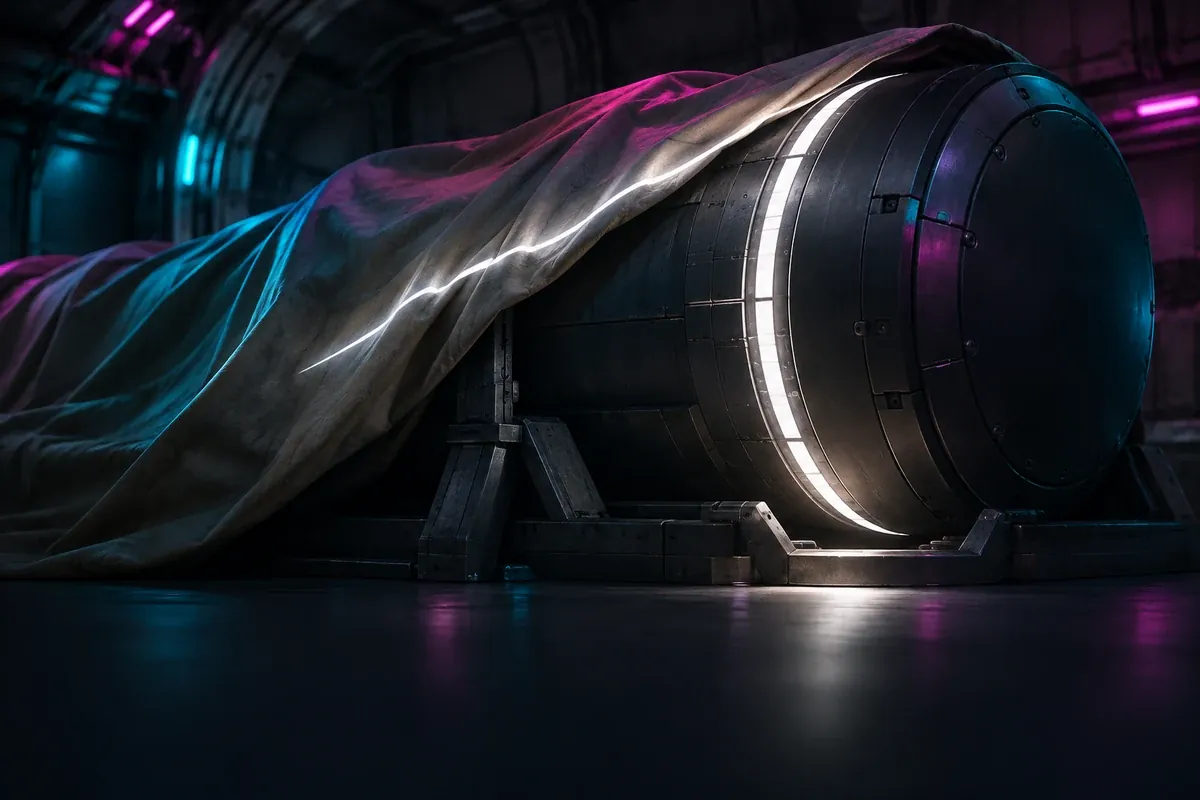
In the hold, the module’s white ring made a thin stripe on the tarp. I pulled the canvas back. My father had hidden it for eleven years. I had managed fourteen hours, and somebody already knew the ticket on my arm wasn’t mine.
I put my palm on the black casing.
The ring warmed. A small rectangle cleared beneath the surface, and letters appeared in the space under my glove.
WELCOME BACK, M. IBARRA.
LAST CONTACT: 2 YEARS, 3 MONTHS, 11 DAYS AGO.
YOU SAID YOU WOULD BRING THE BOY.