

My father’s route log said he had gone to the same pocket of Span 14 once a month, on the first Sunday, for the last eleven years of his life. Every time, he had come home with an empty hold.
That is not how salvage works. A pocket gets picked clean in a week, and a man who keeps returning to one is either lying, stealing, or in love. I was twenty-two, I owed eighty-four thousand scrip, and I was ready to forgive my dead father any of the three if it came with copper.
“Margin’s eleven,” Nia said in my helmet. “Eleven minutes of shadow left, Tobe. After that the sun comes over the Span, the plates start popping, and I’d like you not to be inside a plate when it pops.”
“Copy eleven.”
I hung on an eighty-meter tether off the Small Mercy and let the arc cutter finish its bite through the last coolant rail of the galley block. The Hollow was the dark inside curve of Span 14, where the Ring had folded like a dropped plate thirty-one years ago and never unfolded. Everything in it had frozen mid-sentence. The tables were still bolted down, mugs sat in their racks, and a ladle hung from its hook with frost in the bowl.
Under my boots, Earth slid past, black and enormous. One long thunderstorm over the Gulf flickered like somebody thumbing a lighter in a basement.
The rail came free in my gloves. Forty meters of steel jacket, copper core. Cinch’s rail dealers paid by weight and never asked where it came from, which made them the most honest people I knew.
“That’s twenty-three hundred in the cradle,” Zeke said from the ship, his voice warm with gumbo and bad habits. “Give or take the dealer’s mood. Then Nia’s fuel, then my share, then yours.”
“Then Sol,” Nia said.
“Then Sol,” I said.
Sol Abdi held the note on the Small Mercy. Twelve hundred and sixty scrip every Friday by five o’clock, a point and a half a week, forever or until the ship fell apart, whichever came first. My father signed it before I was old enough to read the numbers. He left me the ship, a gyro that groaned in its sleep, and a debt that grew faster than I could cut copper.
He also left me his hand. Silver contact strips ran along my left forearm to my fingertips, a Tier 2 rig that a clinic in the Basket had re-seated for twenty-six hundred scrip, because a ticket of my own cost nine thousand. It still carried his license number, 40-117. Every time I touched a hull, I was a dead man’s hand with a live man’s debt.
At the edge of my left eye, a small orange number glowed. Bleed fourteen. The rig charged its fee in my body, and that number was the bill.
“Nia, I want to look at the back wall.”
“That’s not on the job.”
“It’s a five-minute look.”
“Margin’s nine, then,” she said, in the voice of a woman writing something down for the inquest. “Nine, Tobe.”
I did not tell her about the log. Waypoint 14-H, forty meters past the galley, behind a crumpled cargo ring. A hundred and thirty-two trips in my father’s tidy block capitals, and not one word about what he did there. I had spent two weeks wondering whether I’d find a stash or a grave. Right then I’d have taken either.
I paid out tether and went hand over hand across the wreck. The cargo ring was crushed like a soda can, and behind it a wall of frozen debris had settled into the dark. I swept my light along it and stopped.
Someone had cut a hatch through the wall. A neat rectangle, just big enough for a man in a suit. The edge had a scalloped lip, one small bite at the end of every stroke, because my father’s arc cutter had hiccupped for as long as I could remember. He used to call it his signature. I used to call it a flaw.
I put my gloved palm on the scallops. The left glove had a patch of conductive mesh, the one part of my suit I never skimped on. My throat did something I was not ready for.
“Tobe,” Nia said. “Your heart rate just went up.”
“It’s cold.”
“It is always cold. Your heart rate doesn’t go up when it’s cold.”
I went through the hatch.
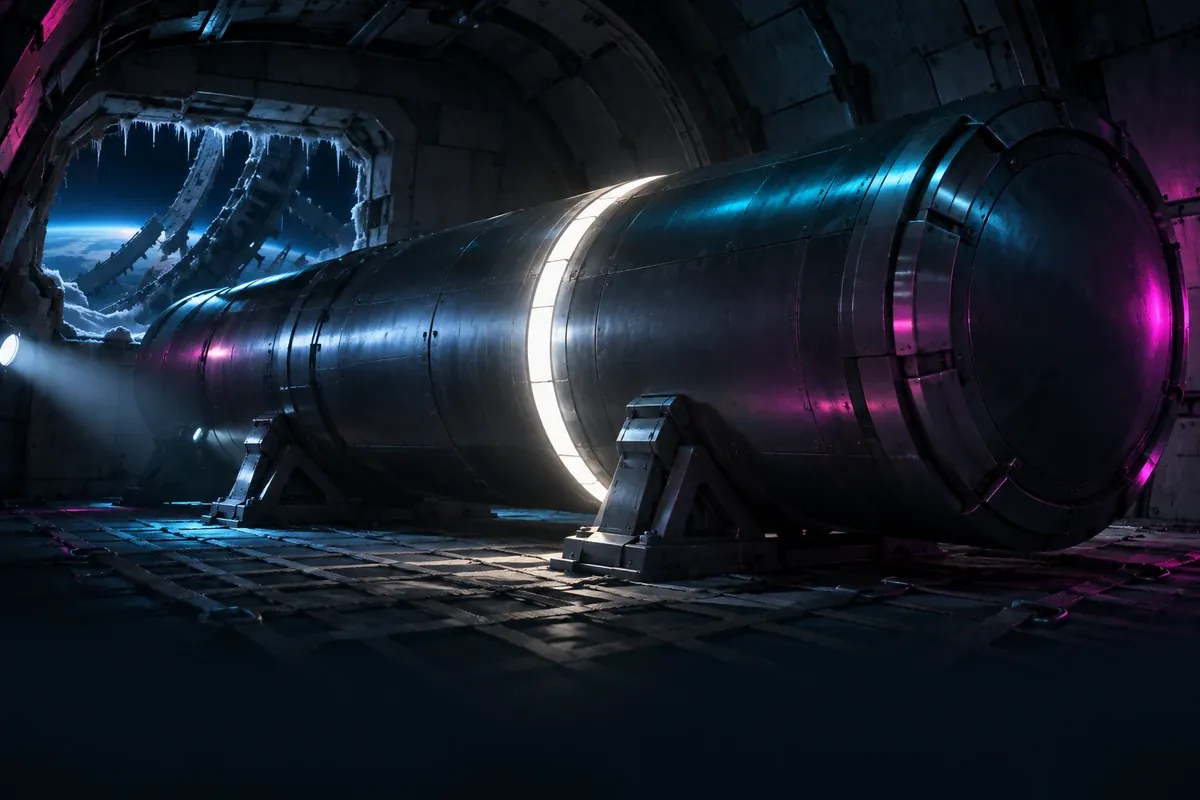
Behind the wall, someone had cleared a room out of the wreckage. Clean walls of cut debris, a floor of tidy cargo netting, a space exactly the size of the thing sitting in it. A black cylinder, six meters long, matte as a hole. It threw back none of my light. A white ring as wide as my hand circled its middle.
Stenciled along its flank in letters a hand tall: HESPER AUTHORITY. CUSTODY. CLASS Z. And underneath, smaller: NOT SALVAGE.
In the Reaches, “not salvage” has only ever meant “not yet.”
“Zeke,” I said. “What’s Class Z?”
A long pause on the line. Something clattered, and I heard him swear at his own left hand, which he called Maurice.
“Authority custody class,” he said at last. “Sealed vaults, the kind they used to mark for the Registrar’s eyes only. I haven’t heard the word in thirty years, cher. Don’t touch it.”
I was already touching it.
Everything tastes of something. When a plate is under strain, my rig fills my mouth with pennies. Vacuum tastes like cold water, a live wire like a nine-volt on the tongue, fatigue like sour milk. I have never touched a surface that tasted of nothing.
The module tasted of nothing. It was like putting my tongue against a held breath. My bleed jumped to nineteen, and the rig did what it does on any first contact, a small cold click in the bones of my wrist.
A line of text unrolled across my vision.
TOUCH LOGGED. PULSE STAMP 04:10:22. CLAIM FORM FOR CLASS Z: NONE ON FILE. CLAIM CANNOT BE OPENED.
I read it twice. In the Reaches, the first licensed rig to touch an unclaimed hull owns it, provided somebody files a Form 9 at the Cinch window within seventy-two hours. The touch was mine. The form, apparently, was not.
“Registry says there’s no form,” I said.
“There’s no form because there hasn’t been one in thirty years,” Zeke said. “The Authority folded, the Compact moved in, and every Class Z thing got stuck in the paperwork. You can’t file on it, cher. A touch without a form is just a man petting a rock.”
“So it’s nobody’s,” Nia said.
“Nobody’s,” I said. “Which means whoever tows it to Cinch first can sell it for scrap by the tonne.”
“Six tonnes of nobody’s with seven minutes of margin.” She went quiet. In the helmet speaker I could hear her tapping the thermal panel the way she did when she was about to be sorry. “Tobe. Don’t move your hand.”
“Why?”
“Because the Mercy’s thermal array is reading something I am not going to believe.”
“Read it anyway.”
“Core temperature of that thing is thirty-seven degrees Celsius. Dead steady. To the tenth.”
Nobody on the line said anything. Outside the hatch, the Hollow ran two hundred degrees below zero. Thirty-one years of black had gone through this place, and the whole time something inside this cylinder had held itself at the heat of a living body.
“That’s body temperature,” Zeke said quietly.
I kept my palm flat on the dark. My father had walked up to this module once a month for eleven years and come home smelling of orange peel, the best smell in the Reaches and the least explained.
Whatever was in there had been warm the whole time, and he had been visiting it.