

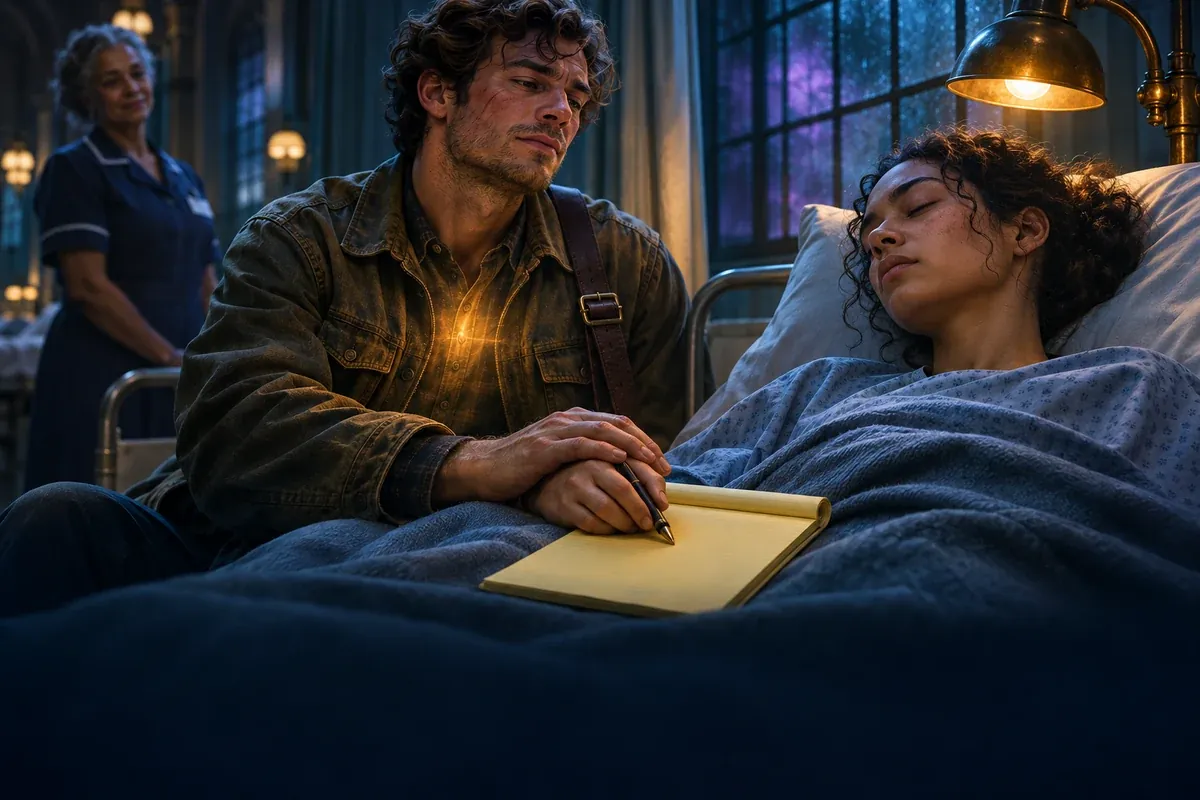
I read the Notice of Return to my sister at 9:40 on Saturday night, in a whisper, to a woman who hasn’t answered anyone in three years.
“Notice of Return of Carried Draw. To Ifeoma Chidinma Okafor, being the debtor of record, in bed six, third floor, St. Brendan’s Long-Term Care.”
My palm is flat on the little blue ducks over her sternum. The ward is dim and the machine beside her ticks along. I read the notice from the first line to the last, name and middle name, and I wait for the warmth under my own ribs to lift out of me and go back where it came from.
Nothing moves. Not a flicker.
I try it a second time, slower. A third time, with the emphasis on the part about consent. The form is clear. A carried draw may be returned to the debtor on her own acceptance, spoken aloud, and a woman in a coma can’t accept anything out loud.
“That’s a no,” I tell her. “I can’t even price a no.”
Winnie says there’s only one other way. The repossession has to be voided, not undone. Voided means the order itself was bad. Voided means finding a defect, and I’ve got a skipped line in a memory and a copy I’ve never seen.
I spent Saturday daytime finding out how little I had. Winnie let me go through her drawers. Junie slept on the cot and asked the space heater whether it ever got tired. The file for March 3 held a tag and nothing else. The order itself isn’t in the stacks. Winnie says an order under carry sits in the vault until the carry is discharged, and mine hasn’t been. Stack has a copy, or says he does.
On the way into St. Brendan’s tonight I rode the elevator past the second floor, where the doors open on pediatrics, and through the glass there’s a child’s room with a horse taped to the window. Crayon, brown, four legs on one side and five on the other. A big man in a work jacket is asleep in the chair underneath it, one hand wrapped around a phone. A monitor over the bed is drawing a line that I know the shape of.
I didn’t get off. I couldn’t price it. I rode up to three.
“You can sit, hon,” says the night nurse, whose badge reads MARGUERITE and who has been working this floor since before my sister got here. “Your sister likes company. Her hand’s going again, by the way. It does it when you’re in the room.”
I look.
Ife’s left hand rests on a yellow legal pad that a nurse strapped to the tray table three years ago, after they noticed it moved at night. The pen is taped between her fingers. They keep the pages in a drawer. There are four hundred and twelve sheets in there. I’ve counted them every Sunday, according to the Blue Book, and I’ve never asked myself what they said.
The pen moves. It drags across the paper in a slow, sure line, like a person dragging a finger through frost.
SERVE THEM.
I look at it for a long time. Then the hand lifts, and writes again underneath.
PAGE NINE.
“That’s it,” says Marguerite, softly. “That’s what it always says. Sometimes the other one. Sometimes it just draws a little box and fills it in.”
A box with a line in it, for initials, and a line left blank.
The warmth under my ribs is moving. It’s pressing toward my sister, as hard as a hand toward a window, and I realize the pen isn’t her. It’s the thing in my chest, talking through the only door it’s got.
“I’m sorry,” I tell her. “I don’t remember the song. I’m told there was a song. I think I owe you a cupcake. I saw it on the tray. I can’t tell you what day it was.” I rub my face with my hand. “You’d correct my grammar. I know that much.”
The pen writes: ME.
“Whom,” I say, and for the first time in three years I laugh, and it hurts.
At 11:25 the corridor lights flicker once and settle.
I know before I look. Three notes, whistled low, up, up, down. They’re coming down the long hallway in the dark between the beds of sleeping patients, soft as a man on tiptoe, and I put my hand over my sister’s hand.
“Boss,” Cutter whispers from the doorway. He’s still got the bandage, the swollen eye gone purple. He sounds hurt. “You just left me in the parking lot. Do you know how that felt?”
“This is a ward. Hospitals are protected. You can’t act on a person in continuing care.”
“Boss, I can act on whoever I like. It’s off the books, remember?” He steps in, soft. “Hand over the thing you’re carrying, and I’ll let you stay with her till morning. That’s a good deal. That’s a hundred-dollar deal.”
“It’s a ten-thousand-dollar deal,” I say, “and you can’t afford it.”
He lunges.
I don’t fight. There are fourteen beds in this ward, and every one has a person in it who can’t get up. If I throw a punch and he throws it back, somebody’s mother will take a ceiling tile to the head. I take the lanyard from my pocket and turn the badge over. CULVER D. RAINES.
“Notice of Default under the Agent’s Code, Article Six,” I say, in the flat low voice you use for a library. “To Culver D. Raines, a licensed Recovery Agent of Firmament Mutual—“
His hand closes on my collar. I keep reading.
“—being in violation of the license bond by acting without paper, and upon premises of continuing care, contrary to Article Six, section twelve. Served by Desmond A. Okafor, Agent of Record, in full.” I breathe. “Culver D. Raines.”
The ward goes still.
Cutter hangs with one hand in my collar, mid-lunge, his mouth open in the shape of a laugh that hasn’t started. His whistle is stuck between two notes. Seventy-two seconds.
I take his hand off me finger by finger. I drag him sideways into the vending alcove, by the collar, a hundred and eighty pounds of cheerful, quiet as a man moving a refrigerator.
I lay the IV pole across the doorway like a barrier. I plug a lamp into the wall and set it on the floor in front of him, shade off, so it shines straight up into his face. The vending machine hasn’t had power since Labor Day. I put my weight against it and tip it, an inch at a time, until it’s leaning over his shoulder like a judge.
Exhibit A, the pole. Exhibit B, the lamp. Exhibit C, the machine. It’s the quietest brief I’ve ever filed.
The seconds tick out. He blinks.
“Huh,” Cutter says, softly, in the lamplight. He looks at the machine over his shoulder and doesn’t move. “Boss. You’re good. You know that?”
“Go home.”
“You know what I like about you?” He smiles up at me, bruised, delighted. “You never ask who’s watching the stacks.”
My phone buzzes against my thigh.
I take it out, and the screen is so bright in the dark ward that it hurts. 11:58 p.m. The number is Junie’s. I read it standing up, and my stomach does the rest.
Mr. Stack says six tomorrow night, thirteenth floor, bring the thing you carry, and don’t read anything out loud. Is that a threat? It’s a threat, isn’t it?