

“Don’t tell me to relax,” Omar said.
Nell had not intended to. She put a chair behind him while Tessa moved the hot cups. He lowered himself carefully, keeping one hand on the doorframe until his weight was down. Sitting, he looked like himself again. The shock left his face and settled somewhere less visible.
“I’ve had a bad ankle for years,” he said. “That wasn’t my ankle.”
“What was different?”
“Nothing hurt.”
Nell wrote that down. She no longer cared about filling the right boxes. On a blank page, she recorded the time, what he had done, and his words. She let him read the page before she added anything else.
He drew a line beneath nothing hurt with her pen. “That part. I don’t want it turned into my old injury.”
“Was it from a fall?”
“Bad landing. Years ago. I’ve had this ankle through more courses than most of the instructors.” He gave her the pen back. “I know which way I’m leaning. I just can’t stop doing it without thinking through the correction.”
Nell asked him not to stand again for her benefit. Omar looked irritated enough that she expected an argument. Instead, he moved his chair away from the doorframe, testing how much support the back gave him while he stayed seated.
“I can tell you something without proving it on the floor,” he said.
“Yes.”
He waited a beat. Nell realized he had expected another question. She closed the notebook.
Beside him, Kit watched the exchange with the concentrated expression of someone listening for the terms of his own future treatment. Nell had been good at keeping candidates from becoming embarrassed by failure. She was less certain she knew how to stop looking for a performance once a person needed help.
The dispatcher called back on the wall phone. Nell reported Omar’s change and asked about the arriving crew. They were on the lower service road. She confirmed that nobody else would train and that both men were seated with someone attending them. Behind her, Kit asked Omar which coffee had been his.
“The one you aren’t getting,” Omar said.
The conversation was becoming a tool. Nell disliked knowing exactly how much that mattered.
Kit offered Omar half the yellow towel to wipe his hands. The paint from the doorframe had left a pale stripe across his palm. Omar rubbed at it, examined the result, and folded the towel back into Kit’s lap.
“Did she say pass?” Nell asked him.
“Crane?”
“Yes.”
“She said I didn’t need to repeat it for you. That you could accept her observation.”
“Did you agree?”
“I asked if that was how it worked.” He looked at the closed notebook. “You didn’t expect me to know your rules.”
“No.”
Kit breathed in. Nell let the next question go.
Omar had taken the course because the mountain team was being asked to work around water more often. He could already carry awkward equipment over ground most people wouldn’t choose to walk. He had wanted the credential to know where his competence ended, he said, rather than let somebody discover it halfway through a job.
Nell had liked that answer at the morning introductions. Now it left her nowhere to place the sensible story in which a reckless student had ignored a limit. She moved his coffee farther from the chair edge, then asked him where he wanted it. He put it back within his own reach.
She shut the equipment cupboard and put a chair against it. The chair would stop nobody determined. It would make an interruption visible. Then she crossed to the pool steps and called Della’s name toward the office corridor.
No answer.
There were windows in the corridor. No need to invent a secret tunnel. Nell could see the director upstairs, standing at a filing cabinet. Della saw her through the glass and held up a folder. Nell pointed toward the door. Della nodded as if this were a minor disagreement over which room to use.
Nell pointed to her phone, then to the table again. Della lifted the folder a second time. She would come down when she was ready, with the version of the emergency she wanted to bring.
The distance between them was only a flight of stairs. Nell could have reached her in less than a minute. She stayed where Kit and Omar could see her and took a photograph through the glass. Della lowered the folder. The picture recorded a woman in an office holding paper, nothing anyone would consider an urgent threat.
“Is she coming?” Omar called.
“She says so.”
“That wasn’t my question.”
Nell put the phone away. “I don’t know when.”
He nodded, satisfied by an answer that gave him less. She had begun to understand how often she used an almost-true statement to give somebody something easier to hear.
The room’s ordinary machinery went on around them. Water ticked in a pipe beyond the basin door. A ceiling vent rattled and settled. Nell looked at each noise when it happened. She wanted one of them to explain the hand that moved next.
At the bottom of the pool, the first dummy lifted its left hand.
Nell stopped.
The movement was slight. Its elbow dragged, then found enough support to bring the hand across its chest. Two gray fingertips touched the inside of its other wrist. The little finger remained bent.
Tap. Tap.
Nell felt an old irritation before she felt fear. Ruth had used the gesture at long meetings, under tables, during lectures they were supposed to find inspiring. Stop pretending everything’s fine. Sometimes Nell had answered by refusing to smile. Sometimes she had done it back.
The gesture had never been a public instruction. Ruth disliked conspicuous solidarity, especially the kind performed by the person least likely to suffer for it. If Nell caught her eye across a room full of people agreeing too fast, the bent little finger could make the agreement harder to sit through.
Nell remembered Ruth using it while Nell made a neat stack of feedback slips. She remembered straightening the stack again instead of responding. There had been nothing terrible about that particular afternoon. The memory was unpleasant because it required no catastrophe to make Nell recognize herself.
She glanced toward the high windows. Nobody stood there. The pool’s painted depth marks looked backward from this angle; she had to turn her head to read them. She searched for a reflection that could have made two gray fingers appear to move. The tiles gave back a dim stripe of light and no answer.
She wanted to call Tessa over and ask whether she had seen it too. That would mean naming what she had seen. Nell discovered she could delay a question even after she had decided that delay was dangerous.
The dummy lowered its hand.
Tessa was watching Nell from the table.
“What?” she said.
Nell almost answered nothing. The word was already arranged in her mouth. She picked up the notebook instead.
“That movement means something to me.”
Tessa’s eyes went to the pool. “Did you teach it?”
“Not today.”
“When?”
“I don’t know.”
Nell checked Tessa’s face before adding more.
“It’s a private signal. I used it with a friend. I might have made it while demonstrating this morning.”
“Might?”
“I wasn’t watching my own hand.”
Tessa nodded toward the ceiling light. “I was filming that before you came in. It kept flickering. Some of your demonstration might be in the bottom of the shot.”
“Don’t delete it.”
“I wasn’t going to.”
Nell almost asked to see it at once. Kit was waiting for the next cue, and Omar was gripping the chair so hard its edge had marked his palm. She returned to them. A recording could wait in a phone. A bodily need could not wait just because a mystery offered her a more familiar kind of work.
“What do you need?” she asked Kit.
“My charger won’t reach.”
The outlet was behind the folding table. Nell had put him beside the open door, in the light, and three feet too far from the ordinary object he had asked for. She moved the table rather than Kit. Omar caught one of the paper cups before it tipped and held it out until Nell took it.
“I’ve still got hands,” he said.
“I see that.”
“Use the information.”
She put him in charge of the bags and the phones within his reach. He asked Kit which pocket held the cable, untangled it, and placed the connected phone on the dry part of the table. The work took longer seated. It still got done without Nell standing over it.
Tessa rose from the stool and stretched one calf. Kit looked at her immediately. Nell sat before he needed to ask. The change of voice unsettled his rhythm for a moment; then he told her to stop speaking as if she were announcing a delayed train.
“I’m trying to sound calm.”
“I know. It sounds like bad news.”
She used her ordinary voice. He liked that better. It was a modest preference she could meet without understanding anything in the pool.
She wrote the possible explanation on the back of Kit’s form and left the space for confirmation blank. The mark on her own wrist was reddened where she’d been rubbing it. She stopped rubbing.
The distinction remained exact and insufficient. Nell had never been in this building before Sunday. She had demonstrated routine hand signals that morning, including how to attract a distracted partner’s attention without startling them. She had also touched her wrist while describing that routine. Her body did things her official account of herself did not include.
Kit lifted one hand. “Can the talking be about something else?”
They had made his emergency into a conversation he was forced to host. Nell put the notebook down.
“Yes. Sorry.”
He picked a subject: the worst work uniform any of them had been made to wear. Omar won before Tessa could finish describing hers. His had included cream shorts and a whistle on a chain that turned his neck green. He had kept the shorts because they were good shorts. Kit objected to the inconsistency and took a breath without waiting for the app.
Nell did not call it progress. He had remembered consciously. She had begun to understand the danger of naming an improvement before the person experiencing it agreed.
Tessa showed them the practical difficulty of her work trousers: every pocket was large enough for a tool and too shallow for the one she needed. Omar objected that at least she had been given pockets. Kit said the kitchen apron pockets held water whenever he reached across the sink.
“That’s how they get the extra labor,” he said. “Portable rinsing.”
Nell laughed before she could consider whether laughing was appropriate. Kit looked pleased for half a second. Then he looked tired, and she saw how much effort making the others comfortable had cost him.
“You don’t have to keep this going,” she said.
“Neither do you.”
He meant the uniform conversation. He also meant the room arranged around his willingness to keep speaking. Nell put the notebook behind her rather than beside him. Tessa restarted the app at the volume Kit chose. For a while there was no conversation at all, only the rhythm and the separate small sounds of adults trying to wait.
Nell watched the door. The responders were still on the service road. She resisted the temptation to call again simply to make somebody assure her they were moving.
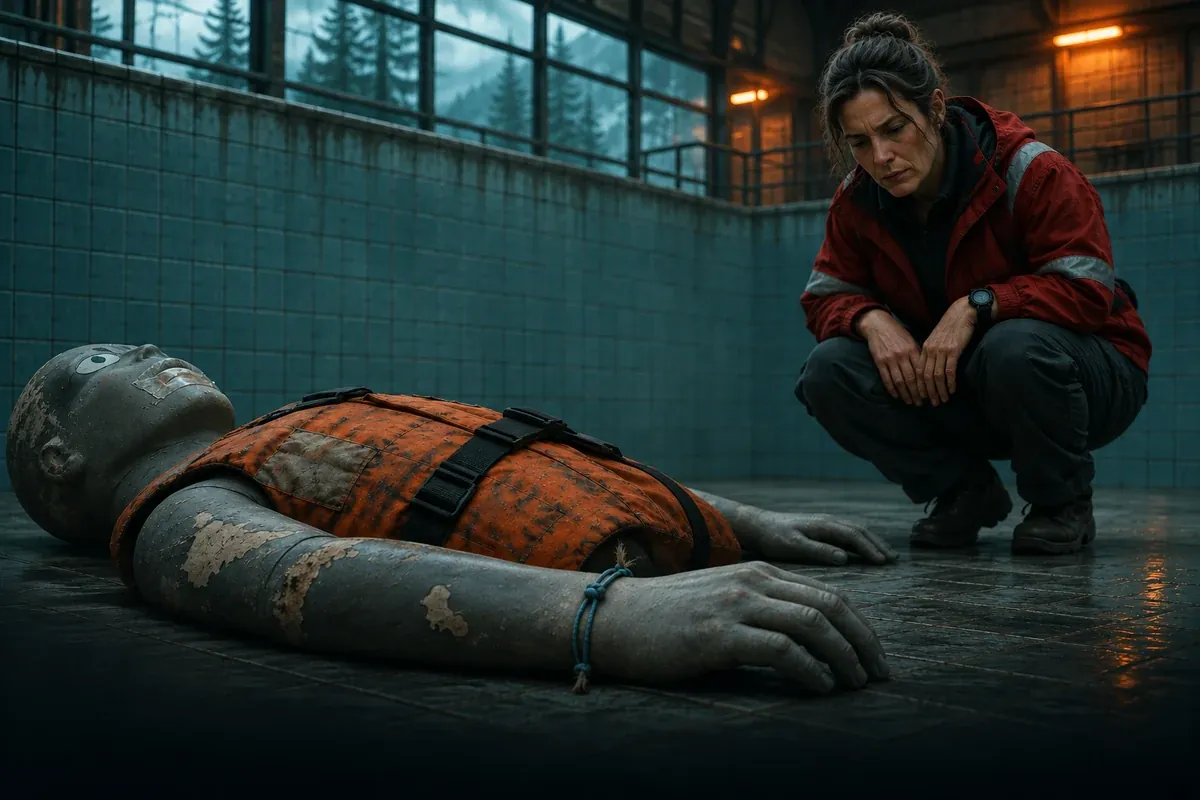
She went down the shallow steps, keeping her shoes on. The dummy lay where it had been. Its eyes were painted, flat and slightly misaligned. There was a tiny tear beside its mouth, repaired with a translucent patch.
“Ruth?” she said quietly.
Nothing happened.
Nell felt both relieved and ashamed of the relief. Ruth Senn had been dead eleven years. If something was using that name, she did not know what it had taken to acquire it.
She lifted the edge of the vest with the end of her pen. The chest slot was empty from the outside. Kit’s tab had gone all the way in.
“Can you hear me?”
The dummy’s fingers brushed its wrist again.
No voice. No knowledge she could test. Only the movement she wanted to recognize. Nell let the vest fall. Want was dangerous evidence.
The name remained in the empty pool after she stopped saying it. Nell looked up to see whether Kit had heard. He was watching Tessa’s phone, and Omar was making a loop of cable that wouldn’t catch under a chair. She had brought a dead friend’s name into an emergency that belonged to two living people.
Nell took one step back from the model. Its patched shoulder scraped faintly against the tile as the chest rose. A vented casing could move. A remembered gesture could be misread. The two explanations did not fit together, but she refused to improve them by inventing a person beneath the gray surface.
She crouched at a distance and checked the wrist without touching it. The blue thread was ordinary thread, knotted twice, its ends stiff with grime. She could not remember Ruth wearing anything like it. That mattered. She had already begun to collect similarities and forget absences.
When she stood, her knee complained. The small pain helped her decide what to do next. She returned to the steps rather than trying the name again.
Upstairs, Della opened the office door.
“Don’t come down,” Nell called. “Bring the folder to the table.”
The director came down the corridor carrying the folder against her chest. Tessa pulled out a chair for her, directly across from the men. Della did not sit. She set the folder on the table and placed both hands on its cover. Nell climbed the remaining steps to the deck.
“You shouldn’t address a model by a personal name.”
Nell stared at her. The director was no longer pretending it held pressure.
“Why?”
“It complicates the retention pattern.”
“What pattern?”
Della looked past her at Kit, then at Omar. “We need to keep them calm.”
“They can hear you.”
Kit said, “We can also understand you.”
Omar picked up Nell’s notebook and opened it to the page he had marked. “If you’ve seen this before, start with that.”
Della looked at him as if the notebook had given him a kind of authority she hadn’t expected him to take. “It isn’t identical in every case.”
“That wasn’t what I asked.”
“We need proper conditions for an account.”
“I’m sitting down. Kit’s got somebody with him. You’ve got your folder. What condition are we missing?”
Nell saw Della look toward the office corridor, then stop. The exit remained behind her. She could leave if she wanted. Her reluctance to do so had begun to look less like concern for her students than a need to remain the person explaining them.
Tessa set a cup of ordinary tap water beside the folder. “You can sit or stand,” she said. “Either way, they’re the people you’re answering.”
Della rested her fingers on the back of the chair. She still did not sit.
“This is a new kind of learning aid,” she said. “Some participants experience an adjustment period.”
Omar leaned back. “And you know what comes after it?”
“There can be a return.”
“Can be?”
The sound of tires on gravel reached them through the open door. Eamon called from outside. Tessa waved to him, and two uniformed responders came around the corner carrying bags. Nell had never been so glad to see equipment whose purpose was written plainly on the side.
She moved to meet them. Behind her, Della opened the folder to a page headed by a familiar phrase.
Independent performance confirmed.
Below it, in a reproduction of her own handwriting, Nell saw her name and a date from eleven years ago.
She had signed that form the morning after they found Ruth.