

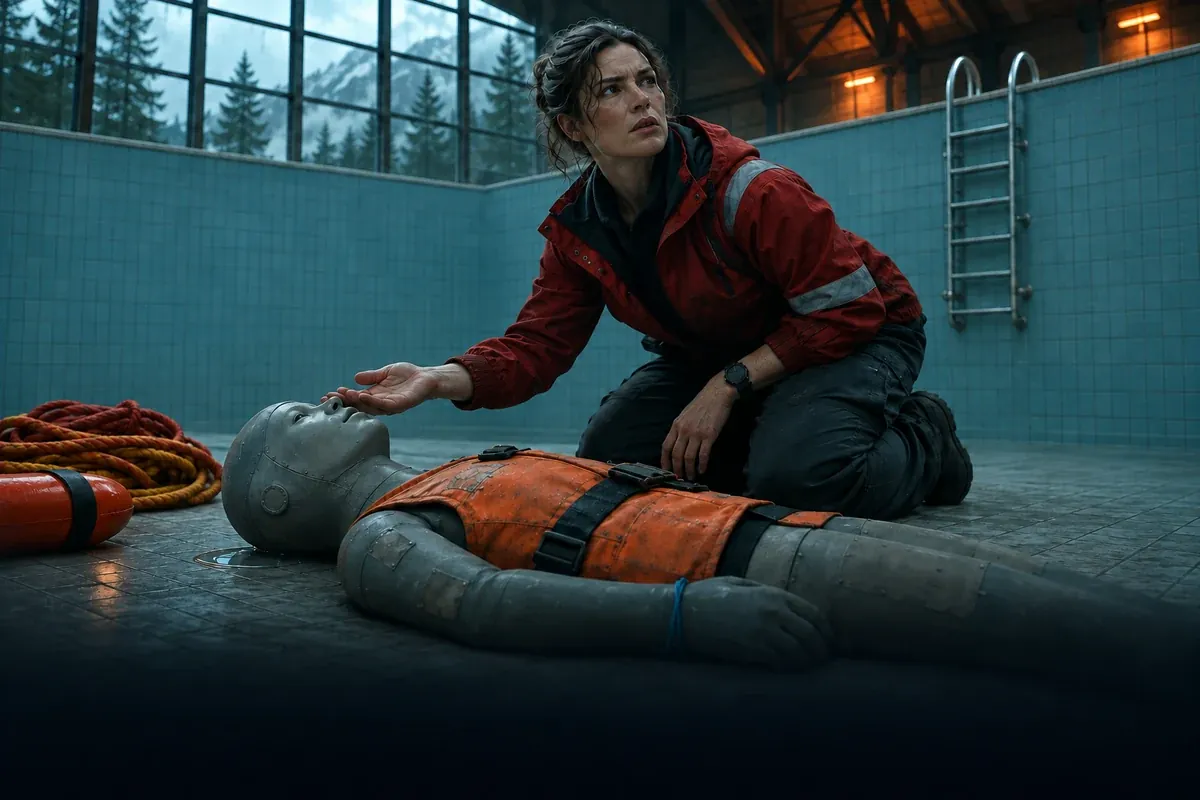
The rescue dummy coughed while Nell Voss was filling out its purchase date.
It lay on the tiles at the bottom of an empty swimming pool. Six feet above it, Kit Abele stood with a rescue rope in both hands, waiting to be told whether he had passed. The cough was wet, small, and irritated. Nell knew that cough. People made it when they had discovered that surviving something did not immediately make them comfortable.
She put down her pen.
“Leave the rope where it is,” she told Kit. “Don’t tighten it.”
He eased his hands apart. There was a red mark across one palm from the last pull. Nell had warned him against wrapping the line, and he had corrected it without argument. He was tired now, which was when an assessment became most useful and most likely to become cruel.
“Are we stopping?” he asked.
“The exercise is stopped.”
He looked at the dummy, then at Della. Nell moved her form off the edge of the table so there would be no doubt where her attention was. The empty pool made every small sound consequential. A shoe squeaked and came back from the far wall as another shoe. She listened for the cough to repeat and heard the room’s ventilation instead.
Kit set the rope down in broad loops. He did it properly even now. Nell wanted to tell him that would be enough. She had not yet decided what enough meant in this place.
“Who’s operating the sound?”
“There isn’t sound,” Kit said.
From the lifeguard chair, Della Crane unfolded herself with the unhurried care of a person accustomed to being watched. She wore pale slacks and indoor shoes. Her shoes had not approached the pool edge all morning.
“Residual air in the torso,” she said. “The new models hold pressure.”
Nell crossed to the ladder. Eight months without water had left a gray ring around the pool. Someone had scrubbed the deep end so thoroughly that it was lighter than the rest, a clean rectangle with rounded corners. The dummy occupied its center. Its orange vest was patched at the shoulder. A short blue thread circled one wrist.
She descended backward. She did not hurry. Hurrying invited other people to do it too, and Kit already looked ready to jump.
At the bottom, she crouched beside the dummy and held the back of her fingers over its mouth. Cool air touched her skin.
The ladder’s last rung stood farther above the floor than she expected. She made the step carefully, then tested the tile with her heel. Dry and sound. No loose mat, no curled drain cover to explain the noise through some ugly little trick of pressure.
“Was it stored in water?” she asked.
“It’s been in the practice basin,” Della said.
“When?”
“During the course.”
“Today?”
“Not today.”
A cupful caught inside a training model could make persuasive noises. A valve could vent when a torso warmed. Nell had watched experienced people become superstitious around equipment whose instructions they had thrown away. She wanted an explanation boring enough to write on a maintenance ticket.
She lifted the rope clear of the model’s throat and followed it back along the floor. Nothing was caught beneath a shoulder. She put it down without changing the body’s position. Up above, Kit leaned forward to see.
“Stay behind the line,” she said.
There was no painted safety line. He understood which joint in the tile she meant and stepped back from it. That ordinary compliance helped her more than Della’s explanation had.
“Does this one have a heater?”
“No.” Della’s answer arrived too quickly.
Nell glanced up. Behind Della, the mountains filled the high recreation-room windows, green and offensively pleasant. Bellwether’s summer contract had promised three days of evaluations, private lodging, and payment on completion. Nell had budgeted the money twice on the drive up. She had not budgeted for an argument about a coughing doll.
“Then I’ll need the technical sheet.”
“After the exercise.”
“This is after the exercise.”
Kit shifted at the edge. The rope rasped against the tile. “I kept its face clear the whole time.”
“I saw.”
“Even getting it over the lip. That’s the part I practiced.”
Nell looked at the dummy. There was no pool lip to get it over down here. Kit had hauled it from the deep end to the shallow end, then lowered it again at Della’s direction so Nell could inspect the joints. The sequence was elaborate, inconvenient, and listed nowhere on the evaluation form.
“Your handling was good,” Nell said. “We’ll discuss the rest when I get back up.”
Something dark spread under the dummy’s head.
She touched the tile. Water. A tablespoon at most, seeping from the seam beside its ear. She checked the vest and the underside of its neck. Dry. The last time she’d seen water appear without a source, it had turned out to be a split hose in a wall. She looked for a hose.
There was only gray tile, old grout, and the place where the dummy’s fingers rested against its wrist.
She pressed her palm against the adjacent tile, then against the wall. Both felt dry. The nearest drain was several feet away and filmed with dust. Nell followed the grout to it, looking for the kind of narrow wet trail a person could miss while expecting a large leak. There was none.
That did not make the water impossible. It made its source undetermined. She had spent years insisting on the difference when students wanted an answer fast enough to put in a box.
“Did anyone pour anything in the mouth?” she asked Kit.
“No. I thought about washing the face. It was dirty. She said leave it.”
Della’s indoor shoe appeared at the edge above them. “We don’t immerse these units unnecessarily.”
“You just said it had been in the practice basin.”
“For an assigned task.”
Nell stood. She could keep pulling at the inconsistent answers until lunchtime, with Kit stranded above her waiting for a verdict. She could also stop handling the equipment, record the fault, and take it out of service. The second choice did not require Della to become helpful.
“Nobody uses this one again until we’ve checked it,” she said.
Della nodded after a pause long enough to make the agreement feel temporary.
“Nell?” Della called. “We have another candidate before lunch.”
Nell climbed out and wiped her hand on the towel Kit offered her. It was his towel, striped yellow, with a corner cut off. He had brought it in a grocery bag along with his lunch.
“How long have you trained here?” she asked him.
“Since Friday. I took time off.”
“From what?”
“Kitchen. Mostly washing up. There’s a recreation job where my aunt lives. They said this would count.”
He did not ask if it would count. He needed her to have already decided.
He folded the towel along its stripes. “They said I could start on afternoons. If I got the right part done.”
“The right part matters. What does the job description say?”
“Mostly setting up, cleaning, watching the rooms. But they want somebody they can train for the water side later.”
Nell asked whether he had the description on his phone. He did, buried beneath an exchange about covering a kitchen shift. While he searched, he apologized for the cracked screen. She told him she could read it. He turned up the brightness anyway, accommodating her before she had named a difficulty.
The position sounded ordinary and badly paid, with a schedule stable enough to rearrange a life around. Kit pointed out the guaranteed hours before he pointed out the wage.
“Friday was meant to be my last dish shift,” he said. “Then I said I’d do one more. Just in case.”
Nell gave him back the phone. “Don’t give it up on my account. Ask them exactly which assessment they accept.”
“You think this course is no good?”
“I think you should get the answer in writing before it costs you another week.”
His face tightened. She had meant to give him something useful. He had heard the possibility that the whole trip had been a purchase he couldn’t return.
Della handed Nell a narrow cream card clipped to Kit’s lanyard. His name was printed at the top. Below it were boxes for completed, assisted, and independent. At the bottom sat a single word in dark green: PASS.
“The model retains its own training record,” Della said. “The tab goes in the chest.”
“I retain the record. You get a copy.”
“Of course. This is for the next instructor to scan.”
Nell turned the tab over. No chip, no code, no battery. Ordinary stiff paper.
At the side door, a woman in work trousers was replacing a light switch. She had stopped with the cover plate in her hand. When Nell looked at her, she lowered her eyes to the exposed box.
“Is there a scanner?” Nell asked.
“Not a conventional one.” Della smiled. “We don’t need to make their first day harder.”
Kit looked down at his lanyard. Nell recognized the arrangement. An instructor raising a procedural question; a director answering it with a student’s needs. She had used the technique herself, when the problem was a late lunch or a missing signature. It was effective because the needs were real.
“Could we just leave the card out?” Nell asked.
Kit went still. Della noticed him go still and kept her answer gentle.
“Then his equipment record would be incomplete.”
“The paper copy can be complete.”
“It’s a paired system. One record with the candidate, one with the unit. We lose tabs otherwise.”
“People lose paper too.”
“Yes. You can photograph it.”
Nell laid the tab on the table rather than handing it over. Her completion fee was a flat sum. She would receive no extra money for finding a problem, staying late, or coming back when the equipment had been checked. She had accepted that arrangement because a flat sum could be entered in a budget without hoping for enough hours.
Della knew what her fee was. Kit did not. Nell felt suddenly uncomfortable about standing between them with both the power to delay his application and a private reason to finish her own work.
She took out her copy of the course agreement. Della watched her find the relevant paragraph. The room had the suspended quiet Nell knew from any practical exam where a candidate feared the adults were arguing about whether he deserved a chance. She made herself turn toward Kit when she spoke next.
Before she marked anything, Nell checked the course heading. This was supposed to be a dry handling assessment. A water assessment would come later, with a different venue and a second instructor. She had refused Della’s suggestion to combine them on one certificate when they spoke by phone. The dry pool was odd; it was not, by itself, permission to certify somebody for work he hadn’t done.
She wrote DRY HANDLING ONLY across her copy and asked Kit to initial beside it. He read the words, asked whether the recreation job needed the later assessment too, and listened carefully to her answer. Nell liked that about him. He was willing to risk an awkward question before accepting the result he wanted.
She circled independent. Kit had done the haul without a cue. The cough was an equipment fault to investigate, not a reason to fail him.
“Tell me the part you’d change,” she said.
“On mine?”
“Yes.”
“I’d move the rope before I went around the shoulder. I had to step over it.”
“And if you couldn’t move it?”
“Ask for help. Stop calling it a solo.”
She had heard people with ten years’ experience find elaborate ways around that answer. Kit said it with a faint air of disappointment, as if asking were a deduction she might still decide to make.
“That’s right,” she said.
Della glanced at the wall clock. Nell could see the next appointment folded inside that glance. She checked Kit’s initials a final time. Her task was narrow. She had observed him perform it, and he understood what he had and hadn’t done. The model was out of service. None of those things required her to withhold his result.
She set her own marked copy aside, away from the damp towel. Later, she would remember the care with which she had protected the paper.
“Kit Abele,” she said, making certain the name matched his application. “Independent completion.”
Della took the tab. Nell reached for it, intending to photograph both sides, but the director was already climbing down the shallow-end steps. She slid the card into a narrow slot beneath the dummy’s vest. A click carried up through the empty room.
The woman at the switch put down her screwdriver.
Kit smiled. Then his smile became a puzzled open mouth.
Nell was writing the time when he touched her sleeve.
“Can we sit down?”
She pulled a chair away from the folding table. He sat, planted both feet, and breathed in so deliberately that she heard the air catch against his teeth.
“Dizzy?”
He shook his head. Another deliberate breath. “Probably just excited.”
Nell watched him. She had spent twenty years learning the different ways people tried not to inconvenience an instructor. This was one of them. She asked whether he had eaten, and he described a sandwich in unnecessary detail. As he spoke, his shoulders settled.
“It’s in the bag,” he said. “If you’re checking.”
“I’m asking you.”
“I know. Sorry.”
“Don’t apologize.”
He nodded too quickly, then seemed to catch himself agreeing to another instruction. She moved her chair so they sat at the same height. Behind his shoulder, Della began collecting the loose assessment sheets. Nell put one hand on her own pile before the director reached it.
“Leave those.”
Della withdrew her hand. Kit watched the movement and drew another breath, slow and deliberate. His eyes were wet with effort or embarrassment. Nell asked whether anything hurt. He shook his head. Could he tell her what felt wrong? He looked down at his chest as if it were a coat he had buttoned incorrectly.
“I have to do it,” he said. “I know that sounds stupid.”
“It doesn’t.”
“Everybody has to do it.”
She understood why he couldn’t finish the distinction. She did not make him keep trying to find a better description. The towel lay across his knees. He smoothed its cut corner flat and breathed again. For a moment, Nell thought the episode was passing. It was an attractive thought, offered before she had evidence for it.
Then he stopped speaking.
Three seconds passed. Five. His hand closed on the cut corner of the towel.
“Kit.”
He drew a sharp breath and nodded, embarrassed.
Nell set her form facedown. “Tell me about the recreation job.”
“It’s permanent. Well. Permanent if the funding stays.” He swallowed. “My aunt says they always say that.”
The woman from the switch came over. Her name badge said Tessa. She carried a stool and placed it beside Kit rather than behind him.
“I’m getting help,” Nell told him. “Tessa’s going to stay here.”
His fingers tightened on her sleeve. The effort to speak made his face pinch, though there was nothing blocking his mouth, nothing around his neck, nothing Nell could remove.
Behind them, down in the empty pool, the dummy’s orange vest rose and fell.
“Please,” Kit said. “Keep talking. When you stop, I forget.”