

Junia had spent the night hearing the stranger’s voice from the chute. By morning, she was prepared to tell Corwin about it. She had even written the words in her appointment book so she couldn’t improve them into something less alarming.
He was waiting beside the desk with the old register open.
“I’ve been here before,” he said.
She looked at his signature. Seven years. A preservation consultation, two weeks after a drowning that had filled every shop window with donation jars. She remembered a young man in a brown coat, rain running from his cuffs. Not his face. She had been an apprentice then, twenty-one and convinced that carrying a cup of tea without spilling it was a contribution to another person’s grief.
“I remember the appointment,” she said. “Not well enough to answer your questions.”
He shut the book. “Then please find somebody who can.”
Before she could reply, Hollis Dane came in holding a recipe notebook with both hands. He had flour on the shoulder of his coat. Junia had once asked how it got there. He had said that was where he rested his head when things went badly.
“I need the third version of my mother’s sugar crust,” he said. “Wedding order. The ordinary notebook has the second.”
“The third has a sensory loan attached,” Junia said. “You can borrow it without a deposit if you bring a guarantor.”
“My sister’s out of town. I’ll leave the taste of my first failed batch. Happy to be rid of it.”
Corwin stayed at the end of the desk. Junia unfolded a fresh schedule where Hollis could see every section.
“Temporary deposit, not a fine,” she said. “Return by next Tuesday, get it back. If you’re late, we discuss an extension or the ordinary payment. No automatic final transfer.”
Hollis nodded, reaching for the pen.
“Not yet.”
She asked him to describe the failed batch. Burnt sugar, bitter butter, smoke. His mother had found him trying to scrub the pan with salt. She had laughed, then shown him how to melt the crust away with water.
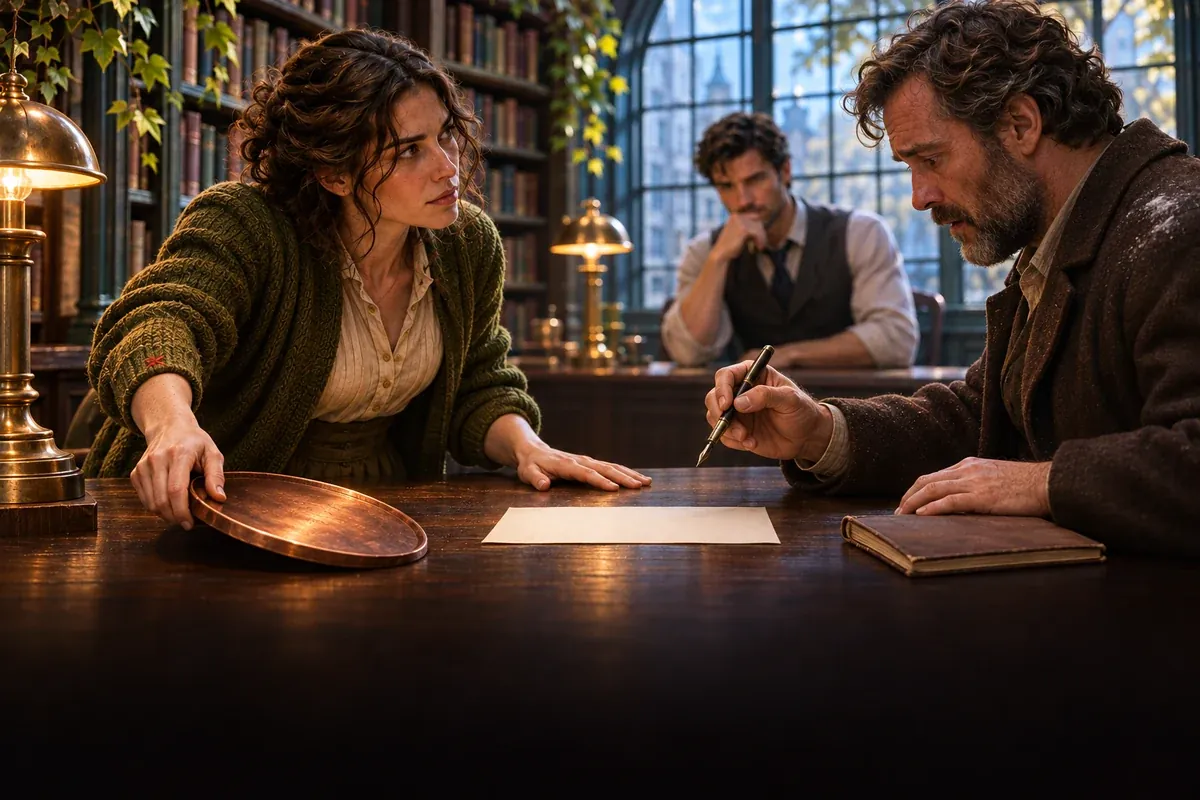
Junia glanced at the copper plate. Its edge was beginning to warm though no one had signed. The first trace of a linked recollection, responding to his choice.
“Was that the last time you baked with her?”
Hollis’s hand stopped above the slip.
“No. It was the last time she could stand long enough to show me.”
She pulled the plate away.
“Then the failed batch isn’t the whole memory. The lesson is tied to it. We would need to separate what can be separated, and you would need to hear exactly what you’d lose for the week.”
“I was only leaving the taste.”
“I know.”
His ears had reddened. Junia hated the shame that appeared when people thought they had almost been foolish at her desk.
“You haven’t agreed to anything,” she said. “The pen is still dry.”
Corwin stood. “Is there a reference copy of the recipe?”
“Ordinary words,” she said. “Without the taste and timing.”
“Then he could start there.”
Hollis looked from one of them to the other. “I know how to bake. I wanted her to tell me I was getting it right.”
Junia set her father’s old apron on the back of her chair more carefully than she needed to.
“We can copy the words,” she said. “And I can taste a trial batch. I am very critical.”
“She is,” Wick said, passing with a stack of atlases. “I once brought buns.”
Hollis laughed. He took the ordinary copy and left without putting his finger on the plate. Corwin wrote nothing until the door closed.
“You stopped that quickly,” he said.
“I knew his mother.”
“What happens when you don’t?”
Junia looked at the new linked-memory box. It was larger now. Still a box, waiting for somebody to know enough to fill it.
They spent the next hour tracing deposits through to the available return notices. Corwin asked for the restricted index. Junia said it held private recollections with owners who hadn’t consented to general inspection.
“I can review the terms without reading their lives,” he said.
“The index isn’t always that tidy.”
“That sounds like another reason to see it.”
She said she would arrange access. She heard how much the words resembled the Archivist’s due course and disliked herself for using them.
In the binding room, she took down the privacy manual. It allowed supervised examination of transaction records when private content could be screened. She had used that provision for an estate dispute three winters earlier. Her delay now was not an unavoidable rule. She wrote the relevant clause on a separate sheet for Corwin, then sat looking at it.
The Archivist asked whether she needed help locating an exception.
“I’ve located the ordinary rule.”
“The situation is delicate.”
“Yes.”
She closed the manual. Delicate things needed support, light, and enough room to handle them. Keeping them in a cupboard was only a way of putting the damage out of sight. She had spent years teaching apprentices that about paper.
During lunch, Wick sat on the binding room step while Junia repaired a torn hinge. Outside, a girl sang the multiplication tables so badly that even the numbers seemed uncertain.
“Does it bother you?” Junia asked.
Wick followed her glance to the window. “Children learning arithmetic? Frequently.”
“The singing.”
He turned the bell on his cart until the clapper fell quiet.
“Ada couldn’t sing either. That’s the part I remember without difficulty.”
Years earlier, he had chosen the memory of his sister’s singing to pay a fine. He had understood the choice. The thread had later been damaged during a flood. Nothing Junia could bind would put the sound back in his mind.
“I knew what I was signing,” he said. “That doesn’t mean I’d sign it again.”
She pressed a fresh strip of cloth along the hinge.
“I keep thinking if I protect the books, I’m protecting the people.”
“Sometimes. Sometimes people want their book back.”
At the restricted door, the Archivist spoke before she touched the lock.
“An inspector may misinterpret incomplete records.”
“Then we give him complete ones.”
“You hold a duty of confidentiality.”
“And you processed Mrs. Vale without checking her route.”
The tube stayed silent. Junia unlocked the outer index cupboard. Its shelves held ordinary catalog books, not memories. Private subjects could be screened while dates, terms, and signatures were examined. She should have arranged that yesterday.
On the bottom shelf, a blue folder carried a name in the old apprentice hand she recognized as her own. Corwin Ashby. Preservation loan. Attached was a notice with tomorrow’s date.
The date marked a required preliminary notice, not the final conversion. She checked both lines before taking the folder upstairs. He needed the whole schedule, even if the larger red stamp made the first date easier to see.
Junia took it upstairs without opening the sealed inner envelope.
He was standing by the public window, watching the harbor. She laid the folder on the table between them.
“Tomorrow morning,” she said. “Restricted index, supervised access. I should have offered sooner.”
His gaze moved from the folder to her face.
“Do you know what’s inside?”
“I know I wrote your name. I know there’s a notice due. I haven’t read your envelope.”
She told him about the voice from the chute. This time, she did not soften anything.