

I told the Committee at nine that night, in the vestibule between 88 and 87, with the door shut and the thermos going around like a peace pipe, because I’m a coward about everything except paperwork.
Yun took it first. He read the Payout Source Report off my hand with his lips moving, got to the interest rate, and sat down on the floor of the vestibule, which is free, and put his head between his knees. Carol said “oh, honey” in the voice of a woman who’d been about to get a refund. Dev Raman asked, quietly, whether the interest was compounding, and when I said I didn’t know, he said, “It’s compounding,” with the dead calm of a hospitality major who has read a lot of hotel contracts.
Pearl didn’t say anything. Her needles didn’t even stop. She waited until everyone had made their noise, and then she said, “How long?”
“Forty-eight hours to the Timetable Hearing. The recovery gets collected there. Thirty-one thousand, eight hundred eighty-three, sixty cents, across Coach.”
“And whose fault is it?”
“Mine,” I said. “I designated myself. They signed. I filed.”
“Mm.” Click. Click. “That’s an answer, but it isn’t the one that helps. Try again.”
It took me a minute. I’d been so busy being the man who’d made the mistake that I’d forgotten I used to be a man who found them. I took out the notebook, flipped to a clean page, and wrote at the top, in pencil: WHO PAID?
Here is what four years on a fare gate teaches you about refunds: they come from somewhere, and the somewhere is written down. If a transit authority refunds a rider, the money leaves a named account. The accountants insist. Nobody gets to just make money out of a rail yard, and nobody hands out forty percent interest by accident.
So I went looking for the account.
I read the whole Tariff again. The whole thing, front to back, not skimming for loopholes but reading it the way you read a will. That took four hours, and Dev made me eat half a protein bar I’d refused three times, and around one in the morning the Committee had set up in the vestibule like a night shift: Yun on the Quiet Car side watching for Porters, Pearl in the corner knitting something the color of a bruise, Carol and Dev doing arithmetic on the back of a Galley menu.
Around midnight, in Section 9, I found a clause so strange I copied it into the notebook just to have it somewhere that wasn’t the Tariff. 9(a). REVIEW OF THE SCHEDULE. ANY PASSENGER, UPON REQUEST, MAY CAUSE THE FARE SCHEDULE ITSELF TO BE REVIEWED FOR CONFORMITY WITH THE TARIFF. Down in the margin, in the small type that records history, was a single line: INVOCATIONS: 0. I drew a box around it and forgot it. It read like the kind of right they put in a bank charter so nobody can say you didn’t have one.
At 1:14 I found it.
Schedule C. Compensation and Remedies. Section 2. Source of Funds. It was buried between a clause about lost umbrellas and a clause about the disposal of unclaimed ashes, which tells you what the drafters thought of readers.
COMPENSATION OWED UNDER CLAUSE 44 SHALL BE DISBURSED FROM THE CARRIER’S OPERATING ACCOUNT (ACCOUNT 0001). NO COMPENSATION SHALL BE FUNDED, IN WHOLE OR IN PART, BY ADVANCE AGAINST THE ACCOUNT OF ANY PASSENGER.
I read it aloud. Nobody said anything. Dev put down his pen.
“It’s in the Tariff,” I said. “In plain language. The Carrier pays. Not us. The Source Report says the money was an advance against our future balances, which Schedule C expressly forbids.” I could feel my own pulse in my wrist, which made the ledger shake, and I didn’t care. “They misapplied my claim. It isn’t a debt at all. It’s a charge that violates the Tariff’s own funding clause.”
“So you dispute it,” Yun said, from the floor.
“I dispute it.”
“And if you lose,” Pearl said, without looking up, “the penalty is double the disputed amount.”
I’d done that math the moment I’d read the report: thirty-one thousand eight hundred eighty-three, doubled. Sixty-three thousand seven hundred sixty-seven Fare and some change, which I owed to nobody and could pay to nobody, and which would send me to the one department on the train that has never once been late.
“If I win,” I said, “it all goes away. The advance, the interest, all of it. If I lose, I’m the first man to default on the Meridian Line in an expensive way.”
“Not a lot of upside for you,” Dev said.
“No.”
“Do it,” Carol said. She said it the way my mother used to say things, as if she’d grown up in a house where you said the thing and then did the thing. “You did something stupid because you did something kind, and now you’re going to do something smart because you’re not a coward. That’s all of it, honey. File the paper.”
I wrote it out, in pencil, block letters, the Authority style. [DISPUTE] CHARGE: ADVANCE AGAINST FUTURE ACCOUNT BALANCES, COACH SECTION, 22,774.00 PRINCIPAL, 31,883.60 RECOVERABLE. GROUNDS: SCHEDULE C, SECTION 2. And I gave it to Felix, at 2:03 a.m., when he came through to do his rounds, and he took it in both hands as if it were hot, and his face did something I’d only seen it do once.
“I will have to escalate this,” he said. “It exceeds my authority. It is going to the Timetable Hearing.”
“I know.”
“The hearing is Thursday at three in the afternoon. Annex car 90.” His holes were arranged into a pattern like a held breath. “Inspector. In forty years on this line, nobody has ever filed a dispute against a payout. I would like it noted that I think you are right.” A pause. “I would not like it noted that I said so.”
“I won’t note it.”
“Thank you.” He folded the notice and put it inside his coat with the care of a man pocketing a letter from a prisoner.
That was the easy part. The hard part came at seven the next evening, when Mr. Veen asked to buy me tea.
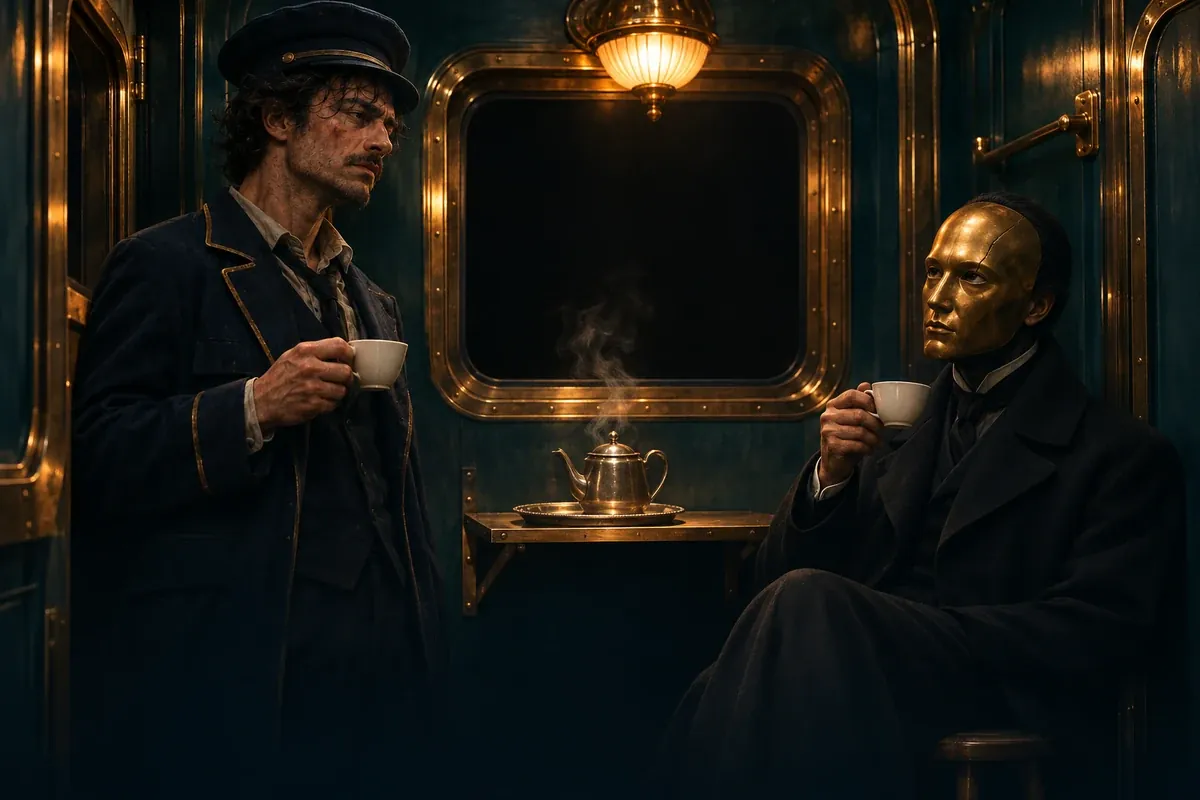
I’ll tell you what I expected: a brass mask and a squad. Collections in a line down the aisle. What I got was Veen alone, in the vestibule at the end of 88, with a small silver tray, two cups, and a pot of actual tea, which he set down on a folding shelf that hadn’t been there a minute before. He poured. The steam smelled of bergamot. I looked at my wrist: a charge was pending. TEA SERVICE, 4.50. He saw me looking.
“The Line will bear the cost,” Veen said. “Consider it a courtesy of the house.”
“You can’t lie about ledgers.”
“No. I can’t.” He seemed pleased that I’d noticed. “So when I tell you the tea is on the house, you may take it as a statement of record. Please. Sit.”
I stood. He didn’t seem offended. He lowered himself onto the folding shelf’s attendant stool as if it were a bench in a park, his mask turned a few degrees toward the black window, the hairline crack over the left eye catching the vestibule light.
“I’ve read your dispute,” he said. “It’s admirable. You’ve found Schedule C, Section 2, which fewer than a dozen persons in the history of this service have ever read. I congratulate you. You are going to lose, Inspector.”
“Why?”
“Because the hearing is not a court. It is a review.” The mask turned back to me. “You will be heard. And at the end of the hour, the Examiner will observe, with perfect accuracy, that the Tariff is the Tariff, and that the Carrier’s operating account is an account, and that an advance is a thing the Carrier may elect to make out of any funds it controls, including funds that haven’t been earned yet. Passengers’ balances are, after all, the Carrier’s future revenue. It is a matter of definition. You do not want to lose a matter of definition. The penalty is not pleasant.”
I didn’t answer. I picked up the cup. I’m not proud of this, but he’d said the tea was on the house, and a man in my position doesn’t refuse a free cup of anything.
“I would like to propose an alternative,” Veen said.
“Of course you would.”
“Withdraw the dispute. I will personally authorize the validation of your ticket. The grace period is converted to standard passage, paid in full, from the Carrier’s goodwill reserve. You will be a passenger like any other, with a balance of your own and a seat if you wish it, and no examiner will ever again take an interest in the origin of the instrument.” He lifted his own cup, though I couldn’t see how he would drink. “The Carrier will, additionally, write off the advance for car 88 as a gesture of goodwill. Fifty-two accounts. Your friends.”
I put the cup down very carefully.
There are moments in a negotiation when you can feel the clauses click. I felt them. Car 88 would be fine. Yun’s nine thousand wouldn’t change, but his balance wouldn’t climb by an inch of interest. Carol and Dev and the man in the good coat. And all the other cars in Coach, the two thousand people I’d never met, who’d had a good afternoon and who would, in twenty hours, find their ledgers reaching into their futures at forty percent: those, the Carrier would collect.
“And the rest of Coach?” I said.
“That is not a matter before us.”
“It’s a matter on the same piece of paper.”
“Is it?” said Veen, pleasantly, and I realized he had never raised his voice, or hurried, or threatened, and that it was a form of courtesy, and an effective one. “You designated fifty-two. The Carrier would be happy to make fifty-two whole. What happens to the others is a consequence of the Tariff. I suggest you stop carrying consequences that do not belong to you.”
I hadn’t slept in a day and a half, and I was tired, and the tea was warm, and my balance was forty-six Fare. And Prue’s hearing was a little under three days away. A valid ticket was a door. I knew exactly what a valid ticket was. It was all the rest of the train I’d spent my life watching the other side of.
I said, “I’d like to read something before I answer.”
“Of course.”
“My own file. The boarding charges. I never looked.”
“By all means.” He gestured with a hand like a man offering a seat. “Take your time. I find the file unusually clean.”
It was a tab I’d never opened, because it had no reason to be interesting. Level 3 [Audit] had put a new button on the ledger, a small gray tab beneath my current balance, labeled BOARDING CHARGES (HISTORIC). I opened it. Six lines scrolled up that I’d expected: the conversion of my cash, the seat I hadn’t rented, my badge’s absorption into the instrument. Then the seventh.
LINE 7. RECRUITMENT FEE — INSPECTOR CLASS — CARVERTON MTA #4471.
PAID BY: CARRIER (ACCOUNT 0001).
AUTHORIZED: VEEN, M. — SEAL ON FILE.
DATE: [sixteen days before boarding.]
I read it twice. The date was a Monday. A Monday at the end of a month, two weeks before the 12:07, and I knew the date because I’d had it in my pocket in a termination letter for sixteen days. TERMINATION FOR CAUSE: REVENUE LEAKAGE. Authority letterhead. Signed by an HR director I’d never met. Dated that Monday.
The Line had paid a recruitment fee for me on the day I’d been fired.
I looked up. Veen was watching me with the stillness of a man who has given someone enough rope and is waiting for them to find the knot.
“Mr. Veen,” I said. My voice sounded far away. “You recruited me.”
“The Carrier recruits many persons.”
“Sixteen days before boarding. On the day I lost my job.”
“Coincidence is also a billing category, Inspector.”
“You can’t lie about ledgers.”
“No,” Veen said, and for the first time the courtesy had an edge in it, thin as the crack over his eye. “I cannot. The seal is mine. The authorization was not.”
That landed, in the little vestibule, between the tea and the black window. The authorization was not. Someone had told Veen to recruit me, someone who outranked a supervisory grade in Collections and the seal on my grace instrument, someone who had found a transit enforcement officer with a pencil and a conscience and put him on the 12:07 two weeks before the doors sealed.
I’d spent two days believing I’d stumbled onto the Meridian Line. I hadn’t stumbled. I’d been ticketed.
“Withdraw the dispute,” Veen said, very gently. “You’ll be safe. I think you’d like that.”
“I think I would,” I said. It was the truth. I looked at his mask, at the crack over the eye, at my own name on the seventh line of my own file, and I thought about Prue’s token collection, her little brass coins from systems that don’t exist anymore, and I thought about what she’d say. She’d say Inspector Gadget, you’re off by one.
“No,” I said.
Veen did not move.
“I’m not withdrawing,” I said. “I’ll see you at the hearing. At three. In Annex 90.”
“I would strongly advise against it.”
“I know. You’re polite.” I picked up the notebook, closed it, and put it in my breast pocket on top of Margaret Hollis’s ticket. “Thank you for the tea.”
“The tea,” said Veen, rising, the silver tray vanishing into the air, “was billed to you, of course. Four-fifty. I said the house would bear the cost. I did not say which house.”
My wrist printed. TEA SERVICE, 4.50. DEBITED.
He bowed, an actual bow, like a maitre d’ dismissing a table, and went through the door the way paper goes through a slot, and I stood in the vestibule with the steam going out of the air and twenty hours to a hearing I was going to lose.