

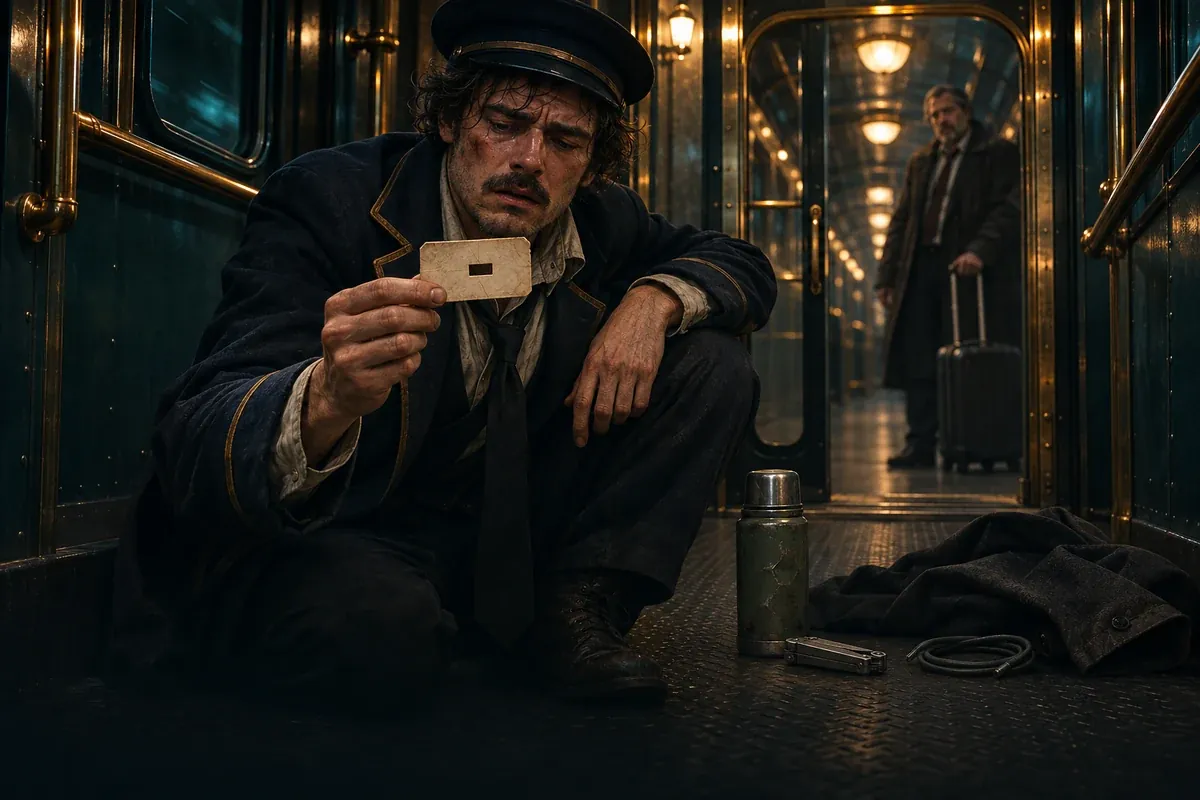
The thing in the vestibule between cars 87 and 86 had been, at various points in its career, nine overcoats, a bicycle, a saxophone case, about sixty meters of charging cable, and a full set of human teeth, and it had arranged all of this into the shape of a bad decision crouching over a man’s rolling suitcase.
I’d come forward at mid-morning because Yun insisted the real economy lived in 86 — “Odile runs it, she’s the worst, you’ll hate her, bring the notebook” — and we’d opened the vestibule door into a smell like a flooded coat-check and a sound like a modem trying to purr.
The man whose suitcase it was stood flattened against the wall with his lanyard still swinging. The thing had one coat-sleeve limb inside the case up to the shoulder, rummaging with horrible intimacy, and a second limb — the one made of cable, with teeth braided into the business end — raised toward the passenger in a gesture I can only describe as don’t wait for me, this will take a while.
“Stowaway,” Yun said, from well behind me. “Big one. Vestibules are theirs; everybody knows.”
“It’s robbing him.”
“It’s salvaging him. They take stuff with weak title.” He said it like a kid reciting safety rules off the back of a cereal box. “Bags you forgot to tag, coats off the hook, people whose balance — look, the move is, we close the door.”
“And then what, it follows us?”
“It can’t. Vestibules are the only places they can stand. A Stowaway is a debt with legs, and the Tariff only lets debt walk where nobody’s paying rent on the floor.” Yun was talking fast, the way people do when they’ve said a thing a hundred times to people who didn’t listen. “It’s the one rule that’s ever kept anybody alive back here. Aisles are rented. Vestibules aren’t. So they live between.”
“Between,” I said. Something at the edge of my mind turned its head. “So the floor of a vestibule belongs to nobody.”
“That’s what I said.”
“No, that’s what the Tariff says. Which means anyone standing on it is standing in a common area. A passage. A right of way.” I could feel it assembling, the way a citation does, like a sentence you’ve said forty thousand times finally finding its object. “A common passage, obstructed by a party with no standing to remain.”
“Grady.”
“I wrote that sentence on a hundred transit-authority forms, Yun. Obstruction of a common passage. I never once had a gate that charged by the minute.”
The cable limb dipped into the suitcase and came out wearing a watch.
I’d like to report a plan. What happened instead is that four years of muscle memory happened. A fare evader is climbing over the gate; you do not tackle the fare evader; you stand where he’ll land and you start writing. I stepped into the vestibule, flipped the notebook open, clicked the pencil against it twice — the sound cut through the modem-purr like a hole punch — and said, in my aisle voice, the one that carries:
“Sir. You’re obstructing a passage.”
The Stowaway stopped rummaging.
It didn’t have a face. It had a region where the coats agreed to disagree, and the whole region rotated toward me, and sixty meters of cable went very still, and in the corner of my vision my own wrist printed, helpfully: ENTITY LEDGER DETECTED. And oh, that changed the shape of the morning.
Because it had a ledger. Everything on this train had a ledger. The seats had ledgers. The coffee smell had a ledger. And if it had a ledger —
“Tariff, Section 12,” I said, walking my eyes down the floating green text as fast as they’d go, “Clause 12(b). Obstruction of a passage, common area, or vestibule. Rate: one hundred Fare per minute of obstruction, assessed against the obstructing party.” I looked up at the region. “You’ve been in my vestibule, by your own ledger timestamp, for eleven minutes.”
The modem-purr stopped.
“That’s eleven hundred Fare,” I said. “I’m citing you.”
I want to be honest about what I expected: nothing. I expected to die in a vestibule wearing a voided uniform, and the last entry in my notebook would say 1,100 in good clear figures. What happened instead was that the air between me and the Stowaway turned into paperwork.
The citation assembled itself out of green light, itemized, timestamped, clause-referenced, and it struck the Stowaway the way a stamp strikes a passport. The thing’s whole structure shuddered. Its ledger — negative, of course, a scrolling wall of red I hadn’t had time to read — tried to pay. Failed. And the Tariff, blessed carnivorous document that it is, moved to its remedy of record.
ACCOUNT UNABLE TO SETTLE. COLLECTING IN KIND.
The bicycle went first. It tore out of the thing’s torso, dissolving into green figures as it went, eleven hundred Fare collecting itself in parts — coats, cable, the saxophone case, the watch, each item unwinding into light with a sound like a receipt being torn off cleanly. The Stowaway came apart the way a committee does when the funding ends: all at once, with a smell of wet wool, each piece surrendering its own small title.
It took four seconds. At the end of it there was a vestibule, a shaking businessman, a rolling suitcase with one sleeve of a strange coat draped over it.
And a ticket.
It fell out of the middle of where the thing had been and landed face up on the floor plates: card stock, old, soft at the corners the way paper gets when it’s been handled through two generations of fingers. A single rectangular hole was punched through it. Not a validation pattern. One hole, dead center, like the thing had been shot.
My wrist was printing the whole time. I missed most of it happening because I was watching the ticket, which is the only excuse I have for a level-up landing on me like a dropped ceiling tile:
CITATION 12(b) — COLLECTED: 1,100.00. INSPECTOR’S COMMISSION (10%): +110.00.
STANDING: +25. THRESHOLD REACHED.
CLASS ADVANCEMENT: INSPECTOR — LEVEL 2.
CLAUSES UNLOCKED: [CITATION — 12(b)] (RETAINED), [LOST & FOUND CLAIM — 19(c)].
The light that came with it was not subtle. It came up through the floor of me, every joint at once, like the feeling of a held train finally moving — and because the Tariff has the comic timing of a hangman, it chose that exact moment, while I stood glowing in a vestibule, to also print:
COMMISSION NOTE: INSPECTOR REVENUE ACCRUES TO INSPECTOR’S GRACE INSTRUMENT, NOT FARE BALANCE.
My 110 Fare wasn’t mine. It had been paid into the sealed thing keeping me alive — into the tab somebody else was running on me. I was generating revenue for my own creditor. I stood in the warm light of my first level and felt, with great clarity, like a leased vehicle.
“You BILLED it,” Yun was saying, meanwhile, at a pitch I associate with much younger children. He’d come all the way into the vestibule. He was circling the empty floor. “It’s been eating luggage since before I boarded and you — Pearl is going to — do me. Can you do me? Can you cite my debt? Who do I obstruct?”
“It doesn’t work like — “ I stopped, because I didn’t actually know how it worked yet, and a man who quotes a tariff he hasn’t finished reading deserves everything the footnotes do to him. “We’ll look. Later. Hold this.”
I used [Lost & Found Claim] right there, because the clause was clean and the vestibule was full of unowned salvage: recite the docket line, claim the item, the Tariff witnesses the transfer of title. The businessman got his watch back with paperwork attached — he held it afterward like it might itemize him. From the general residue I claimed two things for the crew we didn’t know yet we were becoming. A multitool, honest steel, pre-sealed manufacture. And a thermos, dented, army green, which the Tariff listed, with what I’d come to recognize as the document’s one genuine joke, as: VESSEL, SELF-REFILLING — CONTENTS: CHEAPEST BEVERAGE CURRENTLY LISTED ON ANY ONBOARD MENU.
I unscrewed it. I smelled it. “What is it today?” Yun asked.
“Hot water,” I said, “that has been shown a photograph of tea.”
So that was the comedy, and then I bent and picked up the punched ticket off the floor plates, and the comedy stopped.
It was a Meridian & Western ticket. The old name, the freight concern, the name from the Tariff’s front matter — but this was a passenger ticket, second class, and the passenger’s name was typed on it, actual typewriter type, letters pressed into the card like little graves.
HOLLIS, MARGARET ANN. BOARDED: 1974.
My wrist, unprompted, matched it against something I had no standing to search and gave me the line anyway, which is how I learned that [Audit] at level 2 reads deeper than I’d ever want it to:
MANIFEST RECORD: HOLLIS, M. A. — BOARDED 1974. BALANCE EXHAUSTED 1977.
STATUS: SALVAGE. TITLE REVERTED TO CARRIER.
CURRENT CONFIGURATION: [DISASSEMBLED — SEE CITATION 12(b), THIS DATE.]
I read it three times, the way I’d read Yun’s nine thousand. Yun read it over my shoulder, lips moving, and went quiet in the way that isn’t calm.
The businessman, whose name was Teague and who sold commercial insurance, pressed something warm into my hand before I could stop him. “Thirty Fare,” he said. “Please. I know it’s nothing.”
“It’s two hours of seat rent and a lot of arithmetic you’ll need later.” I put it back in his palm and closed his fingers over it, and it took everything I had not to count it as I did. “You owe me nothing. It’s a citation. The train paid.”
“The train paid you,” he said slowly, and I watched him do what everyone smart would do, which was look at my wrist. “You get paid when you cite them. How much?”
“Ten percent.”
“Of what the thing owed?”
“Of what it owed. And the ten percent isn’t mine.”
He frowned. Then, to his enormous credit, he said, “Then who’s it for?” and I realized the only person on that train who’d asked the useful question was a man whose watch I’d just rescued. I told him I didn’t know yet. It was the truth, and the first time that day I’d said it and meant something other than I’m scared.
When he’d gone back toward 87 clutching his suitcase, Yun leaned on the vestibule glass and said, “So that’s the job.”
“What job?”
“Inspector. You walk the aisles, find the bad numbers, file them.”
“That’s the job. And the paycheck goes to whoever is running my account.”
“Great,” Yun said. “A union man whose union is the company.”
I laughed. I couldn’t help it. Then I opened Margaret Hollis’s file one more time, because an auditor who stops at the headline is a tourist.
Her ledger was a column of green going back fifty years, and what I’d taken for a generic death was a pattern. Margaret Hollis, 1974, boarded with twenty-six dollars, converted at the prevailing rate. She had sat for three hours on the first day and then never again. For three years she stood: in aisles, in vestibules, in the cold of the Quiet Car, shaving her costs to the bone. NO CYCLE, said the sleep column, NO CYCLE, NO CYCLE. A ledger of a woman who didn’t sleep. Then, in March of 1977, one line: SEAT RENTAL, CAR 91, POSITION 12A, 1.00/HR. She had sat down. After three years on her feet she had bought herself an hour and a half.
The hour ran out at 1:30 a.m. At 1:31 her ledger printed ACCOUNT IN ARREARS. At 1:32, in type so small I had to read it twice, it printed COLLECTIONS DEFERRED: PASSENGER HAS NO REMAINING ASSETS OF VALUE.
A woman had sat down, been told she had nothing worth collecting, and the System had filed her under SALVAGE. Then I had cited her wreckage for a commission.
I closed the file. I did not feel like a man who had leveled up.
The Stowaways weren’t vermin that had crept aboard somewhere in the Dark. They were the end of the fare structure. They were what the Meridian Line did with you after Collections, after the upholstery, after the last quarter-Fare of you stopped performing — it salvaged the title, and the salvage kept moving, and it stole luggage in vestibules for sixty years, and it could be cited for obstruction, by me, at a hundred Fare a minute, commission payable to my creditor.
I’d just collected eleven hundred Fare out of the remains of Margaret Ann Hollis, boarded 1974, and the System had given me a level for it, and the level had felt wonderful.
“Grady,” Yun said. First time he used my name. He was looking down the vestibule, through the glass, into car 86 and the long lit train beyond it, cars and cars and cars of seats and balances. “How many people you figure have ever gone broke on this thing?”
Somewhere beneath us the wheels said what wheels always say: a number, a number, a number.
I put Margaret Hollis’s ticket in my breast pocket, where the badge used to live. “Get me to car 86,” I said. “I want to meet the worst person in Coach while I’m still angry.”