

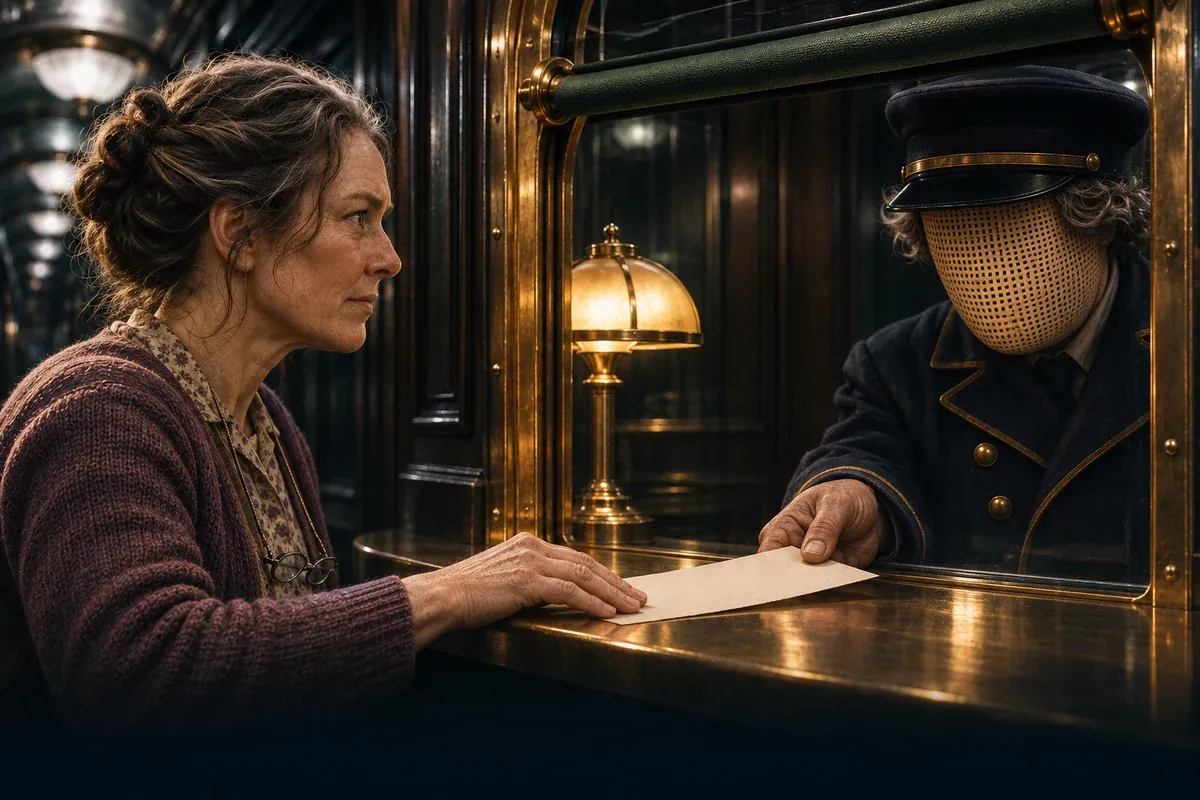
“Don’t choose people,” said Pearl. “Choose a rule.”
It was ten past nine, and I was sitting on the floor of the Gallery antechamber with my back against the wall and my head in my hands, doing arithmetic that had stopped being arithmetic around the third hundred. Four more sponsorships. Four out of a line that still reached through the gate at 79 and the greenhouse beyond it. I’d already caught myself looking at them, in the vestibule, the way you look at lifeboat seats: who’s small, who’s old, who has a kid.
“It isn’t fair,” I said.
“No. And you can’t make it fair, and if you try, you’ll pick four people and hate yourself, and the other four hundred will hate you too.” She had a paper cup in each hand again, though I never saw her pour either. “But you did something yesterday, Inspector, that nobody on this train has ever done. You made a rule work for the people it was never written for. That’s the only kind of power the Tariff can’t take back.”
“Which was?”
“Delay compensation. A clause. A filing. A man with a pencil.” She handed me one of the cups. “You can’t sponsor everyone. But you could teach them to file.”
I took the coffee. It was hot dishwater in a paper cup, and it was the best thing I’d tasted in two days.
“A clinic,” said Yun, from the doorway. He’d been listening, which with Yun is a full-time job. His eyes had gone bright. “You mean, like, a dispute clinic. People line up, you read the clause, you tell them what to write.”
“That’s — “ I stopped. “That’s actually what I did at the fare gate. For four years. Half of the job was reading people their rights off the back of the transit card.”
“So do it again,” Pearl said.
By ten o’clock we had a clinic.
I’d like to claim it was organized. It was a card table that Odile, God forgive her, had rented to us for six Fare an hour, set up in the antechamber of the Gallery beside the Clerk’s window, with a folding chair on each side and a stack of blank notice forms Dev had liberated from the Galley. A cardboard sign said FREE DISPUTE HELP in Carol’s best school-board lettering. Forty-Four stood beside the door with its arms crossed over its seat-back, as still as a bouncer, and nobody went past without being looked at.
We had a system, because Dev had insisted on one.
“Triage,” he said, sitting behind his menu-pad like a headwaiter at a fire. “Three queues. Green is a charge you can dispute in one line. Yellow needs a clause lookup. Red is a legal question that might get you killed. Mr. Finch sees reds. Everybody else sees yellow or green.”
“Who sees yellow?” asked Carol.
“You do,” said Dev. “You’ve got a stern face.”
“I do have a stern face,” Carol agreed, with deep satisfaction.
The surprise of the morning was Teague.
I hadn’t expected him. He was the man whose watch I’d saved in the vestibule on Tuesday, a commercial insurance salesman with a good coat and a nervous habit of straightening his tie, and he turned up at the card table at a quarter past ten with a briefcase he’d somehow kept for two days and a particular look in his eye.
“I’ve been reading the Tariff,” he said.
“Everyone has,” said Yun.
“No. I mean I’ve been reading it as a contract.” He opened the briefcase. It held a legal pad, three pens, and a pocket calculator of the kind that hadn’t been manufactured since the nineties. “I sold commercial liability for twenty-two years. You learn to read exclusions first. Nobody ever lost an insurance claim in the part of the policy that says what’s covered. They lose it in Section Seven, Subsection K, where it says, ‘except as provided in.’ I’d like to help.”
“You’d like to — “
“Exclusions first,” said Teague, and straightened his tie. “I’ll check every dispute against its carve-outs before you file. That’s the part you’re missing. I watched you lose that sandwich dispute through the glass of the Galley. It was in Appendix 2.”
I looked at him for a long moment. Then I took a blank notice form, wrote RECRUITED: ONE ACTUARY on the top of it in pencil, and pinned it to the sign.
The first hour was easy. That’s the thing nobody tells you about winning: the easy ones come first, and they feel like the whole game.
A woman in a gray raincoat had a charge on her ledger for “supplementary handrail,” half a Fare an hour. She’d been paying it since Tuesday. Teague read the definition aloud (“a handrail not forming part of the original structure of the car”), and Yun checked the car’s own manifest, and it turned out the handrail in question was bolted to the original frame by the original manufacturer.
I wrote the notice, she signed it, and Felix, who’d become the clinic’s unofficial courier, carried it down the line to the Porter at the end of Coach, and it came back in nine minutes, stamped.
[DISPUTE] RESOLVED IN PASSENGER’S FAVOR. REFUND: 18.50.
STANDING: +12.
“That’s it?” the woman said, staring at her ledger. “That’s all it was? Somebody just had to ask?”
“You’d be amazed,” said Carol, with enormous satisfaction, and stamped her name on the log.
We did forty-three disputes before eleven-thirty. Lavender, which was still billing at 0.75 an hour from the stoppage on Tuesday, though the emergency amenity expired, by the Tariff’s own terms, after one hour. The “moisture surcharge” on the drinking fountain’s paper cones.
A sleep cycle that had been billed twice, because a man had dozed off, woken, and dozed off again, and the Tariff’s cycle definition required forty minutes continuous, which he hadn’t had. Thirty-six wins. Five pending. Two losses, both small, both Teague’s fault, and he took them like a man who had been personally insulted by a subparagraph.
I watched the standing numbers move.
It was the thing I couldn’t stop looking at. Every win ticked a little number up over a head in the line: nine, twenty-one, thirty-four. They were small numbers. They were so small. A hundred was the wall, and nobody was going to climb a hundred on handrails.
“It’ll take weeks,” Dev said, quietly, behind me, reading the same numbers. “At this rate, a person needs, what? Nine wins? Ten? For a hundred?”
“They’re not going to have weeks.”
“I know.”
“We need a bigger win,” I said. “Something that pays Standing by the head.”
Carol looked up from the log. She had a pen in one hand and a pair of reading glasses on a chain, and she was considering something, in the slow, ruthless way of a woman who had run a PTA through three budget crises.
“The lavender,” she said.
“What about it?”
“It’s still billing. Tuesday, since the stoppage. It’s billing everyone in Coach, isn’t it? Not just car 88.” She tapped the pen on the table. “Two thousand three hundred people. At three-quarters of a Fare an hour. For two days. That isn’t a handrail, Grady. That’s a class.”
I stared at her.
“I’d need a designated representative,” Carol said. She said it with the most perfect composure. “Somebody who isn’t you. Somebody the section can sign for. So that the Standing goes to somebody who needs it.”
I want to be clear that I hadn’t thought of it, and I’m ashamed of that. A man who builds a clinic for a hundred strangers and doesn’t think to turn the clinic into a union is a man who learned only half of what Pearl was trying to say. But Carol had thought of it. Carol had a niece’s recital she wasn’t going to make and she had a stern face and she’d noticed that a Standing award on a class claim paid out for every head.
“Teague,” I said.
“I’m looking.” The tie was straight, the pen was moving. “It’s a Section Three claim. Service conditions. The emergency lavender amenity is authorized for a single hour, per Schedule B, Section 9, and I see no carve-out. No appendix, no exclusion, no definition by reference. I can’t find one.”
“Check again.”
“I always check twice.” He did. His pen stopped. “There’s nothing. It’s clean. It’s the first clean claim I’ve seen on this train.”
We filed it at 11:52. We filed it in Carol’s name. I stood beside her at the window with my hand not touching her elbow, the way you stand beside someone at a graveside, and Carol Ann Whitlock, who had come aboard the 12:07 to Delmar with her niece’s recital in her purse, wrote CLASS REPRESENTATIVE: C. A. WHITLOCK in the same hand she used for grocery lists, and slid the notice across the counter to Pell.
He took a long time reading it. The holes in his face moved through four expressions and settled, as they sometimes did, on something that looked very much like approval.
“The Clerk will forward this to the Porter of Record,” Pell said. “The Clerk will observe, for the record, that it is a well-formed claim.”
It came back in six minutes. I know because Yun was timing it, and he said the number out loud, a half-whisper, like a man at a track.
[DISPUTE — CLASS] RESOLVED IN PASSENGER’S FAVOR. EMERGENCY AMENITY (LAVENDER) WITHDRAWN RETROACTIVE TO EXPIRY.
REFUND: 2,314 ACCOUNTS. TOTAL: 5,486.25 FARE.
REPRESENTATIVE STANDING: +96.
CARRIER: NOTE FOR RECORD.
Carol’s hand went over her mouth.
“Ninety-six,” said Dev. “And she had four.”
“A hundred,” Carol said, through her fingers. “I have a hundred.”
She had a hundred. The number floated over her head in the antechamber, small and green and exactly round, and I looked at it for a long time, because I’d just watched the Tariff pay out a thousand times what I’d have thought possible for a woman in a cardigan with a pen.
“File,” I said. My voice wasn’t steady. “Rule 4. Petition to intervene. In your own name. You don’t need me. You don’t need a sponsor. You’ve got the Standing.”
“It’s fifty Fare.”
“You’ve got a refund coming. Two and change, from the lavender.” I stopped. “Oh, hell.”
“Two and change,” Carol agreed. “I’m forty-four short.”
It would have been funny, in another country. I put my hand in my pocket, for the thing that wasn’t there, and Dev, on the other side of the table, silently put his hand flat on the table and pushed fifty Fare across it, out of the Committee’s jar, money he’d been saving for something he hadn’t said.
“It’s the clinic’s fund,” he said. “We took up a collection. I had a feeling.”
Carol Whitlock became the first intervenor in the history of the Meridian Line at 12:19 on Friday afternoon, of her own Standing, on her own filing, with a stern face and a refund she’d earned. The board over the lectern, which I could see through the antechamber door, printed one more line under HOLLIS, M. A.
WHITLOCK, C. A. (INTERVENOR, CLASS REPRESENTATIVE, COACH).
The crowd in the vestibule saw it. I didn’t hear it so much as feel it, a long, indrawn breath that ran back through the line, through the gate and the greenhouse and the cars beyond, and for the first time that day it was not a sound of fear.
We took the afternoon in a rush. We filed twelve more class disputes in two hours, with twelve representatives, each of whom had to be nominated by their section, each of whom stood at the window with a hundred-odd Standing floating over their heads like a halo they didn’t know how to carry. The number machine ran out of tabs. Odile sold the clinic its own paper at cost, grumbling, and I noted that she’d stopped asking people how much they had left.
I should have noticed the loss.
I did notice it, in the end. It came in at 1:40, from the end of the line, and it was a man in a green anorak. I’d seen him four hours earlier, a person who’d done something clever in a bureaucracy once and was still trying to remember what. He had thirty-one Standing. He had come up to the table at twenty past one with a handwritten notice and a chin set at an angle, and he’d put it down in front of Teague.
“Convenience premium,” he said. “The Galley. It’s nine Fare for a bottle of water, and the fountain is free. I’ve been reading. It’s unreasonable.”
Teague didn’t pick it up. He looked at me.
“That’s the one I lost,” I said. “Don’t file it. It’s in Appendix 2(a). It’s incorporated by reference.”
“It’s unreasonable,” the man said again, and I knew the voice. It was the voice of a person who had decided, a long time ago, that the world owed him one clean victory, and was going to collect on it in a train car in the middle of nowhere. “I want to dispute it. It’s my right.”
“If you lose,” I said, “the penalty’s double.”
“I’m not going to lose.”
“You’re going to lose.”
“Then sponsor me.” He lifted his chin. “You’ve got the surety. You’ve got three hundred. You sponsored the cafeteria woman.”
I looked at the line behind him. I looked at Pearl, who was watching me from the corner of the antechamber with her knitting stilled in her lap. She didn’t say anything. She didn’t have to.
“Surety’s thirty,” I said. “The disputed amount is nine. The penalty is eighteen, from your ledger, which has what?”
“Four Fare,” said the man in the anorak.
“Then the penalty’s fourteen over. Which means if you lose, you’re in arrears, and the stay doesn’t cover you, because you’re not a party.” I made myself keep my voice flat. “I can post surety on your dispute. But it’s forfeit if you lose. And you will lose.”
“Post it.”
I posted it. I don’t entirely know why. I think, for the same reason I’d walked into the vestibule on Tuesday and cited a Stowaway: because four years of watching a man at the gate with his change and his face had taught me that the most dangerous thing you can say to a person who needs to win is no.
It came back in four minutes.
[DISPUTE] DENIED. CHARGE UPHELD: SCHEDULE B, APPENDIX 2(a). UNSUCCESSFUL DISPUTE. PENALTY: 18.00.
SURETY POSTED BY FINCH, G.: 30.00 STANDING. FORFEITED.
STANDING: 347.
The man in the anorak read it twice. I watched his face do what it had been going to do all along. Then he laughed, a short, dry sound, and said, “Well, I suppose that’s what I get,” and went back to his place in the line, where he stood with his notice crumpled in one hand, quietly, like a man waiting for a bus he knew wasn’t coming.
I looked at my wrist. Three forty-seven. Down from four sixty-two in a single morning, and the clinic had done a thing nobody had managed in sixty years: it had brought thirteen new intervenors to the board and cost me a hundred and fifteen Standing, every point of which I’d chosen to spend.
“That’s the price,” Pearl said softly, from the corner. “That’s what it costs to say yes.”
“I know.”
“Do you?” She wasn’t unkind. “Good. Because here comes the rest of it.”
It was a Porter. It was Felix, but it wasn’t, quite; he’d come back through the vestibule at a pace that wasn’t quite his own, and his face-card held a pattern I’d never seen, a tight, flat arrangement like a man reading a sentence he didn’t want to deliver. He held a sheet of stiff cream paper in both hands. It had a seal at the bottom. It had a hole punched in the seal.
“Inspector,” said Felix. “I’m obliged to serve you.”
I took it. The type was crisp and old, the typeface of the Company Section.
NOTICE OF MOTION. THE CARRIER MOVES TO STRIKE THE PETITIONER’S STANDING AND DISMISS THE DOCKET UNDER CLAUSE 61 (CHAMPERTY AND MAINTENANCE), THE PETITIONER HAVING, FOR CONSIDERATION, SOLICITED, FINANCED, AND DIRECTED LITIGATION BY PERSONS NOT PARTIES TO THE DOCKET.
HEARING: TODAY, 15:00, THE GALLERY CAR.
Signed, in a clean hand, M. Veen. Under the signature, in a smaller type that I recognized from the board over the lectern, the Clerk had stamped one line:
SERVICE ACKNOWLEDGED. THE CLERK WILL HEAR THE MOTION.