

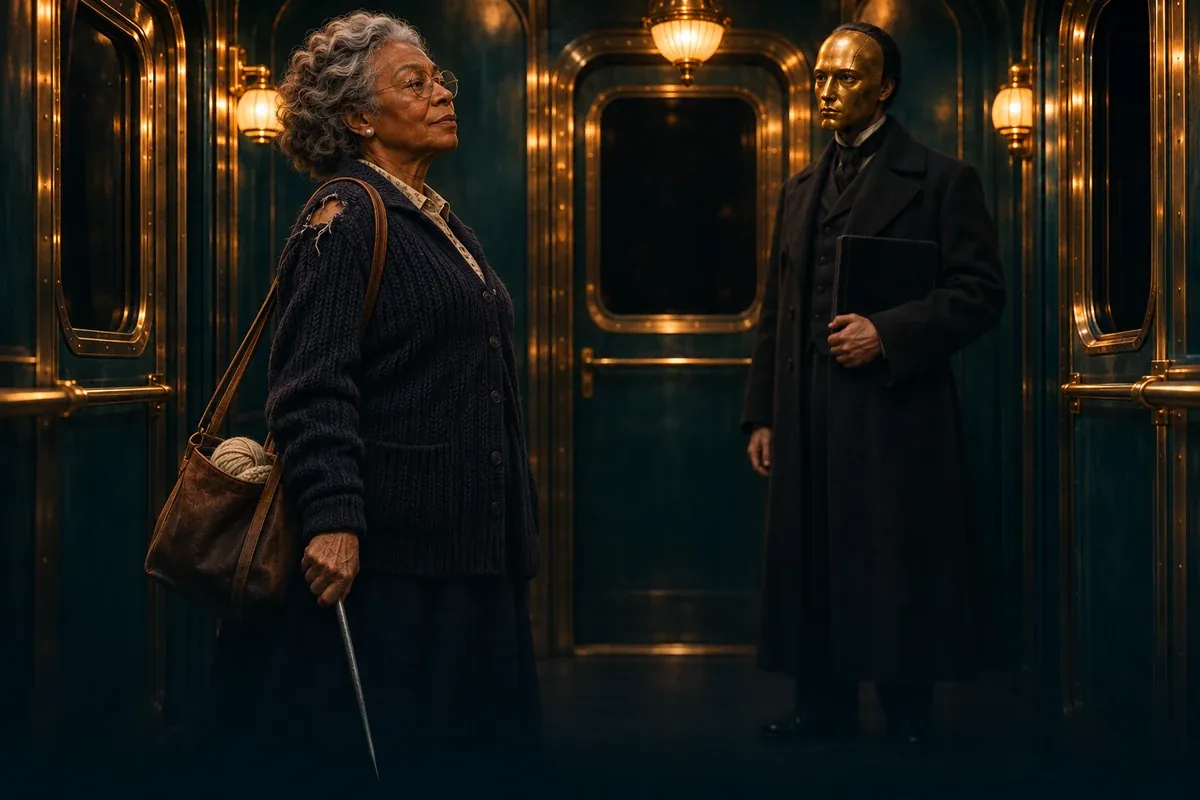
Veen caught us in the vestibule between 78 and 77, which is the one place on the whole train I’d have bet he couldn’t.
I’d been right about the gate. For about four minutes after we passed it, nothing came through the turnstile behind us except the sound of a brass arm turning, one slow revolution, as if a large ghost had decided to take a walk. Then the lights over the booth, which had never once been lit, came up in the color of old pennies, and the grille said, in the stitched-together voice, “THE GATE WARDEN HAS COUNTERSIGNED. PLEASE PROCEED, COLLECTIONS.”
I’d like to tell you I didn’t turn around.
He came through the turnstile like a man stepping off a bus: unhurried, coat buttoned, velvet ledger under his arm. Behind him came the detail: eight agents in brass masks, four on each side of him, in the formation of a procession at an expensive funeral. The warrant in his hand wasn’t paper. It was a card, soft old stock like the tickets, and in the signature line, where a name belonged, there was a single punched hole, dead center, clean as a bullet.
“Countersigned this afternoon,” Veen said, to my face, in his fine tired voice, “at the Warden’s convenience. I wouldn’t have troubled you, Inspector. It is simply that the Carrier takes a very serious view of a fare evader who has been identified on every ledger in Coach.”
“You said you couldn’t lie about ledgers.”
“I haven’t lied.” He seemed almost sad. “I should say, however, that I no longer enjoy this.”
Pearl stepped between us. She had the needle out, the long gray M&W needle, and she held it point-down at her side, the way you’d hold an umbrella on a clear day. In the doorway to 77, behind us, Yun had gone still. He’d put himself in front of me without my noticing, a thin kid in a pocketed jacket with nothing in his hands.
“Mrs. Odum,” said Veen.
“Mister Veen.”
“Your pension does not extend to obstruction of a lawful warrant.”
“I’m not obstructing,” said Pearl. “I’m knitting.”
There was a pause in which eight Collections agents looked at a retired bus driver with a bent needle, and I realized I was watching something I wasn’t supposed to understand. They didn’t advance. The nearest one took a half-step back. It was the smallest motion I’ve ever seen a man in a brass mask make, and I filed it in the part of my head where I keep things that matter.
“She cannot hold the vestibule forever,” Veen said, to me, almost kindly. “And she cannot hold eight. Come with me, Inspector. I can promise you the quickest settlement the Carrier has ever offered.”
“What’s the settlement?”
“Your account, in kind.”
I’d read it on a seat in car 88. I’d watched it happen to a woman named Renata Solis in eleven seconds. I’d seen what it looked like on the other side, a transit seat reupholstered in a dead woman’s name.
“I’m not going to fight you,” I said.
“No.” Veen tilted his mask. “I did not think you would.”
“I’m going to file a paper.”
For about a second the hairline crack over his left eye looked exactly like what it was, a fault line, and something under it shifted.
“Mr. Veen,” I said. I took out the notebook. It was a little thing to hold in front of eight Collections agents, a cardboard cover and a pencil, and I thought of Prue counting rivets on a Route 9 bus. “You said I’m not a passenger. I have no ticket. I have an invalid status that I transferred to a chair, a grace period I paid in full to a hearing, and a picture on every wall that says Fare Evader. By the Tariff’s own definition, I’m not entitled to a damn thing.”
“That is the situation.”
“Except for one line.”
I held up my wrist. The ledger glowed in the dim lamp of the vestibule, a thin green column, and at the top of it, under the balance I’d carried since the doors sealed, there was a new line in the old Meridian & Western type, pressed in like a typewriter. LEDGER CREDIT: 4,112.50. PRINCIPAL ACKNOWLEDGED.
“The gate gave me a credit,” I said. “A credit is a balance. A balance in the Carrier’s ledger is a fare paid, in advance, against the Schedule. A man who has paid a fare is a passenger, Mr. Veen. You don’t want me to be one. But somebody did. Somebody gave me exactly enough to qualify.”
Veen said nothing at all.
“Clause 9(a),” I said.
I will tell you what I expected, because I’ve thought about it often since: nothing. A laugh. A Collections agent at my elbow, the soft click of a velvet ledger opening, my account in kind. What I got was the temperature changing.
“REVIEW OF THE SCHEDULE,” I read, off the notebook page. “Any passenger, upon request, may cause the Fare Schedule itself to be reviewed for conformity with the Tariff. I’m a passenger. I’m requesting it. In writing.” I held up the page. “Invocations, zero. I checked. It’s never been used.”
“It has never been used,” Veen said softly, “because it has never been denied. Do you understand, Inspector? Not once. Not in sixty years. The Carrier does not refuse the clause. The Carrier has never had to.” He had taken a step back, and in the lamp-light the mask looked, for the first time since I’d met him, like a thing that had been struck. “You have no notion what a review is. I would give a great deal to stop you. I would give, in fact, a rather great deal more than the Carrier can afford.”
“Then stop me,” I said.
He didn’t. I think he couldn’t. I think the clause had already begun.
It started in the lights. Every lamp in the vestibule went out at once, and for one second I stood in the black and heard eight brass masks draw a breath. Then, far forward, from somewhere beyond cars 76 and 75 and every car all the way up the train, the dark began to travel. I watched it come toward us through the glass of the doors: a wave of lights going out, car by car by car, rushing toward the Engine like a long soft hand closing, and when it reached the end of the train I felt, in the floor, in my teeth, in the cold place behind my breastbone, something very large and old turn over in its sleep.
The lights came back on, all of them, at once. Not amber, not penny-gold, but a clean, flat, merciless white, the light of a government building at noon.
And every surface in the vestibule printed.
I mean every surface: the windows, the brass plates, the glass of the booth behind us, the lenses of eight Collections masks, the floor underfoot, the back of my own hand. One line in the Authority’s perfect municipal font, all of it at once, so the whole vestibule said the same thing in a hundred places, like a church full of people reading the same verse.
REVIEW GRANTED.
DOCKET No. 1.
FIRST SESSION: GALLERY CAR 77. PARTIES WILL BE SEALED.
Veen’s detail had gone rigid. Each of the eight brass masks had turned, as one, toward the door to 77, and I realized they weren’t looking at me anymore. They were looking at something behind me, the way you look at the sun. The Collections agent nearest Pearl lowered her ledger and set it on the floor, gently, and stepped back from it.
“Warrant suspended,” said Veen, almost to himself. His voice had lost its fine tired courtesy. It sounded, in the white light, like a man’s. “Pending the docket. The Carrier cannot collect from a party to Docket Number One.” He looked at me. The crack over his left eye had lengthened, by a hair, a thread, a line you’d only see if you’d been looking at it for three days. “You have done the only thing the Carrier cannot refuse and cannot survive, Inspector. I’d hoped you would not.”
“I’m sorry,” I said, and was surprised to find I meant it.
“You will be.” He bowed, the old maitre d’ bow, a little less perfect than before. “We will see you in the Gallery.”
He turned, and eight masks turned with him, and they walked back through the turnstile in a line, in perfect step, and the gate closed behind them with the small soft sound of a lock turning in a drawer.
I stood in the vestibule with my pencil in my hand, and my wrist began to print.
TICKET STATUS: WITNESS (DOCKET No. 1).
STANDING: +200. STANDING: 462.
My knees went. I sat down on the floor of the vestibule, which is free, and Yun sat beside me, and for a while nobody said anything. The lights were bright and cold and true. I could hear the wheels, saying their number, a number, a number, and the long low breathing of the thing in the ceiling that had started turning pages.
“You did it,” Yun said finally, in a small voice. “You actually did it. It’s — Grady, you stopped them. They can’t touch you. It’s — “
“It says Witness,” I said. I was reading my wrist. There was fine print, always. It scrolled up from the bottom of the receipt in small gray type the way it always does, the terms and conditions, the part nobody reads, and I read it twice. “Yun. Read this with me.”
He leaned over. His lips moved.
PARTIES TO A DOCKET ARE HELD UNTIL THE DOCKET IS CLOSED.
WITNESSES MAY NOT DISEMBARK.
“It’s not a — “ he began. “They’d have to — it can’t — “
“Witnesses cannot disembark,” said Pearl.
She had come to stand over us, the needle back in her bag, the cardigan torn at the shoulder, looking down at a thirty-one-year-old fare inspector on the floor of a vestibule with the expression of a woman who has known all along how a particular story ends and had hoped to be wrong. She said it quite gently. She said it as if she were reading a station announcement, and it landed in me like a thrown coin.
“It’s the one rule they never had to write down,” she said. “Nobody has ever invoked 9(a), Inspector. Nobody has ever been a witness to the Schedule itself. Do you understand what that means? The Review can’t close until it’s finished. And it can’t be finished while it’s inside the thing it’s reviewing.” She sat down, slowly, beside me. “A witness can’t leave the train. Not at any station. Not ever.”
Yun was the one who opened the door to 77. I’d have waited a week. He stood up off the floor of the vestibule, wiped his palms on his jacket, and slid the door six inches, and the white light of the review leaked out around his hand.
It was a courtroom the length of a train car.
Somebody had built it without ever being told how a courtroom should look, working from a description over a bad phone line: long carved benches in rows for two hundred, a brass rail, a high bare platform at the far end with a lectern on it, and behind the lectern, set into the wall where the window of a normal car would be, a wide black board of the kind they use to post arrivals in a station. Every bench was empty. The air smelled of lemon polish and cold iron. At the top of the board, in the Authority’s perfect font, the lettering was still being written, a letter at a time, as if by an unseen hand with a very steady pen.
IN RE: THE FARE SCHEDULE.
DOCKET No. 1.
PETITIONER: FINCH, G. (WITNESS).
Under it, names began to print, line by line, in a column down the left side of the board. The first was mine. Then, more slowly, as if the board were having to look each one up: VEEN, M. (FOR THE CARRIER). ODUM, P. (CREW, RETIRED). CASTILLO, Y. (ON THE PETITIONER’S BEHALF).
“I didn’t say you could put me down,” Yun whispered, though he looked, faintly, pleased.
The board kept writing. BRANDT, O. I heard Pearl exhale through her nose: Odile would be insufferable. FELIX, PORTER OF RECORD, CARS 88 THROUGH 80. Then a name I knew from a soft, punched card in my breast pocket, and I felt my stomach go, because I had not told anyone I’d kept it.
HOLLIS, M. A. (DECEASED; SALVAGE; REPRESENTED BY THE CARRIER).
And below that, in a smaller type, the one line on the board that made no sense. It sat in the middle of the column by itself, in the space where a name should go, and it was blank except for a single rectangular hole punched through the black, like the signature on Veen’s warrant, with the board’s light shining through.
NEXT SESSION: WHEN ALL PARTIES ARE PRESENT.
“Who’s the last one?” Yun said.
Nobody answered. The hole in the board watched us with the patience of a thing that has been waiting for sixty years and has learned how to enjoy it.
I reached past Yun and slid the door shut.
“Not tonight,” I said. “Not tonight.”
I thought about the 19th. I thought about a courtroom with a green carpet and a folder in a closet and a twelve-year-old with a brass token in her fist, and a calendar on a refrigerator with one date circled, in pencil, in my handwriting. Saturday. Ten a.m. Courtroom 4B. I’ll be there. It’s handled.
I looked up. The ceiling of the vestibule was an ordinary gray metal seam, a line of rivets running from door to door, and I did the thing I do when I can’t afford to feel anything. I counted.
Four hundred and twelve.
I counted again.
Four hundred and thirteen.
Off by one.
The train carried us on through the white light, toward a car where something had been waiting sixty years for someone to ask the question, and somewhere ahead, past the Gallery and the Dining Car and everything that was still to come, the Conductor who had signed the Tariff with a single hole turned a page, and read, for the first time in the history of the line, the name of a passenger who’d filed a complaint.