

At 5:58 in the morning I wake with my cheek on a pillowcase that smells of cedar, and my first thought is a billing code.
It is a good sign. It means I am still myself. My second thought is that I slept, which is a fact I need to hold on to, because clause nine says sleep and I have just been told by a dead man that the clause was drafted by someone who was particular about the word.
The envelope says the bed, on the Virginia side, and I am on the Virginia side. Let the record show that I fulfilled the condition at some point between one and five a.m., fully dressed, with my shoes on, on top of the coverlet, like a woman waiting for a bus.
He did not sleep. I know because he is in the wing chair by the door, sitting upright with his ankles crossed and his hands loose on the arms, and the lamp is out and the windows have gone the gray of dishwater. He looks the way a man looks after the long part of a night shift. I would like to say I feel nothing about that. I look at the ceiling instead.
“Six,” he says, as the little brass clock on the desk clears its throat. He stands. The key goes round. “Mrs. Utley has coffee on.”
“Did you sit there all night?”
“Yes, ma’am.”
“Why?”
“Because I said I would stand in front of the door. Standing’s hard on the knees.” He opens it. The corridor smells of lavender and a hundred years of other people’s rain. “You’re free to go. The clause only binds you from ten to six.”
I go. I do not say thank you. A dead man gave me that instruction in writing.
Two hairpin turns down the mountain, my phone finds a signal and begins to shake in the cup holder like something caught. Nineteen messages. Fourteen from the office, none of them urgent. One from my mother’s old neighbor, who has a cat I am apparently feeding. And one, at 9:12 last night, from a number I have saved under L.
Prosper Lisle. The text is warm, and it is perfectly punctuated. Settled in, my dear counselor? Do not let them feed you too well. Anything unusual about the property, ring me. Anything at all.
I read it at a stop sign with the engine running.
Then I do a thing I have never done in seven years of practice. I turn my phone face down on the passenger seat and I do not answer.
The Dray County courthouse is a squat red building on the Virginia side of the valley, with a flag in front, a cannon that nobody has fired since the Spanish-American War, and a sign on the door that says the Clerk’s Office opens at eight-thirty. I am there at eight-fifteen. I sit in the car with my laptop open on the steering wheel and I do what I do when I am frightened. I draft.
I type a heading, in the font I have used on four hundred petitions: NOTICE TO THE COURT OF A LIVING HEIR. Then I write: The undersigned executor has reason to believe that Wystan Anselm Kincaid, certified deceased by the Medical Examiner of this County, is alive.
I read it. It is the cleanest sentence I have ever written, and it would end me. It would end him too. It would end a certificate with a medical examiner’s real signature on it, and an order with a judge’s real signature on it, and whatever else is in a catalog in the linen elevator. A woman who writes that sentence has to be prepared to live with the consequences for everyone whose name is on that paper.
I save it as a draft. I do not send it. A lawyer who has not sent a thing has not yet decided, and I tell myself that this is a defensible position for a day.
“Miss Pascoe,” says the Clerk of Dray County, before I have said a word. “Gordon Hobbes. Mr. Tallis said you’d be wanting the file.”
He is fifty-five, plump, pink, with a bow tie and the hands of a man who has pressed ten thousand stamps into ten thousand pages. The counter between us is old marble worn into a shallow dish by elbows. A brass nameplate. A bell. An open window onto a back room full of gray files, and a radio playing very softly, a gospel hour. He has already pulled the Tallis estate. It is on the counter, ready for me, square to the edge.
I did not call ahead.
“He said that?”
“He said a good many things, rest his soul.” Gordon Hobbes smiles with great sweetness. “He said you’d read everything twice. Would you like me to certify a copy of the Kincaid order while you’re here?”
I stare at him. He is not hiding it. That is what chills me. He stands there in his bow tie and looks at me with no secret in his face at all, a man for whom the thing I am afraid of is Tuesday.
“Yes,” I say. “Please.”
He does it in four minutes. Raised seal, blue ink, a signature in a firm Palmer hand, and the Order Presuming Death says what the certificate said, with the same wrong letter in the same place. ANSELEM. The e sits in the middle of the name like a stone in a shoe.
“Anything else?”
“Has anyone filed on the Tallis estate?”
“Why, yes.” He turns a page for me and does not look at it. “Eleven days ago, Lisle and Strunk of Roanoke filed a petition for appointment of a special administrator pending probate. Protective, they said. Until a will could be found.” He lets that sit for a moment. “Your firm, I believe. Mr. Lisle himself signed it.”
I know that signature. I have watched it for ten years, in copperplate, at the bottom of every letter that ever promoted me. I had no idea that it was already in this courthouse.
Eleven days ago. I was assigned the Tallis file nine days ago. Prosper did not mention a petition.
“Who knew the will was in Roanoke?” I say.
“I couldn’t tell you, Miss Pascoe.” The pink, kind, unlined face does not change. “You have thirty days from the reading to qualify, as I’m sure you know. That would be April fourteenth, because I counted. You’ll be wanting to bring the oath.”
“The oath.”
“That there is no living heir except as stated in the petition.” He folds his hands. “People sometimes find it a trial.”
I take my certified copy. I thank him because I was raised to. In the parking lot, I sit in my car, in the rain, and for the first time in a very long while I do not open a file or draft a motion.
I put my forehead down on the wheel and I stay there, counting. Eleven days. A petition I did not know was filed, a will that arrived in my office in a cream envelope, and a mentor who texted at 9:12 at night to ask if anything about the property was unusual.
It is a coincidence. I tell myself so. I say it out loud, in the car, in my courtroom voice. Then I put the car in gear and drive back up the mountain, because the Vesper has an envelope with my name on it, and I have never in my life walked out of a deposition before it was over.
The laundry is on the second floor, at the end of a corridor that smells of hot cotton and starch and something faintly sweet, like warm bread. Behind a pair of swinging doors there is a room the size of a church. Long iron tables. A mangle with rollers taller than I am.
Rows of enormous canvas carts, white as snow. Pipes that knock. Steam that rises in a slow pale column from a pressing machine nobody is feeding, because the machine’s operator is standing in the middle of the room with her arms folded and her sleeves pushed past the elbow.
“You’re late for lunch,” says Mrs. Utley, “and early for the hard part.”
“I went to see the Clerk.”
“Gordon.” She says it the way she says soup. “He’s a good boy. He folds a clean corner.” She looks over my shoulder. “Wystan, you’re hovering.”
He is in the doorway, with the sleeves of his shirt turned back, carrying a stack of folded sheets against his chest as if he had been passing and happened to be carrying them. He has not been passing. I do not say so.
“I’m not hovering,” he says. “I’m at the door.”
“That’s where the hovering is.” Mrs. Utley takes a pillowcase from a pile and turns it, once, twice, so that the seam is hidden. “Miss Pascoe. I’m going to say this plain, because I’m seventy-four and you’ve got a face on you like a girl who’s about to be sick in a good hat. You’ve been told the hotel sells endings.”
“Yes.”
“You’ve been told what that means?”
“I’ve been told it comes with a seal.”
“That’s a lawyer’s way of saying it.” She does not smile, exactly. “I do it with linen. Folks come in here dirty. They come in with a name they can’t wear anymore, and it’s got something in it, a stain, a smell.
“Something in the weave that won’t come out. You can scrub it. You can boil it. It’s still there, and sooner or later it’ll show. So you don’t scrub it. You give them a clean one.” She holds up the pillowcase. It is blindingly white. “That’s a Resident.”
“A person with a new name.”
“A person with a new life, and the old one folded so nobody can read it.” She puts the pillowcase on the pile. “I say Resident, not guest. A guest leaves. A Resident stays, in a manner of speaking, and we keep the paper.”
“How many?”
“Two hundred and twelve, since seventy-eight.”
I do the sum, and it comes out as a number I wish I had not done. Two hundred and twelve people since I was not yet born. A death certificate for each. A body or a story for each. A county clerk who knows the weave of every one of them. “How many of them wanted it?”
“All.” Her voice does not change. “Well. All the ones who came in the door.”
There is a brass-framed cage at the back of the room, in an alcove between two windows, and it is what I have been avoiding looking at since I came in. It is the size of a small closet. An accordion gate of black iron.
An open ceiling with a pulley and a thick rope and a counterweight on a chain. Inside it, where a car of linen once went up and down between the floors of this great old hotel, stands a rolling oak cabinet with twenty-six shallow drawers in two columns, and each drawer has a letter in brass.
“The catalog,” I say.
“The linen elevator. Gus had it rewired to stop on four, for the room.” She lays her palm flat against the iron gate, almost tenderly. “Nights it lives up there, behind a door in the wall of 41, so the executor can reach it. Days we ride it down here to file.”
I take the brass key out of my pocket. I have carried it all day. The tag says CATALOG, in green thread. I put it in the gate and it turns with a sound like a swallowed word.
The gate opens. I put my hand out for the first drawer, A, and I stop.
“Not yet,” says Wystan.
He is right behind me. I do not know when he crossed the room. He does not touch me. He is simply standing, close, as if I were a candle he did not want the wind to find.
“It’s the rule,” Mrs. Utley says. “That key opens the gate. The drawers you’ll open one at a time, as the envelopes say, and not before. He was particular.”
“I am the executor. Clause six. I may open every drawer and read every card.”
“Unless I’ve forbidden it in writing,” says Mrs. Utley, and I recognize the cadence. She has the will by heart. They both have. “And he did. In the envelope. On the box, under the lid, in his hand.”
“That is an obstruction.”
“That is a laundry,” says Mrs. Utley, mildly, “and it runs the way it runs.”
I should be furious. I find that I am not. I find that I am looking at twenty-six brass letters, and that one of them is P, the sixteenth drawer in the left-hand column, and that my wrist is trembling on the iron.
I take out my wallet. I do not know why. I take out the laundry ticket, the color of weak tea, with VESPER on it in faded blue letters and one gray cardigan, paid in pencil underneath, and I hold it out to Mrs. Utley the way a woman holds out a ticket at a coat check, in case she has made a mistake.
“Do you recognize this?”
She takes it between two fingers. She looks at it a long time. In the light from the window, her face is very still, and I see that she is reading the stock, the paper, the blue, and not the words.
“That’s one of ours,” she says finally. “From the old pad. We used up the last of that pad six years ago this month.” She gives it back. “You’d be surprised what comes out of a glove box.”
I look at her. She looks at the steam.
Behind me, I hear Wystan breathe out, very slowly, through his nose.
I do not say anything. I put the ticket back in my wallet and my wallet in my pocket, and I take my hand off the iron gate.
At ten o’clock, the door of Room 41 closes. The key goes round once, twice. Wystan is on the inside, in the wing chair, with his hands loose on the arms and a look about him that I would call patient if I were being generous and loaded if I were being exact.
I do not sit on the bed. I stand at the foot of it, on the Virginia side, in my stockings, with the second envelope in my hand. TWO. The ink is green. There is no brass key this time. There is one sheet of paper, and on it, a single line.
DRAWER P. YOU HAVE WANTED IT SINCE THE STAIRCASE. DO NOT THANK ME.
I read it out into the room, and my voice is steady. It is the steadiest I have ever heard it.
“There’s a door,” Wystan says. His voice is lower than usual. “In the wall. Behind the wardrobe. Mrs. Utley sends the car up at ten past.”
“You know what’s in P.”
“No.”
“You have answered every question I’ve asked you for two days. If I ask you now, will you tell me what’s in P?”
“I don’t know what Tallis wrote on it,” he says, “and I don’t know what the card says. That’s the truth.” A pause, in which I can hear the radiators knock. “I know what I’d be afraid of.”
“What would you be afraid of?”
“That’s an envelope,” says Wystan, and for the first time his voice is not quite level.
At ten past ten, the wardrobe swings out from the wall on a hinge I did not know it had. Behind it there is a small green door, and behind the door a cage of black iron, and in the cage, rising out of the dark floor of the shaft with a cable’s long groan, a rolling oak catalog with twenty-six brass letters on its drawers.
I do not wait for it to stop. I step through the green door and into the car. It smells of old oil and paper and, faintly, of cedar. I find the sixteenth drawer in the left column. P.
It has its own tiny lock, and in the lining of the envelope, where I did not look, there is a second key, no bigger than a grain of rice, taped flat. I should have seen it. I did not, and Wystan, at my shoulder, does not say a word.
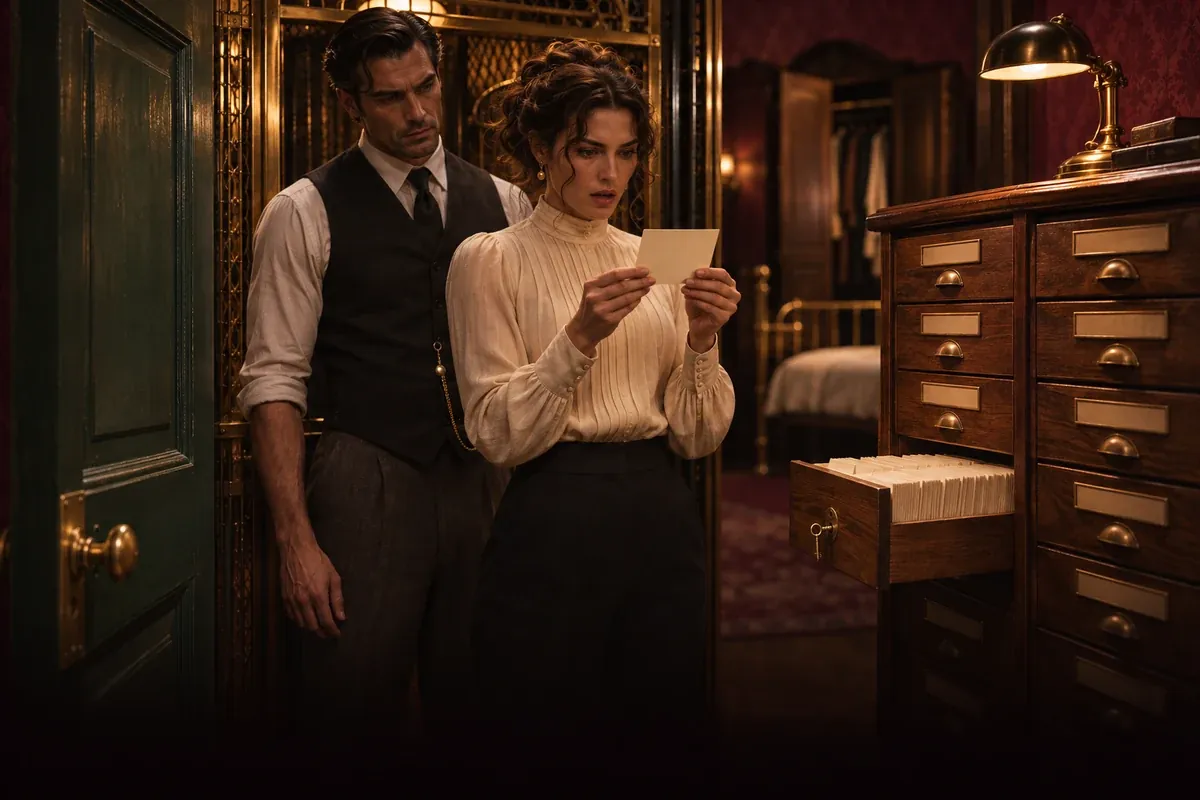
He stands very close behind me, the way he stood in the laundry. He is not touching me. I can feel the warmth of him through the back of my blouse, a patient heat, a man holding a door.
The drawer slides out with a long dry whisper. It is full of index cards, standing on edge, each in a sleeve of tissue paper, each with a tab in green ink. PALMER. PARRISH. PARTRIDGE.
PASCOE.
I put out my hand. It does not feel like my hand. It feels like a hand in a photograph, a hand belonging to a woman who has been dead for six years and is waiting to find out.
The card is stiff, cream-colored, soft at the edges from handling. It has been typed on a manual machine, with the crooked R that I know from the will, and it has been annotated, here and there, in the same hard green block capitals.
GUEST: PASCOE, POSY ELLEN. AGE 23. CHECKED IN: MARCH 21, NIGHT. THE RIVER. SPONSOR: W. KINCAID. REASON: SEE V. LIEN: ONE FAVOR, HELD BY THE HOUSE. UNCALLED. STATUS: RESIDENT.
I read it once. I read it again, because I am a careful woman.
My name. Not mine. My sister’s. My sister, who drowned in the Tallow River on the twenty-first of March six years ago when her car left the Carter’s Mill bridge in the dark, whose estate is still open on my desk in Roanoke, one signature short of final accounting, whose gray cardigan I could not make myself give to the church thrift shop.
Her name is on a card in a catalog in a hotel I have been in for twenty-six hours, in the same crooked type as the will, with a sponsor, and a reason, and a Lien.
And a status. I read the last word again. Typed, uppercase, as plain as a closing price.
RESIDENT.
Under it, in green ink, in the same hard capitals, someone has added one word more.
ALIVE.
The card shakes. I do not know whether it is the card or my hand. I turn it over, because a careful woman always turns it over, and on the back, in pencil, faint, in a round, quick, slanting hand that has dotted every i in my life since I learned to read, there is a line that was not typed by anyone.
Don’t tell Sabine. She’d file it.
I make a sound. I do not know what sound it is. Behind me, Wystan does not move, and does not say anything at all, and does not touch me, and I understand with perfect clarity that he knew. He has known every hour of every day since the staircase. He carried my bag past the ninth stair, and he said Nobody left there at all, and he sat all night in a chair with his ankles crossed, and he knew.
My sister has been dead for six years, and according to the Vesper’s ledger, she checked out alive.