

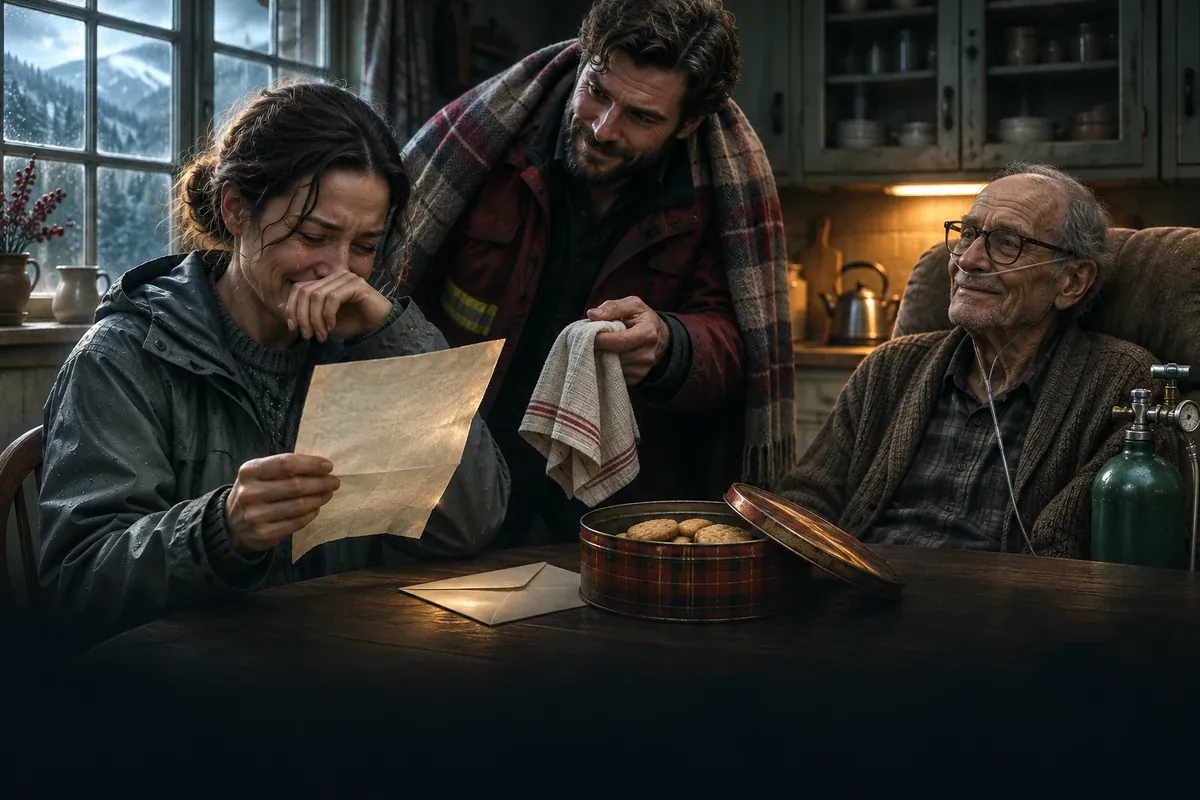
File note: Sunday. Second visit to Gus Trevanion. Insured’s former agent produced a document. Reading it aloud for the record, which is not a thing I normally do, and not a thing I could stop.
On Sunday the old man was awake, and for once he knew exactly who I was.
“Lindmark,” said Gus Trevanion, from his recliner, and turned the green tank toward me like a chaperone. “Go to the cupboard over the stove. Not that one. The one with the cookie tin that says Shortbread. It’s lying.”
I opened the cupboard. The tin was the old kind, tartan, dented in one corner. Inside, under a layer of rubber bands and Christmas cards, lay a flat envelope of onion-skin paper gone the color of tea.
“Carbon copy,” said Gus, with deep satisfaction. “They don’t make carbons anymore. That’s why nobody ever looks for them.”
Teo had driven me up. He stood by the kitchen door with his arms folded, trying to look like furniture. Mick, who had come along for reasons nobody could explain, was feeding the cat. I carried the envelope to the table and unfolded the first page under the window light.
It was a single typed paragraph. I read it aloud, because my eyes did not trust it.
“Endorsement Fourteen. Animal Loss, Special. This policy covers direct physical loss or damage caused by any animal, of any kind, whether or not domesticated, whether or not identified, and whether or not also an insured.”
I read the last six words again. Then I put the page down on the table, because my hand had started to shake.
“Whether or not also an insured,” I said.
“I thought it was funny,” said Gus.
“It’s a drafting joke.”
“It’s a drafting joke that went through underwriting.” He wheezed. “Read the second page.”
The second page was a letter on Harborline Casualty letterhead, dated March 4, 1987. It was addressed to Mr. G. Trevanion, Pell Pass Agency, and it said, in the cheerful, clipped language of someone who had stopped reading halfway through, that the home office had reviewed the special endorsement, and that the wording was approved as submitted. At the bottom was a signature from an underwriting manager named Hadley.
And below that, in a smaller hand, in blue ballpoint, two initials and a short note.
W.L. Fine by me. Funny.
I stared at it. I looked at the initials for a long time. I was reading a joke approved by a twenty-four-year-old underwriting clerk, thirty-nine years ago, who had not known that the joke would one day take his daughter’s job away.
“Your father read it,” said Gus quietly. “He read it, and he laughed, and he signed. That’s why he couldn’t deny the mill claim in ’99. He knew what the paper said. They sent him up the road to say it didn’t.”
I made a noise. It was not a word. It started as a laugh, because the endorsement was so absurd, a loophole as wide as a barn door written by a man who had only ever wanted to protect his friends. It turned into something else halfway through. I put the back of my hand against my mouth and laughed until I was crying, and when I was done, I was embarrassed, and nobody said anything about it.
Teo handed me a clean dish towel. Mick, in a very small voice, said, “Is that good?”
“It means,” I said, and wiped my eyes, “that your bear is insured. Not just the bear. Any animal, identified or not, and whether or not it is also a member of your own mutual. That is a specific grant of coverage, and a specific grant beats a general warranty every time I have seen the two meet in a courtroom. The unmaintained barn is not the point. The intentional-acts exclusion is not the point, because nobody in this room intends anything on those nights. I can pay.”
“You can pay,” said Teo, as if the words were in another language.
“I can pay the eight real ones. Not the three that were staged. But every claim the Book supports, I can pay, and I can defend it in writing.” I pressed the heel of my hand against my eyes. “Mr. Trevanion, thank you. I have never in my life been so happy about a typographical error.”
“It was not a typographical error,” said Gus. “It was love.”
We sat in Teo’s truck on the gravel road afterward, with the engine ticking and the sun going down behind the lift line.
“I haven’t thanked you,” I said.
“You haven’t signed anything.”
“I will.”
“I know.” He looked straight ahead. “I haven’t asked you for a thing, Jo. Not the first day, not when you read the Book, not this afternoon. I want you to know that.”
“I know.”
“I don’t want it to be because of anything but the paper. Connie Vogt is going to come for you, and I do not want you walking into that room thinking you owe me.”
“It’s because of the paper.” I turned in the seat. “It’s also because you apologize to door frames.”
He laughed. It was short and surprised, and it changed his whole face, and before I could think better of it, I leaned across the bench seat and kissed him.
It was a short kiss. It was careful, and it tasted of gas-station coffee, and it was one of the better decisions I have made on the clock. When I pulled back, he was looking at me the way he had looked at the broken door: with great care, and no idea where to start.
“That’s a conflict of interest,” I said unsteadily. “I have to disclose it.”
“Then disclose it.”
“It’ll cost me the file.”
“I know,” said Teo. “Do it anyway.”
I thought about my father, who had signed a joke and been sent to deny it. I thought about every careful, honest, paperwork-shaped way I had hidden from the world. “I’ll put it in the report,” I said. “First paragraph. Before anyone else can find it.”
“All right,” he said, and kissed me again, very gently.
On Monday morning I stopped at the fire hall library to photocopy Endorsement Fourteen four times, once for each place I intended to hide it.
Hollis Penney sat behind the card table with her glasses on their chain. She watched me feed the carbon through the copier. She said nothing, until I was done.
Then she pushed a slim file folder across the table.
“Nobody asked me to keep this one quiet,” she said. “And nobody told me not to mention it.”
It was a recorded instrument. County seal, a stamp dated the seventeenth of October, a legal description of the Pell Pass Cooperative Lodge and Lifts. The title said OPTION TO PURCHASE PROMISSORY NOTE. The purchaser was Strand Summit Partners, LLC. The price was forty cents on every dollar the lodge owed. It could be exercised any time before the fifteenth of November, which was five days after the middle night of the Three.
I read it twice. A note is a debt. Whoever holds the note on a lodge can foreclose on it. This was not a purchase of a loan. It was a purchase of a town.
The seller’s signature, in blue ink, was perfectly legible.
Dorothea Okonjo, Chair.