

Pell Creek has forty-one road segments that I could draw from memory, and by minute four of Run 1 I had met nine that no longer existed.
Hendricks Road went into a hill and did not come out. The county road to the elevator ran a quarter mile and then folded back on itself like a dropped ribbon. At the four-way by the Lutheran church, three of the four ways had traded places, and the church sat in the middle of what used to be the cornfield, looking embarrassed.
"Ma'am, you cannot move a road," I told the windshield. "There are easements."
A pale blue line ran across the glass in front of me, dotted, glowing, a little crooked. I had noticed it around the first turn and said nothing. Now I saw what it was. It was every road I had ever driven, laid over the new world like tracing paper. Where the road had moved, the line stayed put, and it led through fields and fences straight to where the school used to be.
[Passive: Route Memory. Known routes remain visible to Haulers.]
"Well," I said. "That's handy."
Nine took the blue line like a dream, jouncing across a ditch and a stretch of bean stubble that was now somehow in the road. Gravy braced against the dash with his head down and his ears flying. The sign above me read 7:49, then 6:12, then 3:31.
I should say what I saw when I came around the last bend.
Eastside Elementary is a long, low brick building with a flagpole and a bus loop and a mural of a smiling sunflower painted by third graders in 2009. On Saturday mornings in October, it holds the Fall Fish Fry. I had forgotten. Half the town used to come, and the other half used to complain about the smell.
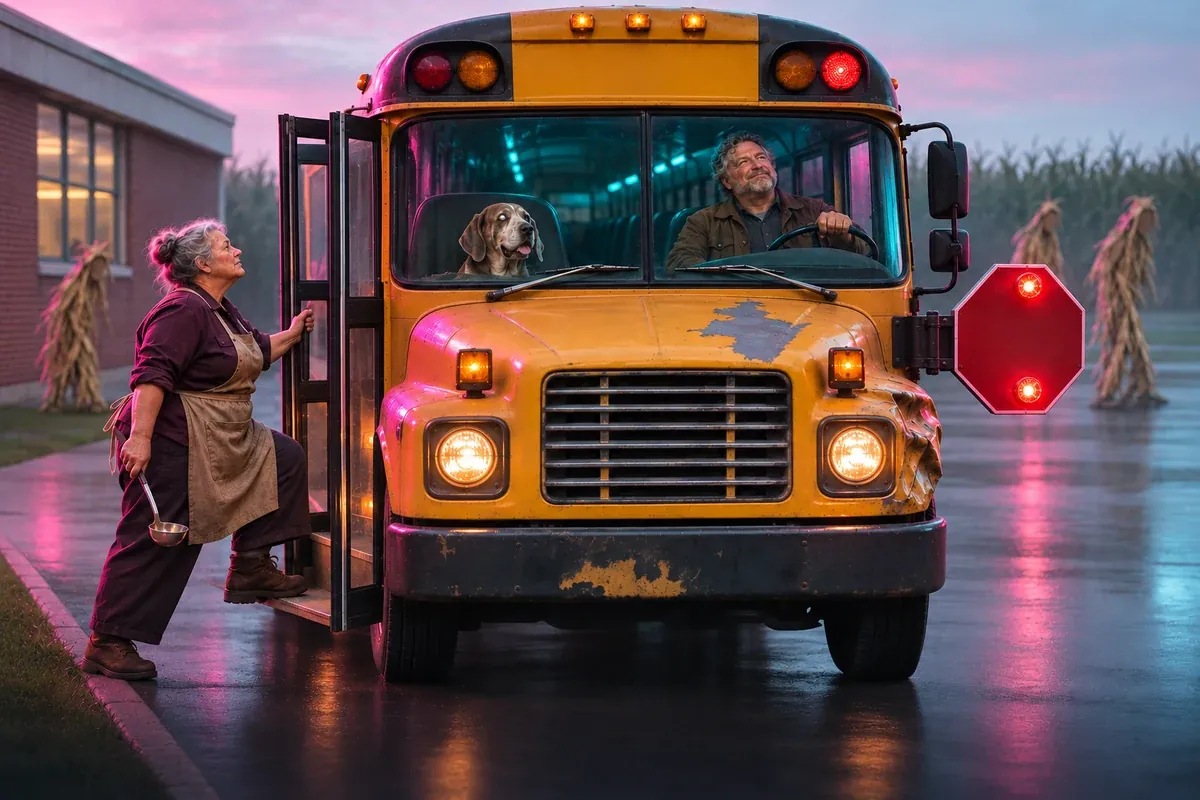
The corn had grown right up to the playground fence. In the lot, between the building and the loop, were eight people standing in a clump on the front steps, and around them, closing in with a sound like a pile of dry leaves learning to walk, were the Huskers.
I did not know that word yet. Everybody learns it eventually. It is as good as any.
They stood about seven feet tall, built of cornstalk and husk, bundled and tied with something like twine, arms too long, with a gap of brown paper where a face should be. They did not run. They shuffled. There were maybe a dozen, and they were doing it from all sides.
"Hold on to something," I said to the dog.
I braked at the curb the way I have braked at that curb ten thousand times, with the nose just short of the walk and the door lined up with the steps. My hand reached for the lever without me.
The door folded open. Beside the driver's window, a red octagon swung out on its arm with a chime and two flashing lights, exactly as it has on every school bus in the country since the sixties.
And every Husker in the lot stopped.
All twelve. Mid-step, mid-shuffle, one with a long arm raised. They stood like people who had just seen a cop.
[Skill acquired: Stop Arm. Cost: 10 Miles. Effect: Entities within thirty feet that obey signs and are rank Class C or lower are halted for 5 seconds. Cooldown: 60 seconds. Door must be open.]
[Miles: 10 of 60.]
I had spent ten of my twenty Miles on a lever I pull forty times a day.
"Five seconds," I yelled. "Everybody, now! Move your feet!"
The people on the steps did not move for about two of them. Then a very large woman in an apron with a soup ladle in one fist, who looked sixty-eight and strong as a fencepost, said "Well, don't just stand there, sugar," to no one in particular and took the first step.
I knew her. Delores Pickett ran the Eastside cafeteria for thirty-one years and had once sent me home with a casserole in a Pyrex dish after Carol died, and had never asked for the dish back.
Behind her came a thin man with a clipboard and a tidy beard; I took him for a vice principal, but he turned out to be the high school chemistry teacher, then two blond ten-year-olds holding hands, then a custodian in gray coveralls carrying a mop like a rifle, then two teenage boys with the same ears. And at the back of the clump, a skinny kid in a puffy vest, dragging a black case about as big as himself.
I knew that kid too. Seat 14, left side, third row. Toby Hill. Twelve years old, trombone, always forgot his lunch and never forgot the bus rules, which he recited under his breath every time I pulled out.
"Mr. Tuttle?" he said, stopping on the bottom step. "You're not supposed to be driving Nine. She's retired."
"So are a lot of us. Get on, son."
He got on. He looked at Gravy in the passenger seat, and Gravy looked at him, and I held my breath. Gravy has bitten two mail carriers and an insurance adjuster.
Gravy thumped his tail twice against the seat.
Two. That is a yes.
"Four seconds," a voice said, quite calmly. I realized it was the System, and that it had learned my pace. The numbers were in the air. 5, 4, 3.
[Boarding: Delores Pickett, Hector Nuñez, Nils Lindqvist, Freya Lindqvist, Mr. Bao, Tobias Hill. Awaiting consent: Cole Brennan, Wade Brennan.]
Wade, the younger one, was already on the bottom step. Cole was not. Cole, the older Brennan, seventeen, stood on the sidewalk with his arms folded and a face like a locked door.
"I'm not getting on a bus that talks," he said.
"It doesn't talk," I said. "It prints."
[Notice: Boarding requires consent. Haulers cannot Manifest the unwilling.]
"Cole," said Wade. "Get on the bus, you idiot."
The Huskers moved. One long arm swung down, and the stop-arm lights flickered like a bad bulb. The five seconds were up. I mashed the pedal for the arm and got nothing but a click. Cooldown.
"Cole!"
He got on. He did not run, because Cole Brennan has never run in his life. He walked up the steps very fast, with the posture of a man who would deny it later, and as his sneaker touched the top step the Husker's hand closed on the air where his collar had been.
I hit the lever. The doors folded shut on twelve rows of stalk and husk.
I kept my foot on the brake and counted heads in the big convex mirror above the windshield. That is the first rule of the job. You count them on, you count them off. Eight passengers. Me. Plus a dog.
[Manifest: 8 passengers, Hauler Wendell Tuttle, Co-Driver Gravy (dog): 10 of 14.]
"Co-Driver," I said.
Gravy yawned.
[RUN 1: Pickup complete. Time remaining: 3 minutes 04 seconds.]
Three minutes. In my line of work, that is practically a nap. A Husker slapped the side of the bus with a sound like a pile of brooms.
I eased out of the loop. Behind me my eight passengers were doing what people do on a bus when they have just been rescued, which is to talk all at once.
"Is that a corn?"
"It's a corn."
"Technically," Toby said, from seat fourteen, "no standing while the bus is moving."
"Thank you, Toby."
"Rule one."
"I know the rule."
The sign above my head clicked, rolled, and began to rattle again. I looked up. The old cloth was running forward on the rollers to a new line.
[RUN 1: Destination assigned. HARMON STOP. 31 miles. Window: 3 hours.]
[Warning: Primary route CUTLER FORK OVERPASS is unavailable.]
The blue line of Route Memory ran down the glass, as steady as a pencil, across the fields and up to the high rise of the Cutler Fork overpass. It was the only crossing over the creek for fifteen miles.
I watched the line run up to the top of the ramp and stop. Not bend or break. Stop, clean, like a ruler lifted off paper.
Past that, nothing at all. Just air.
"Oh, come on," I said.