

The job posting said: NIGHT ASSOCIATES WANTED. $41/HR. NO EXPERIENCE REQUIRED. MUST FOLLOW INSTRUCTIONS.
June Okafor read it four times on the bus, looking for the scam. Forty-one dollars an hour was lie money. Forty-one dollars an hour was the number you printed when you were harvesting Social Security numbers from desperate people, and June was exactly the kind of desperate the number was fishing for: three months behind on rent, a mother on dialysis two towns over, a checking account that had stopped being a place where money lived and become a place where it briefly visited.
But the posting was on the county workforce board, which vetted. And the address was real: QN Fulfillment Services, Facility FC-9, twelve miles out of Harlow on State Road 41.
So at two in the afternoon she sat in a beige room with eleven other applicants while a woman from HR named Ms. Draper handed out pencils and a one-page test, and June found out what MUST FOLLOW INSTRUCTIONS meant.
The test had twenty items. Item one said: Read every item before doing anything. Item two said: Write your name in the top right corner. Item three said: Circle the word CORNER in item two. The items got stranger as they went. Item eleven: Stand up, turn your chair to face away from the table, and sit back down. Item fifteen: Say the word ‘present’ out loud, once, at a normal volume. Item nineteen: Ignore items three through eighteen. Item twenty: Now that you have read every item, complete only items two and nineteen, and set your pencil down.
It was an old trick. A patience trick. June had seen a version of it in sixth grade.
Four people stood up and turned their chairs around. One man said ‘present’ into the silence like a soldier, twice, the second time louder, in case volume was the variable being tested. A woman circled so many words her page looked shot.
June wrote her name in the top right corner and set her pencil down. Across the table a big woman with a trucker’s sunburn — forearms brown, forehead pale where a cap would sit — caught her eye and set her pencil down too, unhurried, like they were the only two people who’d been told the stove was hot.
Ms. Draper collected the pages without grading them. She didn’t have to. She had been watching.
“Thank you all,” she said. “Offers go out tonight by text. If you receive one, your orientation begins at nine forty-five p.m. tomorrow. Not ten. Nine forty-five.” She paused at the door, and said the only thing in the whole afternoon that wasn’t beige. “If you receive an offer and decide the hour isn’t for you, that’s fine. Don’t come anyway and quit later. The night shift doesn’t take partial people.”
The text came at 9:12 that night. June read it standing in her kitchen, eating dry cereal from the box because milk was four dollars.
CONGRATULATIONS. QN FULFILLMENT FC-9, NIGHT ASSOCIATE. ORIENTATION TOMORROW 21:45. BADGE WILL BE WAITING. BRING YOUR FULL LEGAL NAME.
Not bring your ID. Bring your full legal name. She decided it was a translation hiccup from whatever HR software had spat the message out, and she was almost right, in the way that a weather report is almost right about a hurricane.
FC-9 at night looked like a white brick dropped on the desert from orbit. No windows. No sign except the little blue QN hexagon by the gate, lit from below. The parking lot was a quarter full — maybe sixty cars for a building you could have parked a cruise ship in — and the sodium lights made everyone’s car the same color, which was no color at all.
The lobby smelled like new carpet and cold. A security officer checked her against a list, and there it was, as promised: a badge with her photo already on it — her actual photo, the unflattering one from her county employee file that she had never given anyone — and her name. JUNE A. OKAFOR. NIGHT.
“Through there,” the officer said. “Room two. They’re waiting on you.”
“I’m fifteen minutes early.”
“They’re still waiting on you.”
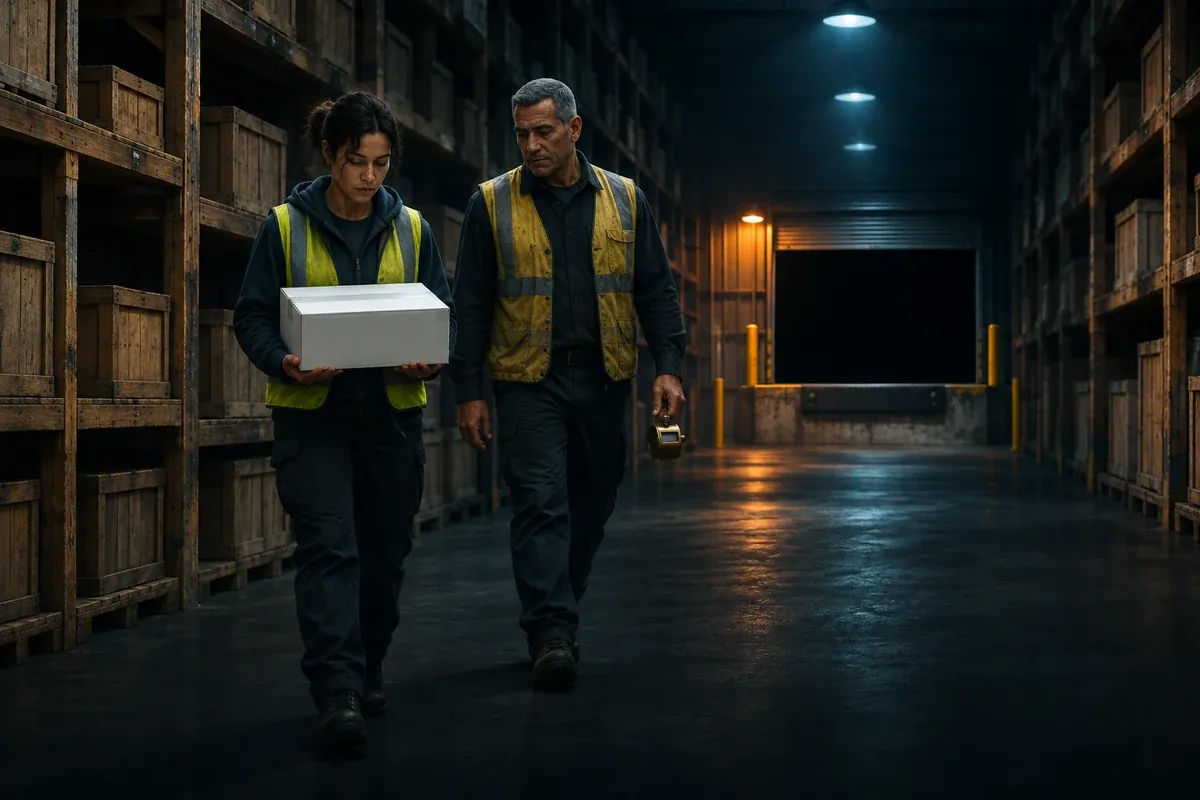
Room two held the trucker woman from the test, a lanky teenager in a hoodie with a gaming logo, and a man in his fifties standing at a lectern with the stillness of furniture. He had a gray crew cut, a high-visibility vest worn soft with washing, and a brass counter in his left hand — the clicker kind, the kind umpires and bouncers use. He clicked it once when June walked in. She would spend weeks learning what the clicks meant. That first one just meant: three.
“I’m Rook Salazar,” he said. “Night supervisor. You’re June, you’re Petra, you’re Theodore.”
“Teddy,” said the teenager.
“Not yet,” said Rook, without heat, and moved on before anyone could decide if that was a joke. “You’ve all worked jobs. So I’ll skip the part where I pretend this one is like them. Day shift at FC-9 is like them. Day shift picks, packs, ships, complains about the air conditioning. You will never meet day shift. There is a twenty-minute gap at both ends of our shift when the floor is empty. The gap is not negotiable, it is not explained, and you will come to be glad of it.”
He lifted three laminated cards from the lectern and dealt them out like a man dealing a hand he’d dealt ten thousand times.
The card was titled APPENDIX N — NIGHT OPERATIONS, STANDARD OPERATING PROCEDURES. Thirteen items. The lamination was thick, the corners rounded, the font the same corporate sans-serif as the exit signs. Item one: Clock in with your own badge. If your badge is already clocked in, leave the building and call your supervisor from the parking lot.
“Questions are allowed,” Rook said. “Answers are limited. Read them now. All thirteen. I’ll wait.”
June read them. Somewhere around item five — Between 3:00 and 3:14 the east conveyor runs in reverse. Items it returns belong to no one. Log them, shelve them in Cage R, do not open them — she became aware of the quality of the silence in the room, which was the silence of two other people also not saying anything, very carefully.
Teddy, of course, broke it. “Is this, like, a hazing thing? The haunted warehouse bit? Because respect, honestly, this is production value.” He flicked the laminate with a fingernail. “Number eight’s my favorite. If you hear your name over the PA in your own voice. That’s good. That’s a good one.”
“Appendix N isn’t a test of belief,” Rook said. “You can believe anything you want. The procedures don’t need your faith, they need your compliance. You can think of them as superstition, union rules, or load-bearing walls. People have thought all three. The ones who keep thinking it are the ones who followed them anyway.”
Petra raised a hand the size of a catcher’s mitt. “The pay.”
“What about it.”
“Nobody pays forty-one an hour to pick totes. What’s it for?”
Rook looked at her for a moment, and June got the sense he was grading the question the way Ms. Draper had graded pencils going down.
“That’s the first good question of the night,” he said. “You’ll get the first part of the answer at three a.m. The rest takes longer. Follow me.”
The floor was the size of a weather system. Shelving ran away into a haze of distance — Aisles 1 through 88, zones A through F, the numbers stenciled man-high on the steel uprights — and the ceiling was a black nothing above the light grid, strung with conveyor lines that crossed and merged like freeway interchanges. It was 10:20 p.m. and the night crew was out there already: she could hear them more than see them, scanner beeps calling and answering across the aisles like marsh birds.
They learned the work, and the work was work. A handheld scanner told you a bin, you walked to the bin, you picked the item, you scanned it, it told you the next bin. The scanner was the whole job. The scanner was also, Rook said, the first thing to watch.
“Normally it shows a bin number.” He held his up. “If it ever shows you a countdown instead — minutes and seconds, going down — you finish that pick before zero. You don’t stop to ask why. You don’t call me first. Pick first. That’s procedure four.”
“What happens at zero?” June asked.
“Nothing,” Rook said, “because you finished the pick.”
He partnered her with Petra — procedure two, work in pairs; your buddy’s count is your count — and the first hours of her first night were almost disappointingly ordinary. Petra talked the way long-haul drivers talk, in a steady stream calibrated to keep a mind awake: her rig, her ex-husband, her theory that the vending machine in Break Room 2 was the best employee at the facility because it had never once called in sick. June picked, scanned, packed. Her feet hurt in the honest way. At 1:40 a.m. she caught herself thinking: this is fine, the rules are a folk ritual, warehouses are full of them, and $41 an hour buys my mother four sessions a week.
At 2:12 a.m., a yellow tote came down the line to their packing station with a shipping carton inside, sealed, label printed, everything normal except the destination field.
It was blank. Not smudged. Not torn. Printed blank — the barcode crisp, the sender field filled (QN FULFILLMENT SERVICES LLC — EST. 1962), and where an address should be, nothing at all, a white rectangle of absence that June’s eyes kept sliding off.
Petra stopped talking midsentence. That, more than anything, was what June noticed: the silence where the trucking story had been.
“Procedure three,” Petra said, in a new voice, flat and careful like a person reading a checklist in a cockpit. She keyed her radio. “Rook. Station fourteen. We’ve got a walker.”
Rook arrived in under a minute. He looked at the label the way a man looks at weather on the horizon — not surprised, only measuring — and clicked his clicker twice.
“Okafor. Good. You’ll learn this one your first night, that’s lucky.” He slid the carton out of the tote and held it at waist height, both hands flat beneath it, the way you’d carry a sheet cake. It was, June would have sworn, light. Lighter than its size. “A package with no destination routes to Aisle Zero. Aisle Zero is between seventeen and eighteen.
“You will not find it on the floor map, and you will not find it in daylight, and you will not find it by looking for it. You walk the package down the middle of the aisle gap, eyes level or down. Not up.” He said it the way other safety officers said hard hats in this area. “Not up. That’s the whole procedure. You carry, you set it on the dock, you walk back. I’ll walk beside you this first time.”
“Dock?” June said. “There’s no dock in the middle of the floor.”
“There is between three and three-fourteen,” Rook said, “and other times, when it’s needed. Tonight it’s needed.”
The gap between Aisle 17 and Aisle 18 was dim, which was itself wrong — the light grid was even everywhere else, a flat white prairie of illumination, but here the fixtures seemed farther away, as if the aisles had politely leaned apart to make room for something. June walked the center line with the carton on her flat hands. Rook walked at her left shoulder, unhurried, his boots making the only honest sound.
The shelving on either side was stocked with ordinary inventory — phone cases, diapers, a pallet of space heaters shrink-wrapped like a mummy — and then, without a seam she could point to, it wasn’t. The shelves were older. Wood, not steel. The stenciled numbers were gone and the bins were crates, and the crates were stamped with a logo she didn’t know: a mountain inside a circle, HARLOW FREIGHT & STORAGE, and the air had gone cold in the specific way the inside of a refrigerator truck is cold, cold with intention.
Ahead, maybe sixty feet, was a loading dock. A plain concrete lip, a rubber bumper, a roll-up door standing open on darkness that the light declined to enter.
“Set it on the lip,” Rook said quietly. “Label up. Step back twice.”
She did. The carton sat there on the concrete, small and white, the blank rectangle of its address catching the dim light like a closed eye.
“Who picks it up?” June whispered.
“The recipient,” Rook said.
They walked back. And it was on the walk back — eyes level, hands empty, forty feet from the ordinary steel shelving and the world where things had addresses — that June heard it.
It came from above, from the black past the light grid, soft and tuneful and unbothered. A voice. A woman’s voice, humming. There were words to the tune and the voice wasn’t using them, just carrying the shape of them, the way you hum a thing you’ve hummed a thousand times, to a child, in the dark, with your hand on their back: hush now, June-bug, morning’s coming.
Every muscle across June’s shoulders locked. Her chin started up — two years of grief in a single reflex — and Rook’s hand closed on her elbow, gentle as a seatbelt.
“Eyes down, Okafor,” he said. “Whatever it sounds like. Eyes down.”
She kept her eyes down. She kept walking. The humming followed them to the seam where the wood shelving became steel, and stopped there, exactly there, like a dog at the end of a yard.
It wasn’t until they were back among the stenciled numbers, under the flat white light, Petra’s voice somewhere near asking was it a clean drop, that June let herself finish the thought she’d been holding at arm’s length the whole walk back — the thought with teeth.
She knew that lullaby. Not from a song. From a person.
Nobody on this earth had hummed it to her except her sister. And her sister had been dead for two years.